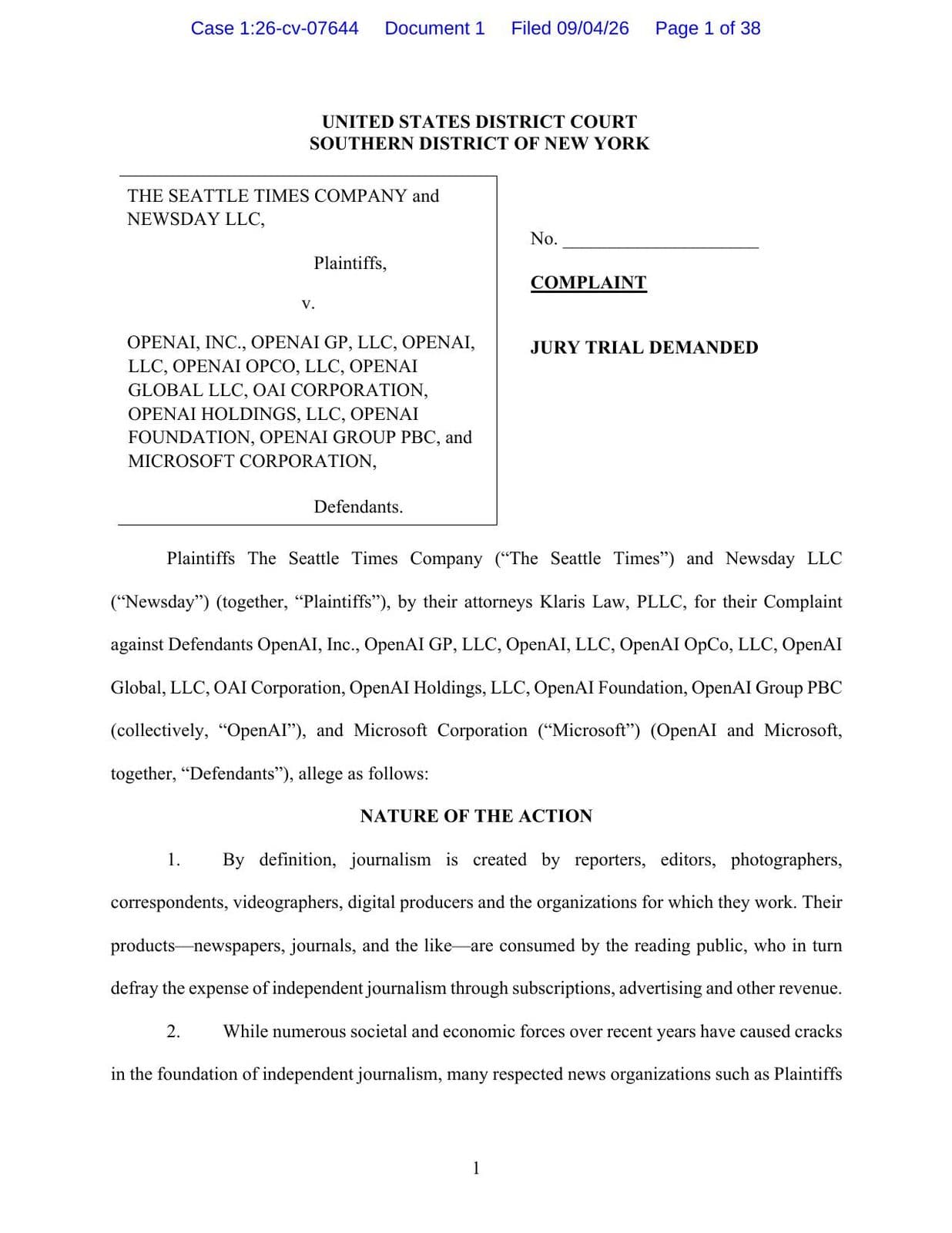
The Seattle Times Company and Newsday LLC v. OpenAI, Inc. et al. was filed in the Southern District of New York on 4 September, No. 1:26-cv-07644, against ten OpenAI entities and Microsoft. It is one case with two plaintiffs, not two suits, and it is not a Seattle action — the complaint grounds venue on the four newspaper cases already consolidated as MDL 25-md-03143.
The counts, in order
I copyright infringement; II vicarious copyright infringement; III and IV DMCA §1202(b) for removal of copyright management information; and then V trademark dilution under 15 U.S.C. §1125(c), VI under Washington's RCW 19.77.160, and VII under N.Y. Gen. Bus. L. §360-l. Two of seven counts are copyright infringement; three of seven are dilution, and they are where the treble-damages and fees request under §1117(a) sits.
What the dilution theory alleges
Not copying, but misattribution: the products "reproduce, output, and associate Plaintiffs' Marks with content generated by Defendants' own models, including content that is not Plaintiffs' authentic" work. The marks pleaded are THE SEATTLE TIMES (four registrations, all 30 April 2019) and NEWSDAY (Reg. No. 2,047,787, 1997), all incontestable, with fame pleaded on "a combined 30 Pulitzer Prizes".
The copyright case is smaller and more specific than the narrative
The complaint alleges the defendants copied "hundreds of thousands" of articles. The counts do not attach to that number. Count I is limited to the "Registered Works" identified on Exhibits 1 and 2 — 596 registrations for the Seattle Times and 770 for Newsday, 1,366 in total, running from 1994 and 1996 respectively to 2026. Their headers show what they are: "The Seattle Times", "Newsday, Nassau Edition", and a column literally headed "Issue Registered (Month / Year)". These are collective-work registrations of whole newspaper issues — the same registration practice Microsoft cited the same day to argue for one statutory award per issue rather than per article.
What the received framing gets wrong
"Another copyright lawsuit" misses which half is load-bearing. If the copyright counts stall in an MDL where the fair-use briefing is already under way, the dilution counts survive on entirely different law, and hallucinated attribution — not training — is what has to be proven. The relief sought is also unusual: impoundment or destruction under §503 of "all copies of Plaintiffs' works, and all LLMs and training datasets" incorporating them. The complaint names no dollar figure anywhere, which makes the "billion-dollar battle" headlines invented. And the one verbatim exhibit offered is 88 consecutive words, obtained, as the complaint itself discloses in the same sentence, with "a simple prompt that included the headline and URL".