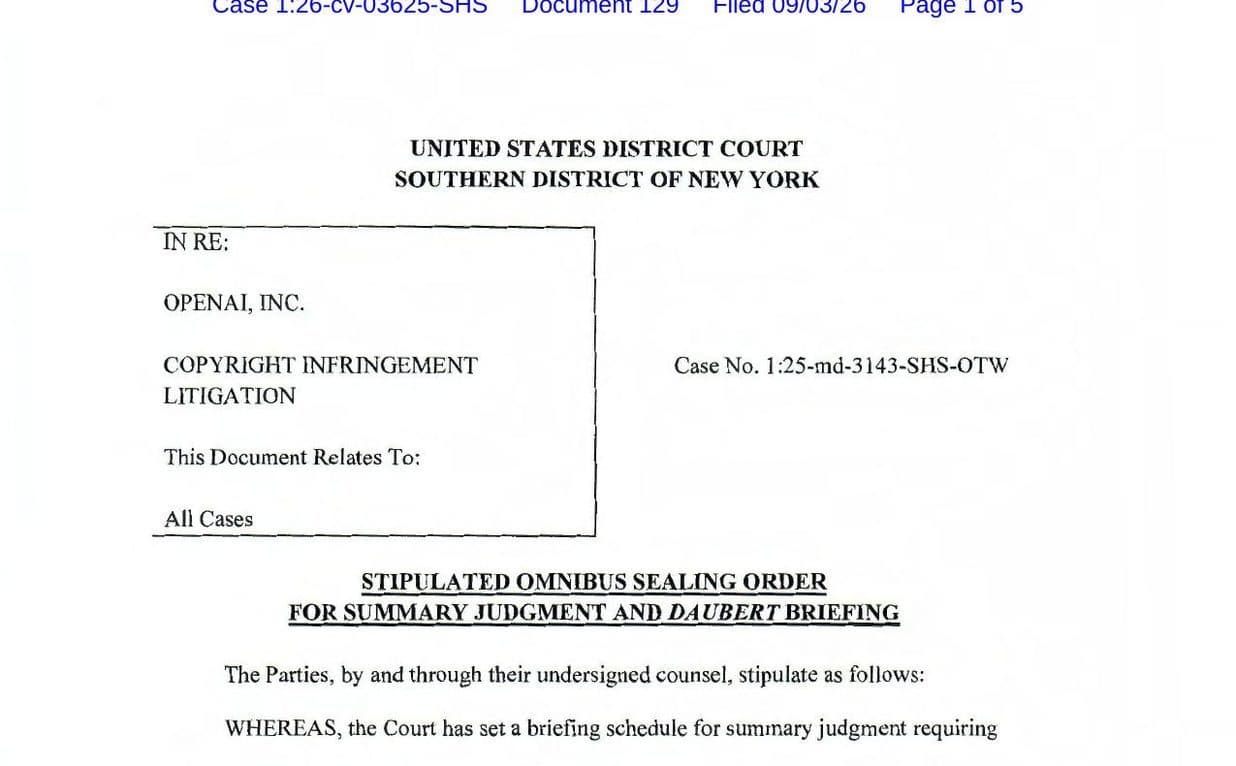
On 3 September Judge Sidney H. Stein signed a Stipulated Omnibus Sealing Order in In re: OpenAI, Inc., Copyright Infringement Litigation, No. 1:25-md-03143 in the Southern District of New York, setting the timetable on which the biggest AI copyright case in the United States becomes readable.
What the order does
It lets every party file summary-judgment and Daubert papers provisionally under seal, relieving them of the judge's individual practice requiring a contemporaneous sealing motion and of the protective order's five-business-day justification requirement. Movants must file a motion to seal their own brief by 4 September, third-party statements follow by 14 September, and briefs and Rule 56.1 statements are re-filed publicly on 17 September.
The rest of the calendar
Summary-judgment motions were due 4 September, oppositions 9 October, replies 6 November. Daubert motions are due 24 September. Oppositions become public on 15 October at 5:00 p.m. ET and replies on 19 November. Amicus briefs on summary judgment are due 16 October.
The evidence is on a 2027 track
Exhibits, expert reports and declarations follow separately: omnibus motions to seal by 13 January 2027, responses by 20 January, and anything nobody moved to seal becomes public on 27 January 2027. That is where the expert analysis of market harm and the discovery record on training data sit — four months after the briefs.
What the received framing gets wrong
Three things. This is not a decision to seal the case: sealing is provisional, the public re-filing dates are fixed, and the burden of justifying secrecy is deferred rather than waived — nothing has been sealed on the merits. "Summary judgment filed today" will be reported on 4 September as though the arguments can be read; they cannot, and surface only partly redacted on 17 September. And Stein signing a stipulation the parties wrote — counsel for Microsoft, the News Plaintiffs, OpenAI and the interim class all signed it — is a housekeeping act, not a ruling. Reading it as the judge shielding OpenAI misidentifies who drafted it.