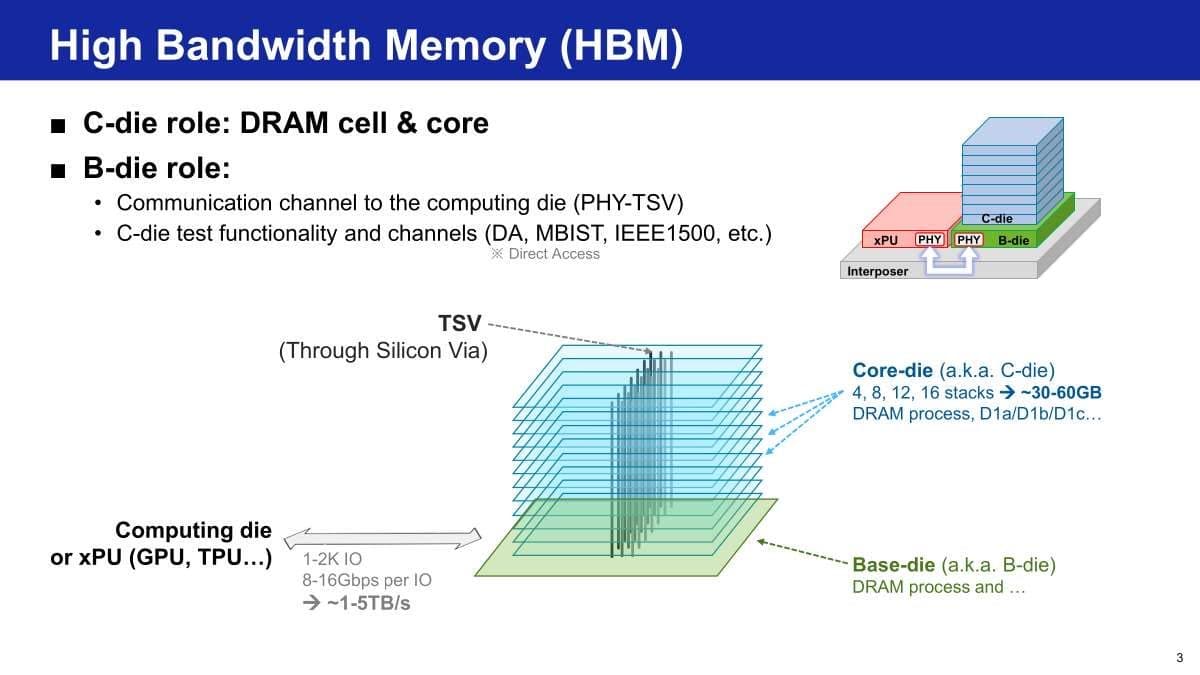
At the Hot Chips 38 tutorial day on 23 August, Samsung set out how the base die underneath a high-bandwidth memory stack is changing. For HBM4 the company is applying its D1c DRAM process together with a logic 4nm node — a foundry-class logic process, used for the layer that has historically been treated as plumbing.
What is actually being disclosed
The base die sits at the bottom of the stack and handles the interface between the memory above it and the processor beside it. Moving it to a 4nm logic process means it can carry real logic — more than address decoding and I/O. Samsung's roadmap runs on to HBM5, which it put past 60GB per stack and 6 TB/s of bandwidth.
The number that constrains the roadmap
The figure worth carrying away is not capacity or bandwidth. It is power density in the base die, which Samsung showed climbing from 0.5 W/mm2 to over 2.0 W/mm2 between sHBM4E and sHBM5 — roughly a quadrupling, in the layer buried at the bottom of a stack of DRAM, where DRAM is the component least tolerant of heat. Everything else on the roadmap is downstream of whether that heat can be moved.
What the common framing gets wrong
Two things. First, a tutorial-session roadmap is not a product announcement: HBM5 has no launch date, no customer and no pricing here, and a slide describing a target is not a shipping part. Second, a widely circulated set of figures attached to Samsung at this conference — the 70% and 230% zHBM claims — does not come from this disclosure. Those numbers trace to aggregator reporting, are absent from the session transcript, and zHBM itself was unveiled around 5 August, weeks before Hot Chips. The base-die and HBM5 material is the new part.
Why the base die is where the fight moved
Memory makers have spent a decade competing on stack height and bandwidth. Putting a logic process at the bottom of the stack turns the base die into a place where architecture can be added rather than merely traversed — which is why all three major HBM vendors spent their tutorial slots on it, and why the thermal number is the one that decides how far it goes.