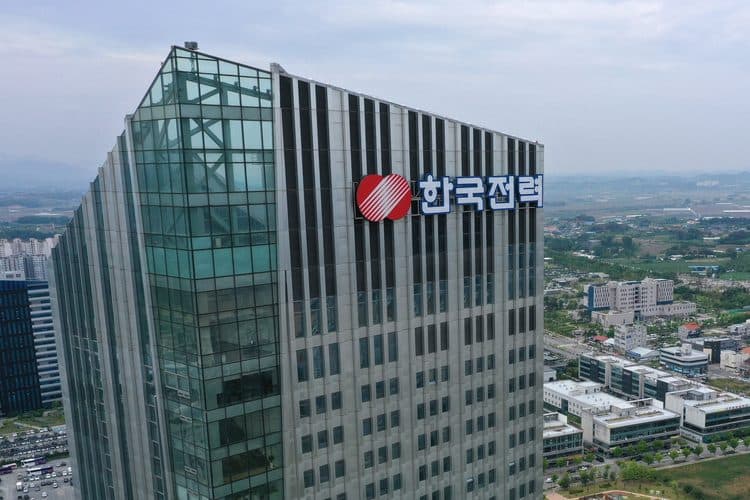
Korea Electric Power Corporation has asked its two largest industrial customers to pay their electricity bills years early. Under the proposal reported on 3 September, Samsung Electronics would prepay ₩20 trillion and SK hynix ₩5 trillion — ₩25 trillion in total, against power to be consumed across the coming years — with the proceeds funding the transmission lines for the Yongin and Honam clusters that those same companies depend on.
A financing instrument, not a tariff
The mechanism already exists. Korea's prepayment scheme has been used mainly by state agencies; the proposal would expand it to private industrial customers at a scale it was never designed for. What the utility gets is cash today for grid construction, without issuing the bonds it would otherwise need to issue. What the chipmakers get is the transmission capacity their fabs cannot run without — eventually.
Why the grid, not the fabs, is the constraint
Korea's semiconductor build-out has moved past the point where silicon is the binding limit. New fab capacity at Yongin and the Honam cluster requires transmission that does not yet exist, and building it is a utility's balance-sheet problem, not a chipmaker's. That is how a power company ends up asking its customers to underwrite its capital programme.
What the common framing gets wrong
This is being written up as Samsung and SK hynix investing in Korea's grid. It is not an investment. A prepayment buys no equity, no asset and no return — it is an interest-free advance on the payers' own future bills, requested by a heavily indebted state utility that would otherwise raise the money in the bond market and pay a coupon for it. The economic transfer runs from the chipmakers to KEPCO's financing costs. Second correction: nothing here is agreed. This is a proposal, its terms are undecided, and neither company has committed.
The number underneath
The reason the figure is this large is the load behind it. Fab expansion plus AI data centre demand is adding grid load in Korea on a scale that has to be built ahead of the customers arriving, and the transmission asset has to be paid for before a single wafer moves through it. ₩25 trillion is the price of the wires, presented as a bill in advance.