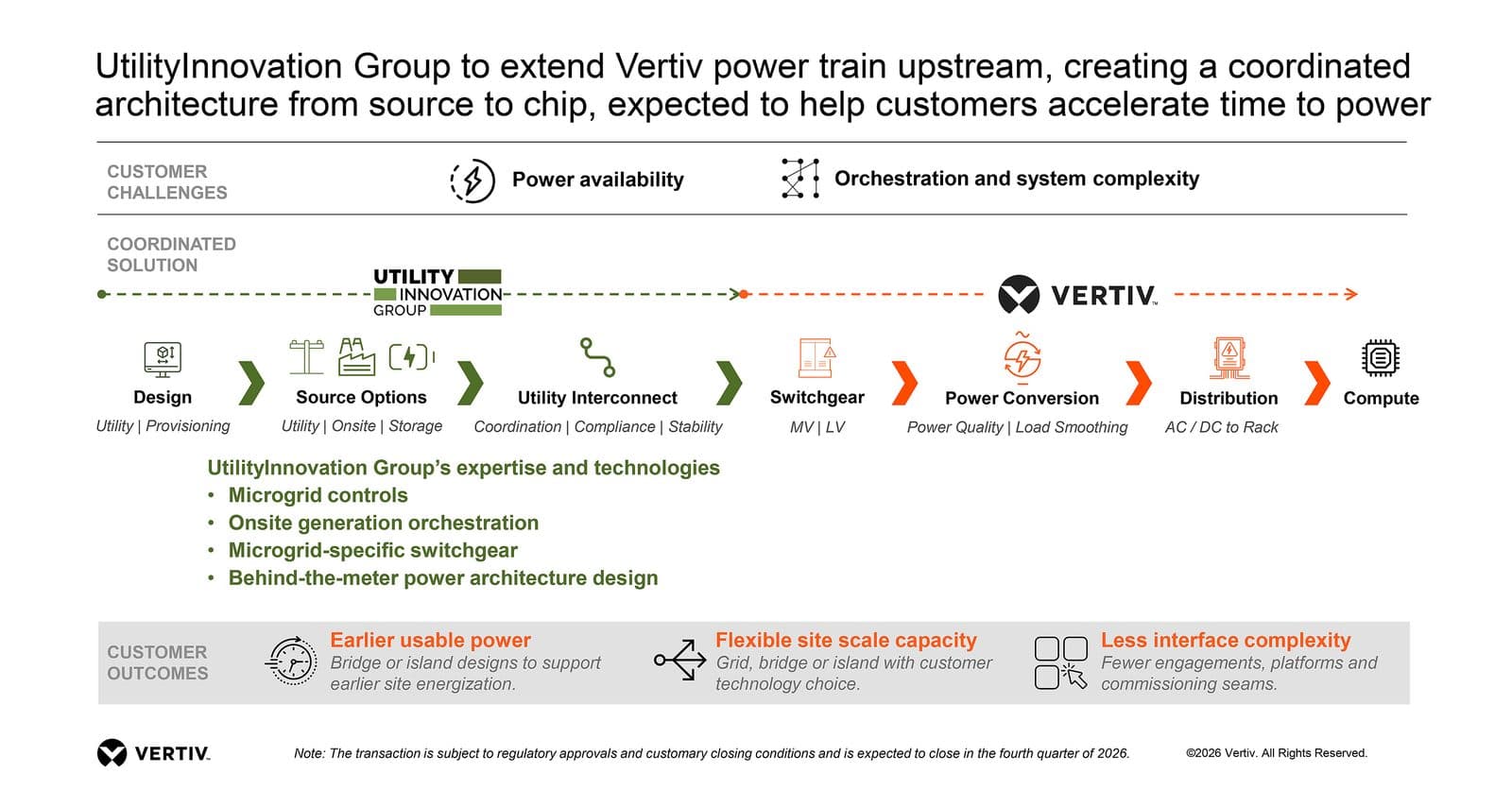
Vertiv announced on 2 September at 10:30 UTC that it has agreed to acquire UtilityInnovation Group, in a deal reported almost everywhere as a $1.45bn acquisition. That figure is the cash at closing. The release also discloses an earnout of up to $1.15bn, tied to EBITDA targets measured over 12- and 24-month periods.
What the common framing gets wrong
Maximum consideration is therefore $2.6bn, and the earnout is the half carrying the growth assumption. The stated valuation is approximately 13x expected UIG 2027 EBITDA — not a trailing multiple but a forward-forward one, struck against earnings a year and a quarter beyond the expected close. Vertiv discloses no revenue, no EBITDA in dollars, no employee count and no megawatt figure for the target, so the denominator in that multiple is not public. The deal is expected to close in Q4 2026, subject to regulatory approvals, and is said to be accretive to adjusted EPS in the first year.
What is actually being bought
Not cooling, and not racks. UIG's capability is microgrid controls, behind-the-meter power architecture and onsite generation orchestration — the toolkit for energising a data centre without waiting in the interconnection queue. Vertiv's own framing, “accelerate time to power”, says so directly.
The thesis inside the price
The largest data-centre equipment vendor is paying up to $2.6bn on the proposition that grid access — not chips, not cooling — is the binding constraint on AI buildout, and that the commercial answer is to route around the utility rather than queue for it. Priced at 13x 2027 earnings, that is also a bet that interconnection waits stay broken long enough for the earnout to vest.
How to read the disclosure gaps
A deal announced with a multiple but no revenue is a deal where the multiple is the disclosure. The two numbers a reader can act on are the $1.45bn that is certain and the $1.15bn that is not, and coverage that reports only the first understates the transaction by four-ninths.