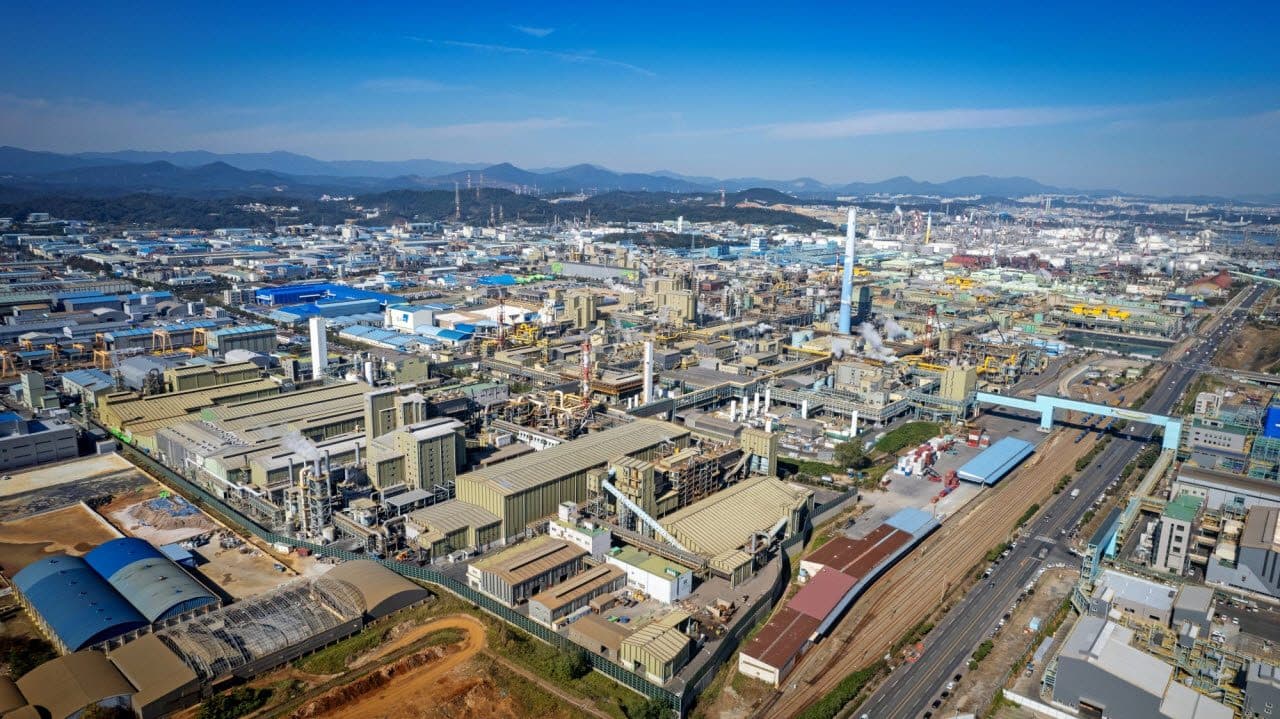
Korea Zinc announced on 2 September that lines 20 and 21 at its Onsan smelter in Ulsan are complete and in full operation, adding roughly 40,000 tonnes a year of 99.9999% (6N) semiconductor-grade sulfuric acid and taking total capacity from 280,000 to 320,000 tonnes a year.
What the common framing gets wrong
Three things, and the first is tense. This is a completed and operating expansion, not an announcement of intent — the future-tense numbers in the same release are the 500,000 t/yr domestic ambition and the Tennessee line, which is explicitly only under review, targeting test runs in 2029 and commercial production in 2030. Second, this is not a chemical plant: the acid is a by-product, recovered from the sulfur dioxide that zinc and lead smelting produces anyway. That is the entire reason a metals company sits in the semiconductor supply chain.
Why a 14% bump is not a small number
Third, and most consequentially: a 40,000-tonne increase looks marginal beside headline fab capex, but Korea Zinc supplies over 60% of Korea's domestic semiconductor sulfuric acid demand, and about 95% of its output goes to major Korean chipmakers, with the remaining 5% exported to Japan and Singapore. One company stands behind most of Korea's wet-clean chemistry — a single-point dependency that appears on no HBM roadmap slide.
Materials are the quiet gate on the ramp
Every new Korean fab line — SK hynix's HBM build-out, Samsung's Pyeongtaek phases — consumes ultra-pure sulfuric acid for wafer cleaning before it yields a single die. Capacity in the materials layer determines how fast announced fabs can actually ramp, and it is measured in years of smelter construction rather than quarters of tool delivery.
The part worth watching
The Tennessee line under review is the first sign of that gate moving onto US soil alongside the fabs. It is not committed, and on the stated timeline it would not produce commercially until 2030 — which is the honest measure of how long re-shoring the unglamorous half of the supply chain takes.