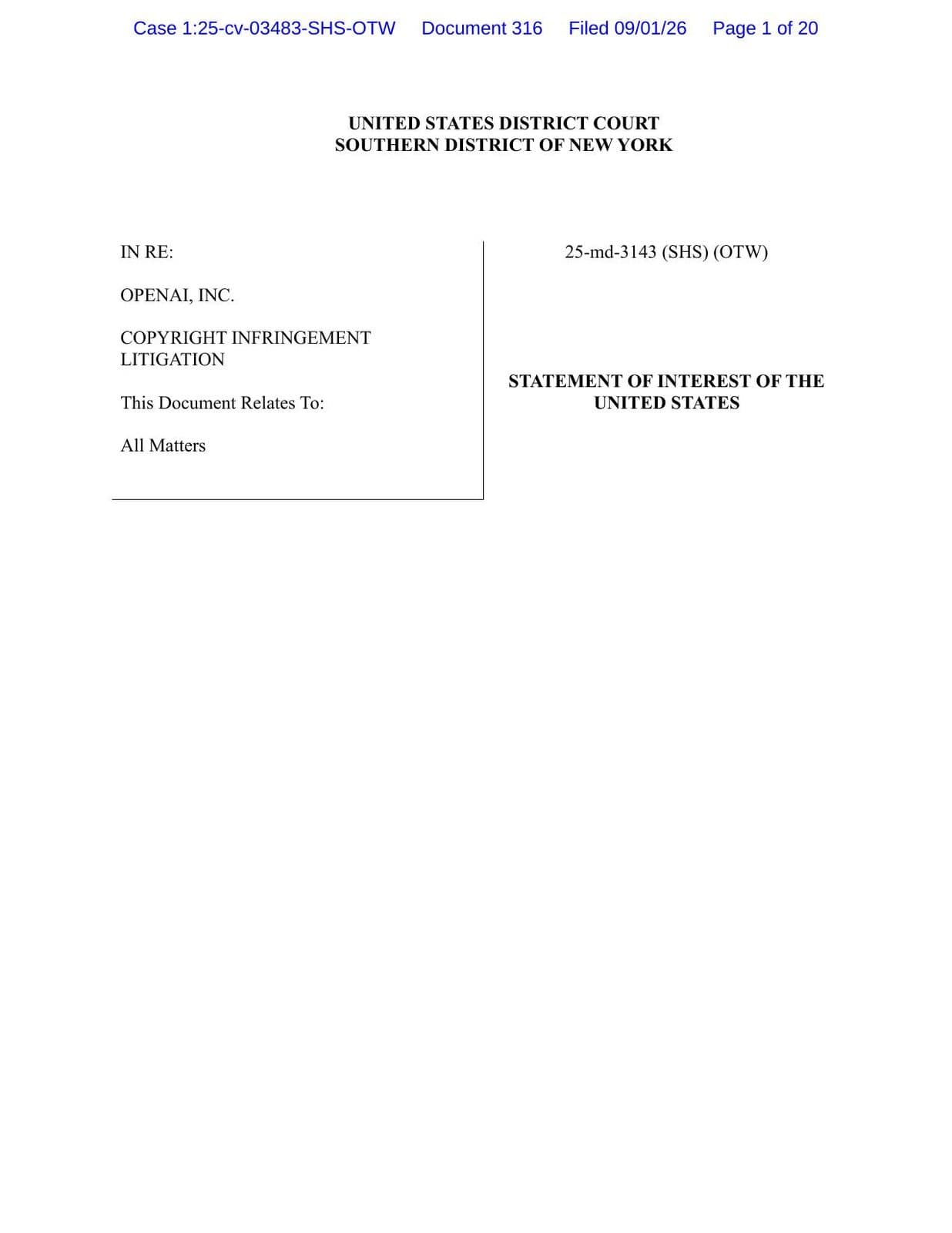
On 1 September the United States filed a Statement of Interest in the consolidated OpenAI copyright litigation in the Southern District of New York, telling the court it “has a strong interest in this Court rejecting any argument that training LLMs on copyrighted texts violates copyright law”. The 20-page brief is docketed at 25-md-3143, Doc. 1682 and was cross-filed the same day into roughly twenty member cases, among them the New York Times, Authors Guild, Daily News and Ziff Davis actions.
Who signed it, and under what authority
It is signed by Associate Attorney General Stanley E. Woodward, Jr. and Civil Division Assistant Attorney General Brett Shumate. The vehicle is 28 U.S.C. § 517, which the filing itself notes “contains no time limitation and does not require the Court's leave”. The government grounds its position in the executive orders of 23 January 2025 and 2 June 2026 and the March 2026 National Policy Framework for Artificial Intelligence.
What the common framing gets wrong
This is not the government joining the case, and it is not a motion. A § 517 statement carries no procedural weight beyond persuasion; Judge Stein may ignore it entirely, and no party is obliged to respond. Nor does it defend the industry generally. The brief separates acquisition, training and output into three stages and says in terms that the United States “focuses on the question whether the use of copyrighted works at the training stage… constitutes fair use”. That leaves untouched the ground on which the Bartz piracy claims survived and produced a $1.5bn settlement, and it says nothing about infringing outputs.
The economic argument runs the other way
The brief argues a licensing requirement would entrench incumbents, not restrain them: “only the largest technology companies might have the capital necessary to pay licensing fees”, producing “an oligopoly on LLM training” whose fees would “disproportionately benefit legacy media outlets”. A footnote then takes no position on whether a licensing regime would be financially or logistically feasible, and another disclaims any suggestion the conduct was authorised for the government's benefit under § 1498.
A criticism aimed at another courtroom
The sharpest passage is about Kadrey v. Meta Platforms. DOJ writes that, “without the benefit of briefing”, the Kadrey court adopted an “indirect substitution” theory of “market dilution” and “did not cite any case supporting such a theory”. That is the executive branch criticising a sitting district judge's reasoning in a parallel case, in writing, on a docket — which is the part appellate courts will notice.