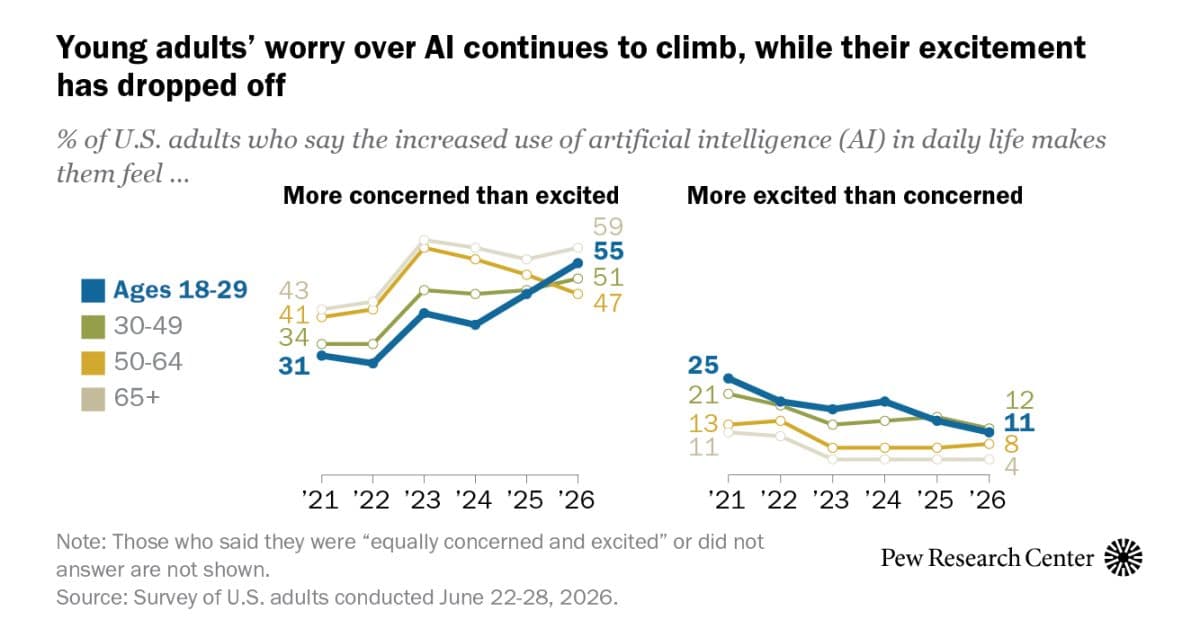
Pew Research Center published survey findings on 18 August showing that 52% of US adults are more concerned than excited about the increased use of AI in daily life, against 37% in 2021 — a 15-point move in five years. The survey covered 3,488 US adults between 22 and 28 June 2026.
The jobs number
71% think AI will lead to fewer jobs, up from 64% in 2024. By age, the expectation of job losses peaks among 30–49s at 74%, with 18–29s at 73%, 50–64s at 72% and the over-65s lowest at 63%.
What the common telling gets wrong
The framing everywhere is that young adults are now the AI-anxious cohort. The movement is real and large — young adults' expectation of job losses jumped from 61% in 2024 to 73% in 2026, which is the sharpest shift in the data. But on the general measure of concern, adults 65 and over remain the most worried at 59%, ahead of 18–29s at 55%. Young people moved the furthest; they have not moved the highest, and the two claims are frequently merged.
The second thing to hold on to: this is a survey of expectations, not a measurement of displacement. Seventy-one per cent believing AI will reduce employment is a fact about beliefs. It is evidence about politics and adoption sentiment, and it is not evidence about the labour market. Reports that cite this number as though it described job losses that have occurred are describing something the survey did not ask.
Why the age pattern is interesting
The convergence is the finding. Young adults' job-loss concern has risen to match the 30–64 range, closing a gap that existed two years ago — which is what you would expect if the cohort entering the labour market has begun to experience entry-level hiring conditions rather than to speculate about them.