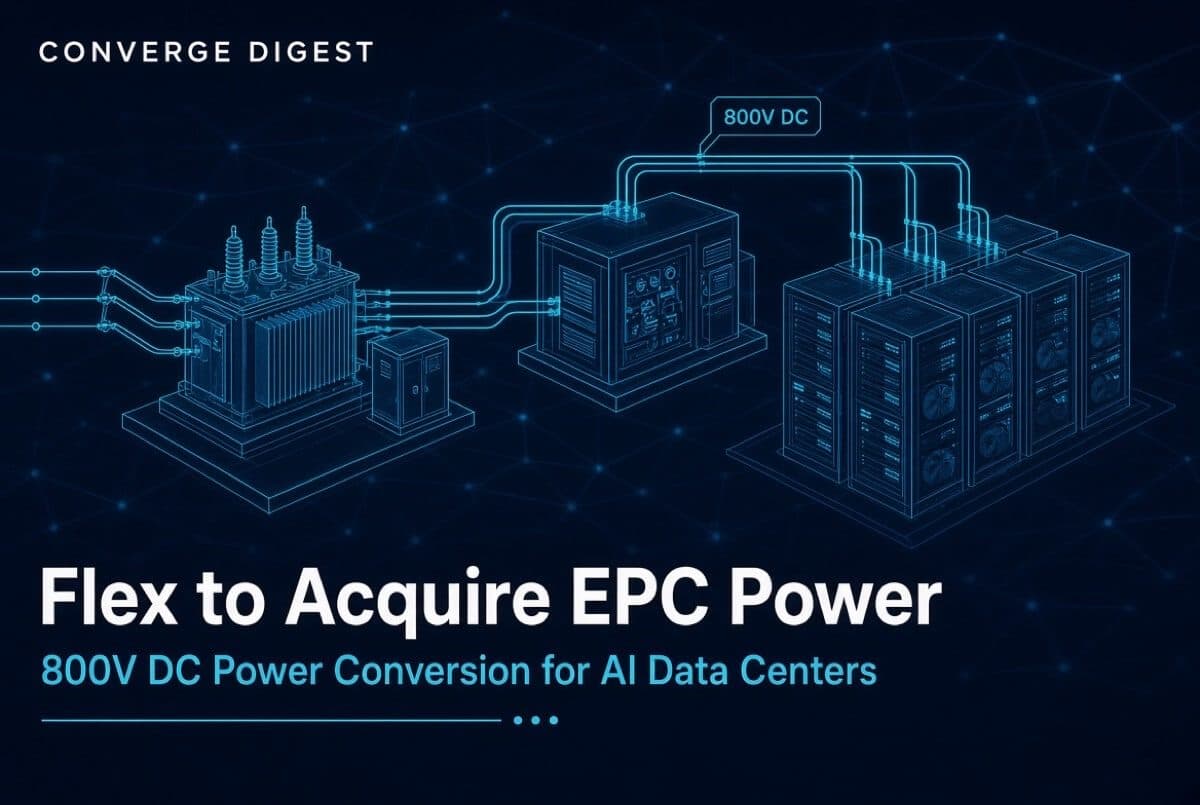
Flex agreed on 3 September to acquire power-conversion manufacturer EPC Power for $4.4bn in cash, in a deal the wires framed as a bet on AI data-centre electrification. The release supports a narrower reading, and the structure is the most interesting part.
Cash to the seller, debt and equity to fund it
The consideration is "$4.4 billion, subject to customary adjustments", payable at closing. Flex says it will fund that with "a combination of debt and equity", with "committed financing to support the transaction... provided by Citi and Bank of America." Calling it an all-cash deal is accurate about what the seller receives and misleading about Flex's balance sheet: the split between debt and equity is not disclosed, and an equity component means dilution.
Every attractive number is a 2027 forecast
The only backward-looking figure given is roughly $800m of revenue in calendar 2026, which puts the price at about 5.5x current-year sales for a hardware manufacturer. The rest is projection: "organic revenue growth of approximately 40% expected in 2027" and an EBITDA margin "expected to expand by double-digit percentage points to approximately 30% in 2027." Today's margin is never stated, so the size of the required expansion cannot be checked from the release.
Bought in order to be handed away
EPC Power joins Flex's Cloud and Power Infrastructure segment, and Flex "plans to separate CPI into an independent publicly traded company in the first calendar quarter of 2027." The deal is expected to close in Q4 2026. That is roughly one quarter between closing and separation — this is loading the spin-off vehicle, not integrating a supplier.
What the received framing gets wrong
EPC Power is not an AI company. It builds rectifiers and DC-DC conversion for utility-scale battery storage and grid applications; the release never breaks out how much of the $800m is data centre at all. The marquee data-centre item, solid-state transformers for next-generation 800V architectures, appears in the release as "planned development of" — it is not shipping. No earnout, contingent consideration or EPS-accretion claim appears in either company's release. The sellers are Goldman Sachs Alternatives and Cleanhill Partners.