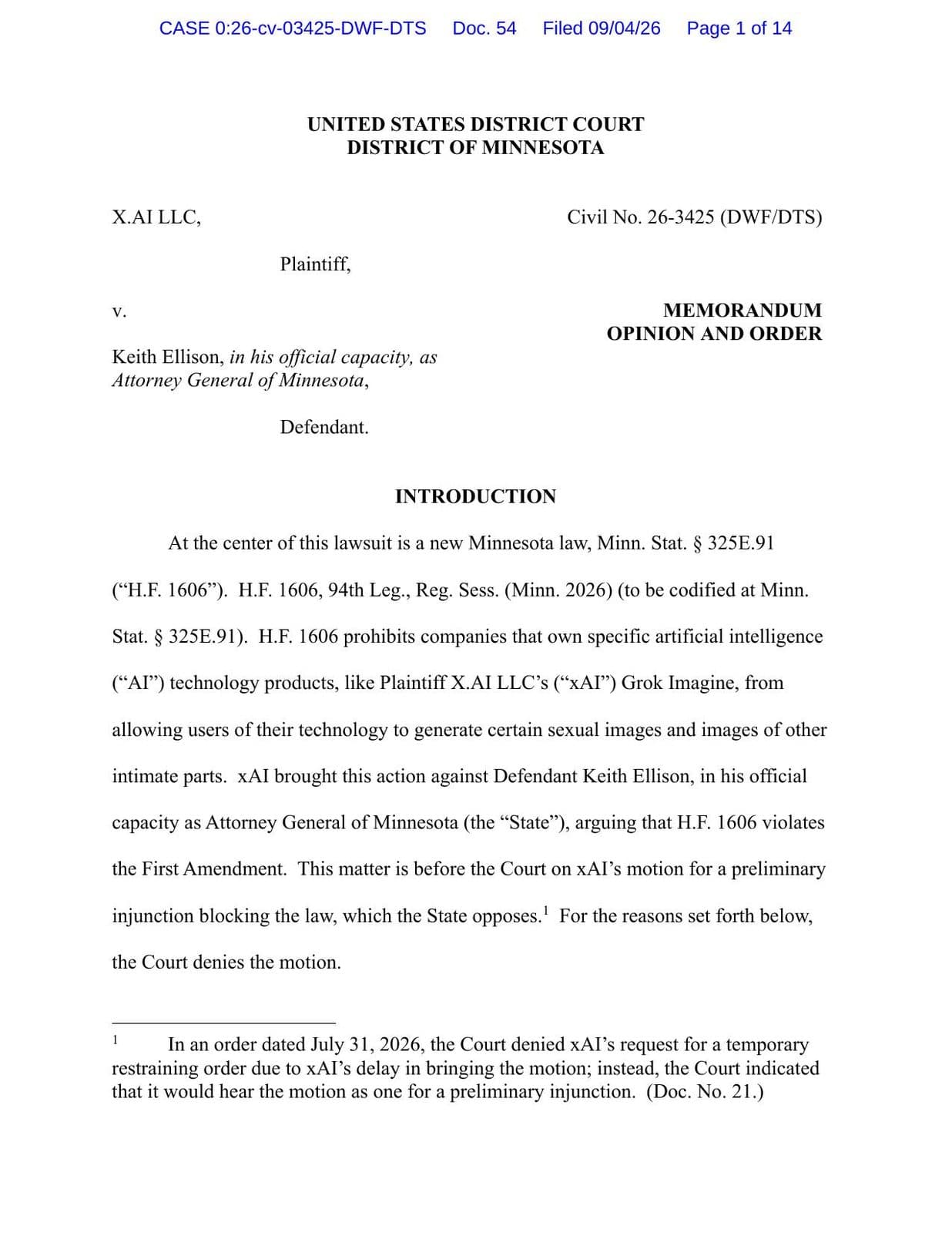
Judge Donovan W. Frank denied xAI's motion for a preliminary injunction against Minn. Stat. §325E.91 on 4 September, in X.AI LLC v. Ellison, No. 0:26-cv-03425 (D. Minn.). The statute bars companies owning AI image products from letting users generate certain sexual images, with civil penalties of "up to $500,000 for each violation" enforceable by the attorney general. It passed the Minnesota House on 23 April, the Senate unanimously on 29 April, was signed 7 May and took effect 1 August.
The holding, in the court's own words
"H.F. 1606 was signed into law on May 7, 2026. Nearly three months later and only three days before the law was set to take effect, xAI filed this motion. xAI has not offered an explanation for its delay" — and the motion "is properly denied for these reasons alone." The court had already refused a temporary restraining order on 31 July for the same reason.
What was expressly not decided
"The parties sharply contest the strength of xAI's First Amendment claim… The constitutional issues raised by the parties are complex … These issues deserve, and will receive, full consideration," the order says, routing them to the state's pending motion to dismiss. Likelihood of success, standing and the level of scrutiny are all untouched.
Why the penalty is not irreparable harm
Because the exposure is hypothetical: penalties are unlikely, the court notes, "because xAI has disabled its nudification tool in Minnesota". Moderation of image-editing prompts in the state has risen by more than 10 percent. The order also recites, from the state's filings, that SpaceX "has set aside a fund with more than $500 million for potential litigation losses" arising from Grok Imagine's Spicy and Unhinged modes, and three pending suits alleging the tool was used to produce child sexual abuse material. xAI's own pleaded figures: over 50,000 accounts suspended in 2026, over 70,000 reports to NCMEC, at least 244 arrests.
What the received framing gets wrong
This is being read as a court upholding a state AI law, or as xAI losing a First Amendment challenge. Neither happened. A judge decided two of the four preliminary-injunction factors, said so explicitly, and sent the constitutional question elsewhere. The proximate cause of the loss is a filing date. xAI appealed to the Eighth Circuit the same day, which means the first appellate word in this line of cases may also be about equities rather than speech.