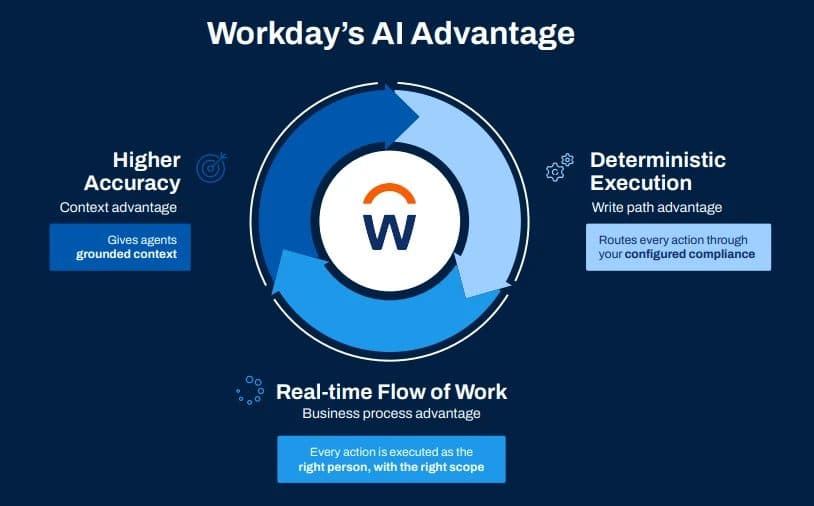
Workday reported fiscal 2027 second-quarter results at 20:01 UTC on 27 August, one minute after the US close. "Total revenues were $2.649 billion, an increase of 12.8%," with subscription revenues of $2.471bn, up 13.9%. CEO Aneel Bhusri led on AI: "AI driving more than 25% of our new ACV and more than 5,500 customers now using at least one of our organic agents" — a figure the release puts as "up more than 35% from last quarter."
The backlog split
Twelve-month subscription revenue backlog: $9.034 billion, up 14.2%. Total subscription revenue backlog: $27.403 billion, increasing 8.0% year-over-year. Total backlog is growing at roughly half the near-term rate — and below the 12.8% revenue growth. That is the signature of shortening contract terms and thinner long-dated commitments. The release leads with the 14.2%.
Margins up, cash down
Non-GAAP operating income reached "$824 million, or 31.1% of revenues," against 29.0% a year earlier, and GAAP operating income $313m against $248m. But operating cash flow fell to $520 million from $616 million, and free cash flow to $460 million from $588 million — down about 22% against 12.8% revenue growth. The GAAP-to-non-GAAP operating income gap is roughly $511 million in one quarter, more than the entire GAAP operating income the headline excludes.
What the common framing gets wrong
"AI drives 25% of new ACV" is not AI revenue. It is a share of new annual contract value — bookings on deals with an AI SKU attached — not recognised revenue, not ARR, and not necessarily money paid for AI. Workday discloses no AI ARR figure anywhere in the release, and "driving" is nowhere defined.
The 5,500 figure is activation, not spend: customers "using one or more" agents, not seats, consumption or revenue. And "organic" is a live qualifier — it excludes agents from acquired products, which is how a company that just made Sana-powered Workday Learning generally available reports an agent number that carefully does not include Sana.
Most tellingly, the agent catalogue shrank. Bhusri told diginomica the following day: "We had a lot more agents when I came back. We killed a lot or we rolled them into bigger agents." A 35% quarterly rise in customers-using-an-agent, measured on a consolidated catalogue of fewer and bigger agents, is a much easier number to move.