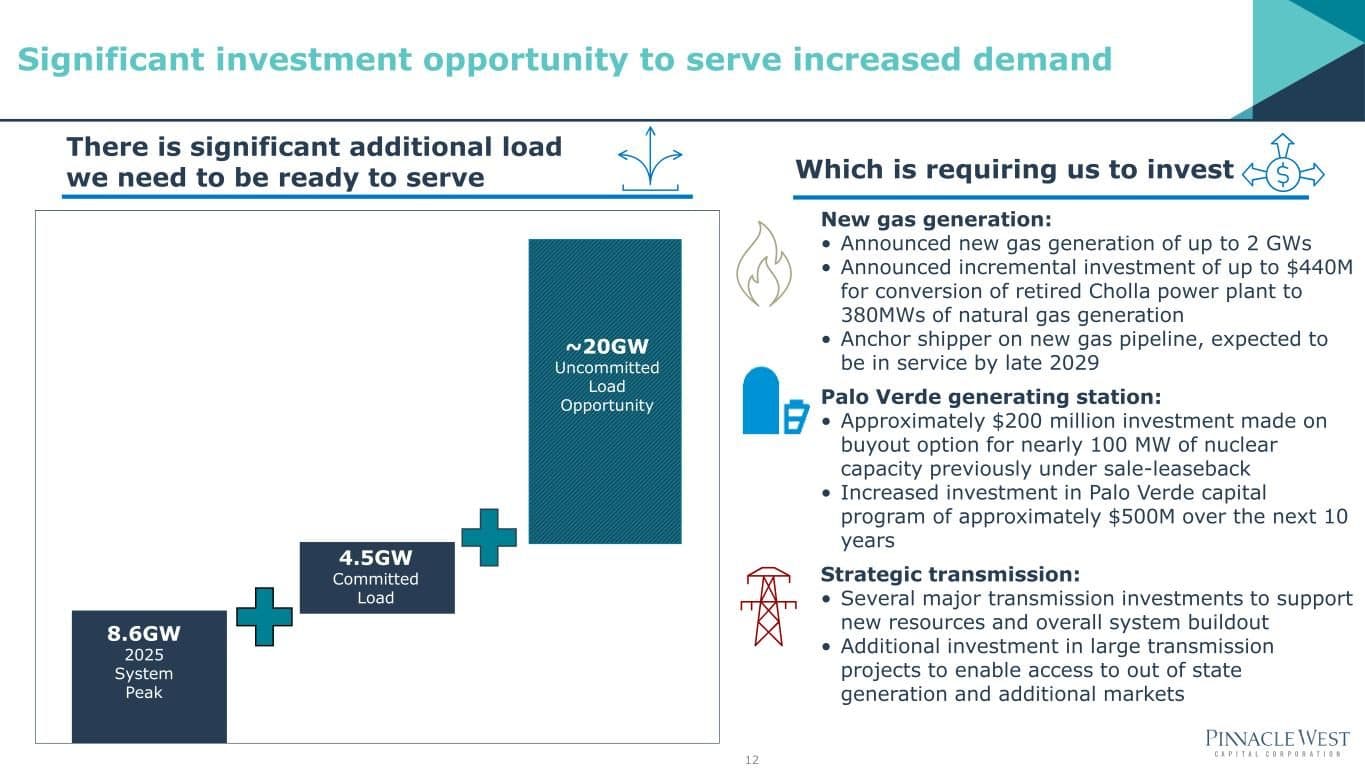
Pinnacle West Capital, parent of Arizona Public Service, furnished its September investor presentation as an 8-K Item 7.01 disclosure accepted at 20:27 UTC on 4 September. The deck is 36 slide images; the number that matters is on slide 12, and the utility labels it itself.
The line, verbatim
Under the heading "Significant investment opportunity to serve increased demand", the slide reads: "8.6GW 2025 System Peak | 4.5GW Committed Load | ~20GW Uncommitted Load Opportunity". Those are APS's own words for its own pipeline. Committed load — service agreements the utility is obliged to serve — is 4.5 GW. The larger figure is an opportunity: requests, enquiries and prospects, not signed obligations.
What has actually been announced against it
The same slide lists the supply side: "Announced new gas generation of up to 2 GWs"; "up to $440M for conversion of retired Cholla power plant to 380MWs of natural gas generation"; "approximately $200 million investment made on buyout option for nearly 100 MW of nuclear capacity previously under sale-leaseback"; and roughly $500m more into the Palo Verde capital programme over ten years. Add it up and announced generation is about 2.5 GW against a 20 GW "opportunity". Transmission gets "$6 billion+" through 2035, over 600 miles of 345 kV and above.
Neither number has cleared the regulator
The Arizona Corporation Commission's inquiry into data-centre rate classifications, docket E-00000A-25-0069, is still open. APS's 2026 Integrated Resource Plan — the document that would test any of this against actual resources — is not filed until 30 October. The deck reports 2026 year-to-date commercial and industrial sales growth of 13.6% and long-term sales growth raised to 5%–7% through 2030.
What the received framing gets wrong
Twenty gigawatts of Arizona data-centre demand is now circulating as a fact about the state's power needs. It is a pipeline figure the utility explicitly marks as uncommitted, sitting alongside a committed figure a quarter its size, ahead of an open rate docket and a plan not yet filed. Separately, coverage the same day reported Arizona as "projecting 4,000 MW needed by 2033" — a planning number five times smaller than the one APS shows investors. Both are circulating as demand.