South Korea formally launched its national Modu-ui AI — "AI for All" — programme at a briefing in Seoul on 4 September, with Deputy Prime Minister and Science Minister Bae Kyung-hoon alongside the chief executives of Kakao, KT and SK Telecom. A ministry budget document obtained by the office of legislator Lee Jung-heon puts numbers to it that the framing does not survive.
This year has no money in it
The launch year is funded with 512 GPUs handed over in kind and no cash budget at all. A ministry official is quoted directly: no budget was allocated this year, so GPUs are being provided in kind instead. The cash starts in 2027, at ₩250bn a year, and the document shows that rate holding through 2030.
What ₩250bn buys
Of that, ₩170bn goes on GPU rental. At a monthly B200 rental of ₩6.6m, the document works that out at roughly 2,100 GPUs — which the ministry itself scopes at about 10 million users a year. A further ₩30bn is split as operating money, ₩10bn per consortium, roughly $7.4m each at the 3 September ECB rate of ₩1,357.29 to the dollar, to be shared with partner firms.
The operators' own targets are smaller than the pitch
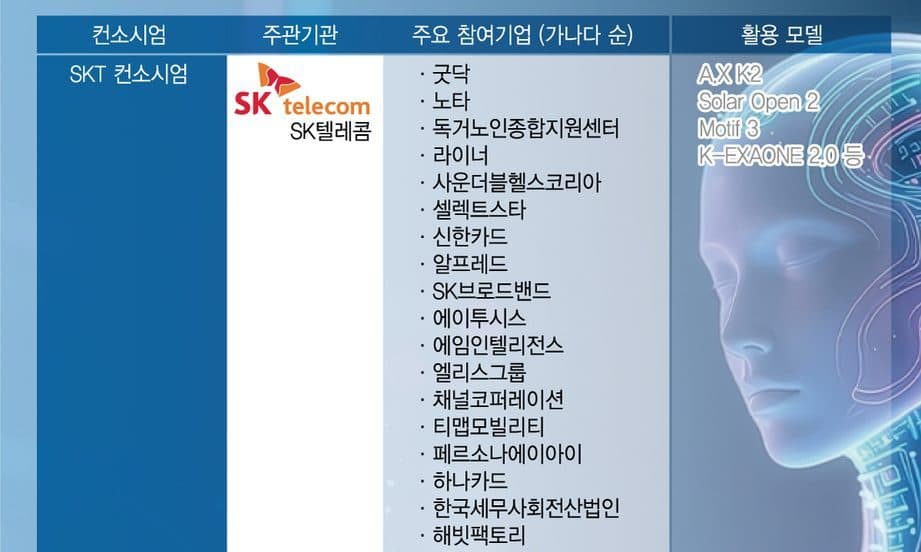
Beta service is due by November 2026 and official launch in December. All three consortia target 5 million monthly active users in 2026. Kakao aims at 10 million by February 2027 and 30 million by 2030; SK Telecom at 10 million next year; KT says it has built capacity for 20 million. The consortia comprise 52 firms in total — Kakao 15, SK Telecom 20, KT 17.
What the received framing gets wrong
English coverage describes the first country to make AI a free public utility for all 52 million citizens. Four corrections follow from the ministry's own figures: there is no 2026 money; capacity is sized for a fifth of the population; ₩10bn per consortium is an operating stipend rather than a national AI budget, with the build cost sitting on the telcos; and the operators were selected on 28 August, so reporting that dates the selection to this week has the wrong day. Note the ministry's own site was serving a maintenance page during reporting, so the budget figures trace to the legislator's document as carried by three same-day Korean outlets rather than to a ministry release.