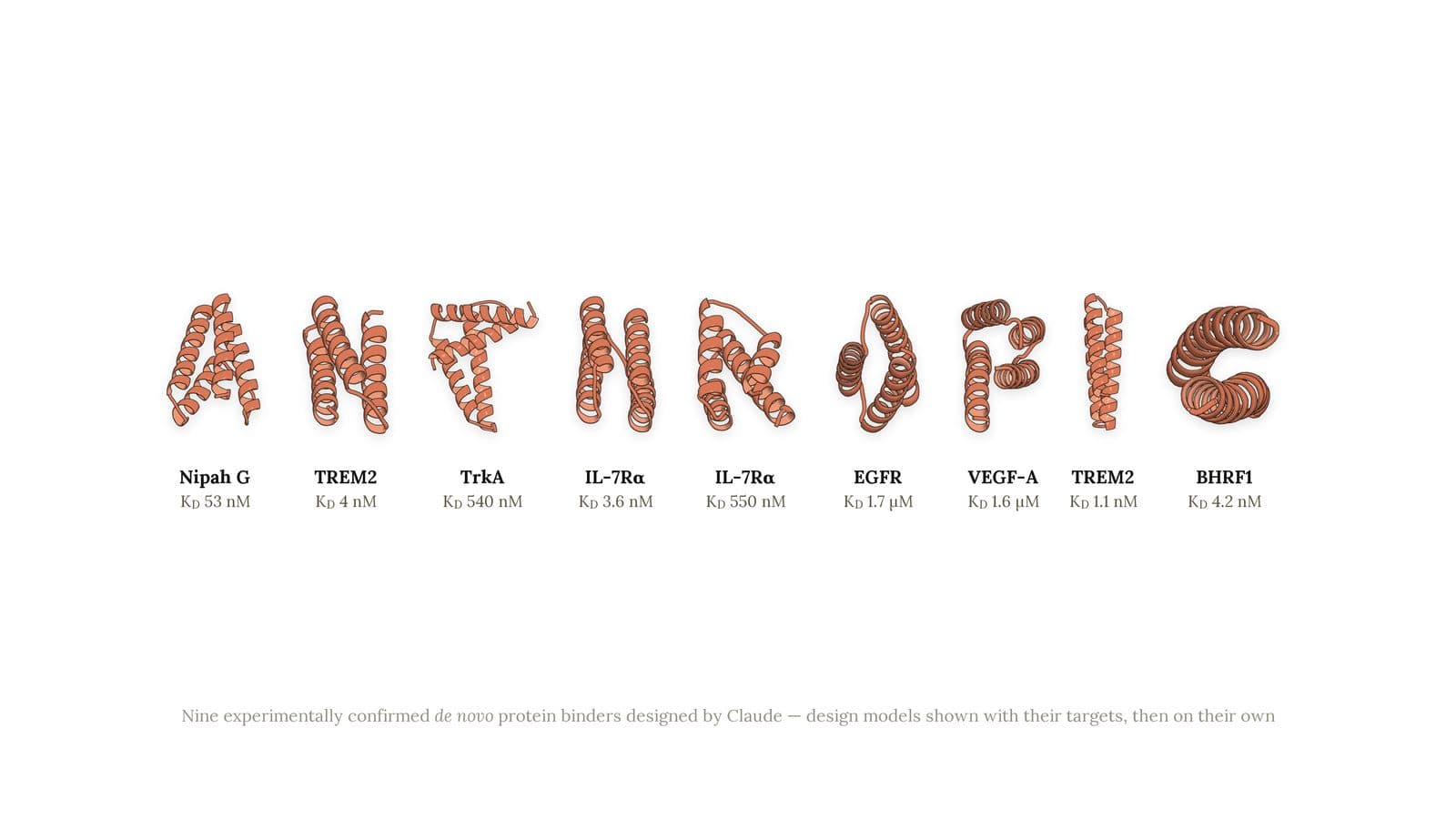
Anthropic published wet-lab-validated results on 18 August in which Claude designed de novo protein binders against 15 targets and produced confirmed binders for 14. The topline is real. It is also the least informative number in the paper.
What the experiment produced
From 1,320 designs came 354 confirmed binders. In multi-target mode, where all fifteen targets were attacked in a single 48-hour session, hit rates ran 22.6–26.7%; in single-target mode, with separate 24-hour sessions, Mythos Preview reached 35.1%. Anthropic's stated field baseline for comparable campaigns is 10–15%. Different models had different strengths: Opus 4.8 succeeded against TNFα where Mythos Preview failed.
What the common telling gets wrong
Three things. First, "14 of 15" is not a success rate — it is the count of targets where at least one design bound. The rate that describes the work is 22.6–35.1%, meaning roughly three designs in four still fail. Second, this is not drug discovery: Anthropic's own page says minibinders "are not a standard therapeutic modality for drugs." There is no efficacy data, no animal work and no candidate. Third, the cost is absent from every summary. A multi-target session consumed up to 12,500 NVIDIA H100 hours, and single-target runs up to 2,500 H100 hours per target. This was an industrial compute campaign, not a chat prompt.
The failure that matters
Against maltose-binding protein, Claude generated 90 designs and none of the 90 was confirmed to have bound, though one showed weak reproducible binding. A method that works on fourteen targets and collapses completely on the fifteenth is a method whose failure modes are not yet understood — and Anthropic does not claim to understand them.
The capability is withheld from the best model
The wins came from Mythos Preview and Opus 4.8. Protein design remains unavailable for general access in Claude Fable 5, Anthropic's most capable model, on dual-use grounds. A lab publishing a capability it is simultaneously declining to sell is the unusual part of this release.
The dissent
Martin Shkreli called the work "not impressive," arguing that "affinities are quite low for peptidics" and that "these aren't useful probe molecules because notice none of them are intracellular" — extracellular binders, he argued, already have an established alternative in monoclonal antibodies.