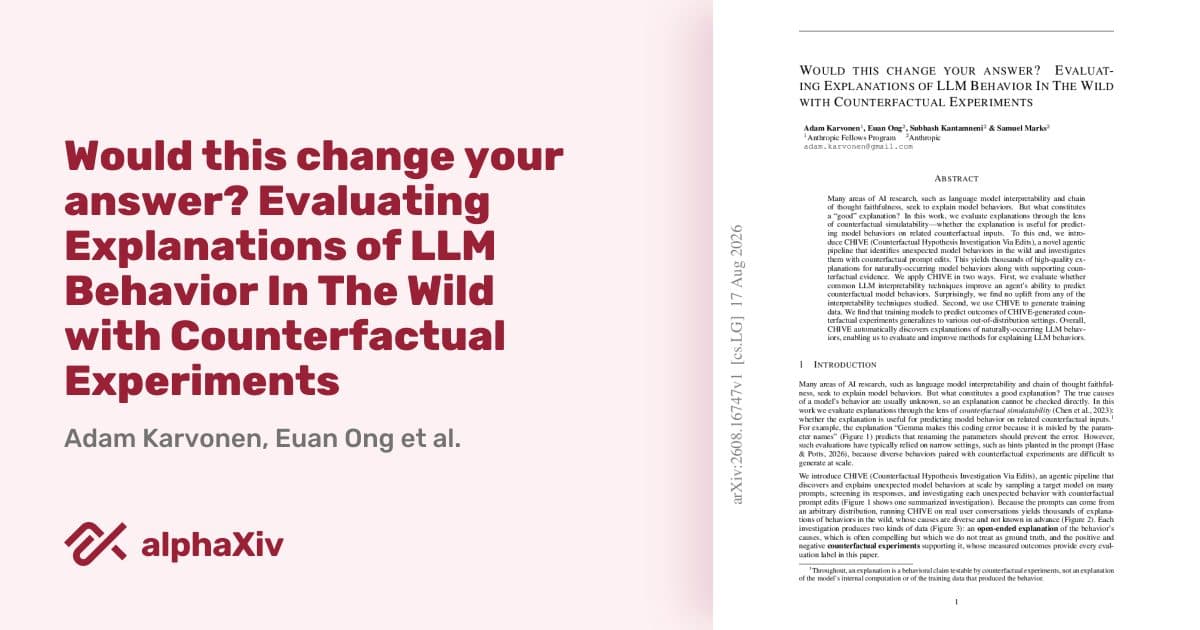
A paper submitted at 15:57 UTC on 17 August 2026 by Adam Karvonen, Euan Ong, Subhash Kantamneni and Samuel Marks introduces CHIVE — Counterfactual Hypothesis Investigation Via Edits — an agentic pipeline that identifies unexpected language-model behaviours in the wild and investigates them by editing the prompt and seeing what changes. Its headline result is negative, and it points at the field's own toolkit.
The test and the result
The authors ask a specific, falsifiable question: do common interpretability techniques help an agent predict how a model will behave on related counterfactual inputs? They evaluate sparse autoencoders, natural-language autoencoders and activation oracles. The finding, in the abstract's own words: "Surprisingly, we find no uplift from any of the interpretability techniques studied." The comparison is against an agent that simply reads the conversation transcript.
What the common framing gets wrong
The obvious headline is that sparse autoencoders are dead. That overstates it, and the paper does not say it. The claim is narrower and more precise: on this task, the activation-based tools added nothing beyond what reading the transcript already provided. That is a statement about marginal information over a strong text baseline, not about whether SAE features correspond to anything real inside the model. A tool can describe genuine internal structure and still fail to tell you something the visible text did not.
The other half is the useful half
The second application is more constructive and is getting less attention. The authors use CHIVE to generate training data, and report that models trained to predict the outcomes of CHIVE-generated counterfactual experiments generalise to out-of-distribution settings. So the pipeline that produced the negative result also produced a method that works — the explanation of a behaviour turns out to be learnable from counterfactual evidence, even where reading activations did not help.
Why the authorship matters
Interpretability is the primary technical pillar that frontier labs cite when asked how future systems will be overseen. Two of the four authors are on Anthropic's alignment team. A lab publishing a measured null result against its own strategic bet, with a concrete benchmark attached, is a healthier signal than another capability demonstration — and it gives the field a definition of success it can actually be held to: beat the transcript.