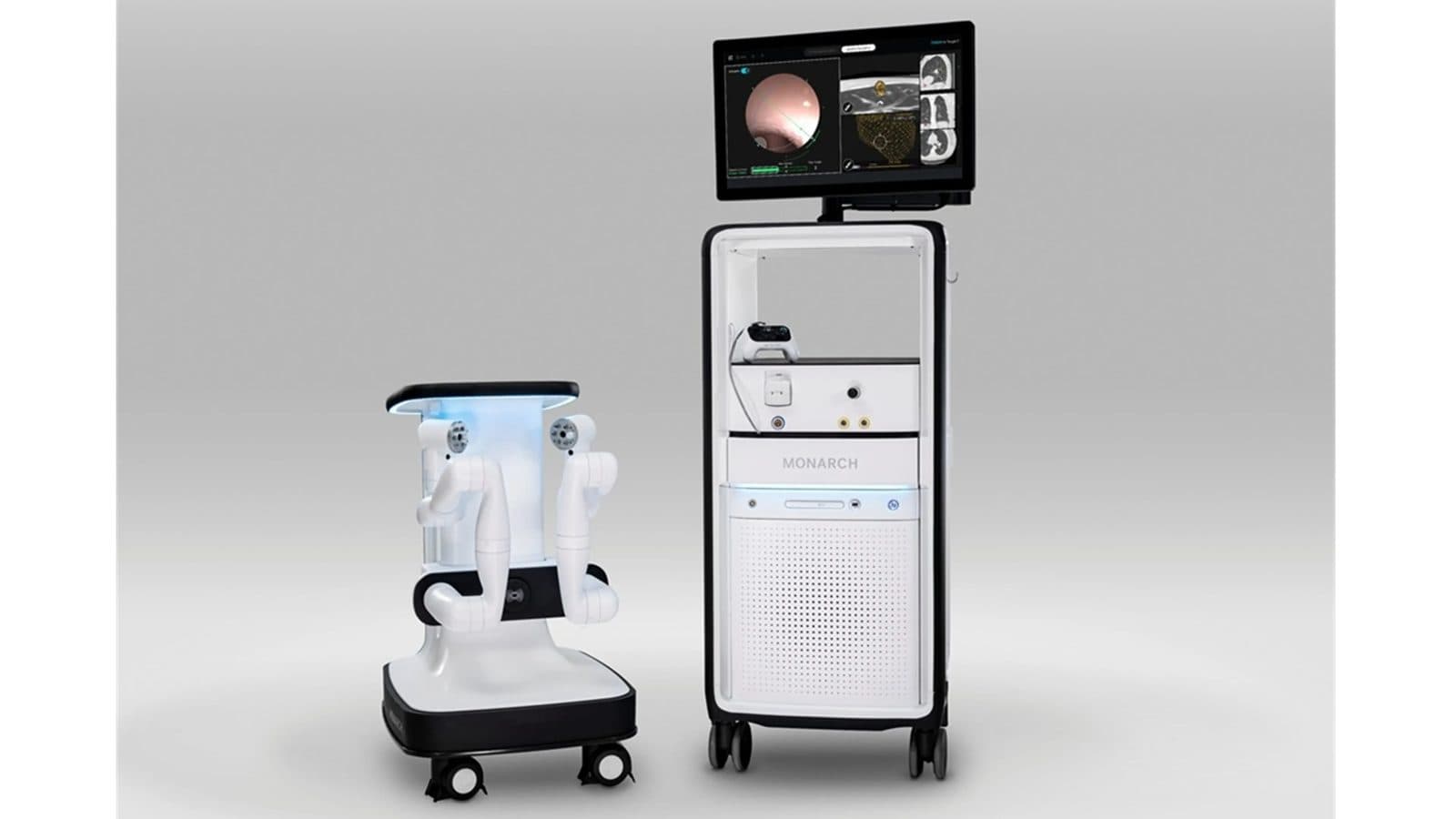
Johnson & Johnson MedTech announced on 17 August 2026 US 510(k) regulatory clearance for MONARCH QUEST 3, a software release for its existing robotic bronchoscopy platform. The headline feature is AI-powered nodule segmentation, which automatically generates the boundary of a lung nodule during a navigated biopsy.
What is in the release
Alongside the segmentation: software enhancements for registration and navigation accuracy, a 3D Compass overlay, broader compatibility with CBCT imaging systems, continuous registration with real-time scope-tip tracking, and connection to the Polyphonic digital ecosystem. The company notes the launch "follows three launches in the past eighteen months."
What the common framing gets wrong
Trade headlines read "FDA nod for AI features," which a reader reasonably hears as an AI approved to find lung cancer. Two corrections are needed. First, 510(k) clearance is not approval: it is a determination that a device is substantially equivalent to one already legally marketed, and it does not require clinical evidence of efficacy. Second — and this is the part that should be reported and is not — the release contains no efficacy data of any kind. There is no accuracy percentage for the segmentation, no diagnostic yield figure, no procedure count and no patient-outcome number anywhere in it. The single quantitative claim in the entire announcement is the count of prior launches.
What segmentation actually does
Nodule segmentation draws the boundary of a lesion that a clinician has already identified on imaging. It is a contouring aid inside a navigation workflow — useful for targeting the biopsy — not a detector, not a classifier and not a diagnosis. Describing it as AI that finds lung cancer inverts the workflow: the nodule is found first, by a radiologist, and the software helps aim at it.
This is the normal shape of AI clearances
Most "FDA-cleared AI" news looks like this: an iterative software update to existing hardware, cleared on equivalence rather than outcomes, from a manufacturer shipping several such updates a year. That is how the count of cleared AI devices climbs steadily without a corresponding body of published evidence that patients do better. The clearance is real and the engineering may well be good. But a cleared device with no published performance figure is a regulatory fact, not a clinical one, and the two get reported as though they were the same.