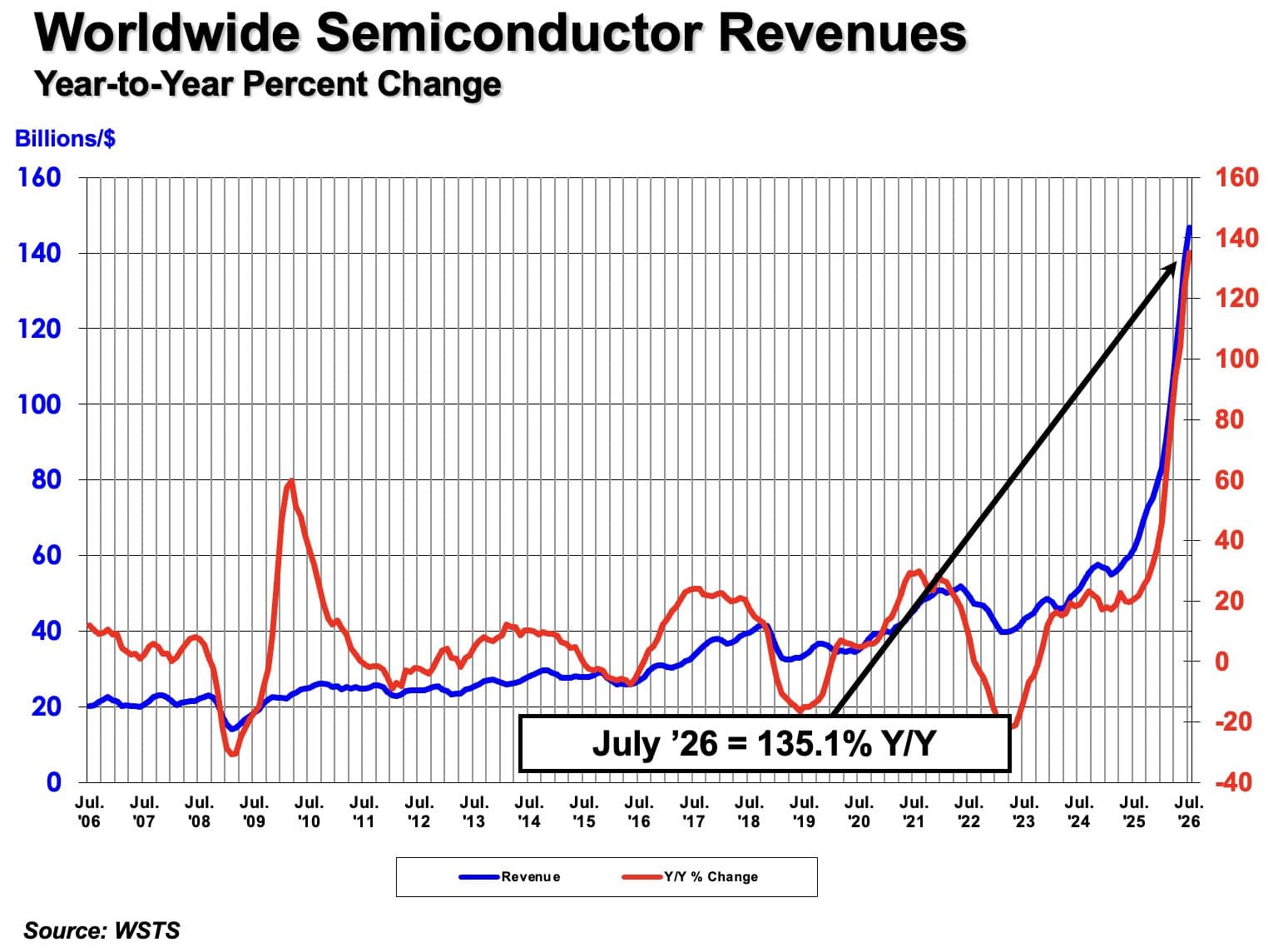
The Semiconductor Industry Association published its July global sales release at 21:00 UTC on 4 September: "global semiconductor sales were $146.8 billion during the month of July 2026, an increase of 6.4% compared to the June 2026 total of $137.9 billion and 135.1% more than the July 2025 total of $62.5 billion." Two things in that sentence need reading carefully, and SIA supplies both.
It is not a month
Further down the same page: "Monthly sales are compiled by the World Semiconductor Trade Statistics (WSTS) organization and represent a three-month moving average." The $146.8bn is the May-July average, not July's billings. "Chip sales hit $146.8bn in July" and "sales grew 135% year over year in July" are both statements about a smoothed series presented as statements about a month.
June moved
SIA's own release of 6 August reported: "Global sales were $134.5 billion during the month of June 2026, an increase of 123.6% compared to June 2025 and 9.7% more than sales in May 2026." On 4 September the same June is $137.9bn — $3.4bn higher, a 2.5% restatement, with no note anywhere on the page. That revision is what produces the reported month-on-month figure: against the June that SIA itself published a month earlier, July is up 9.1%, not 6.4%.
What the received framing gets wrong
The story being told off this release is a deceleration — June's +9.7% cooling to July's +6.4%. On the numbers as originally published there is no deceleration at all; the apparent slowdown is an artefact of the base being lifted. And the 135.1% year-on-year comparison is a smoothed figure divided by another smoothed figure from before the memory-price surge, not a doubling of shipped silicon in twelve months. Regionally, July year-on-year: Americas 171.3%, Asia Pacific 134.9%, China 123.6%, Europe 85.2%, Japan 50.8%.
Why the series is worth policing
This WSTS number anchors the $1.5 trillion-in-2026 forecasts, capex justifications and the trillion-dollar-market talking point. Those are long-horizon uses, and smoothing is defensible for them. Month-to-month acceleration read off the same series — which is what traders and planners actually do with it — is partly noise from the smoothing plus unannounced back-revisions of billions of dollars.