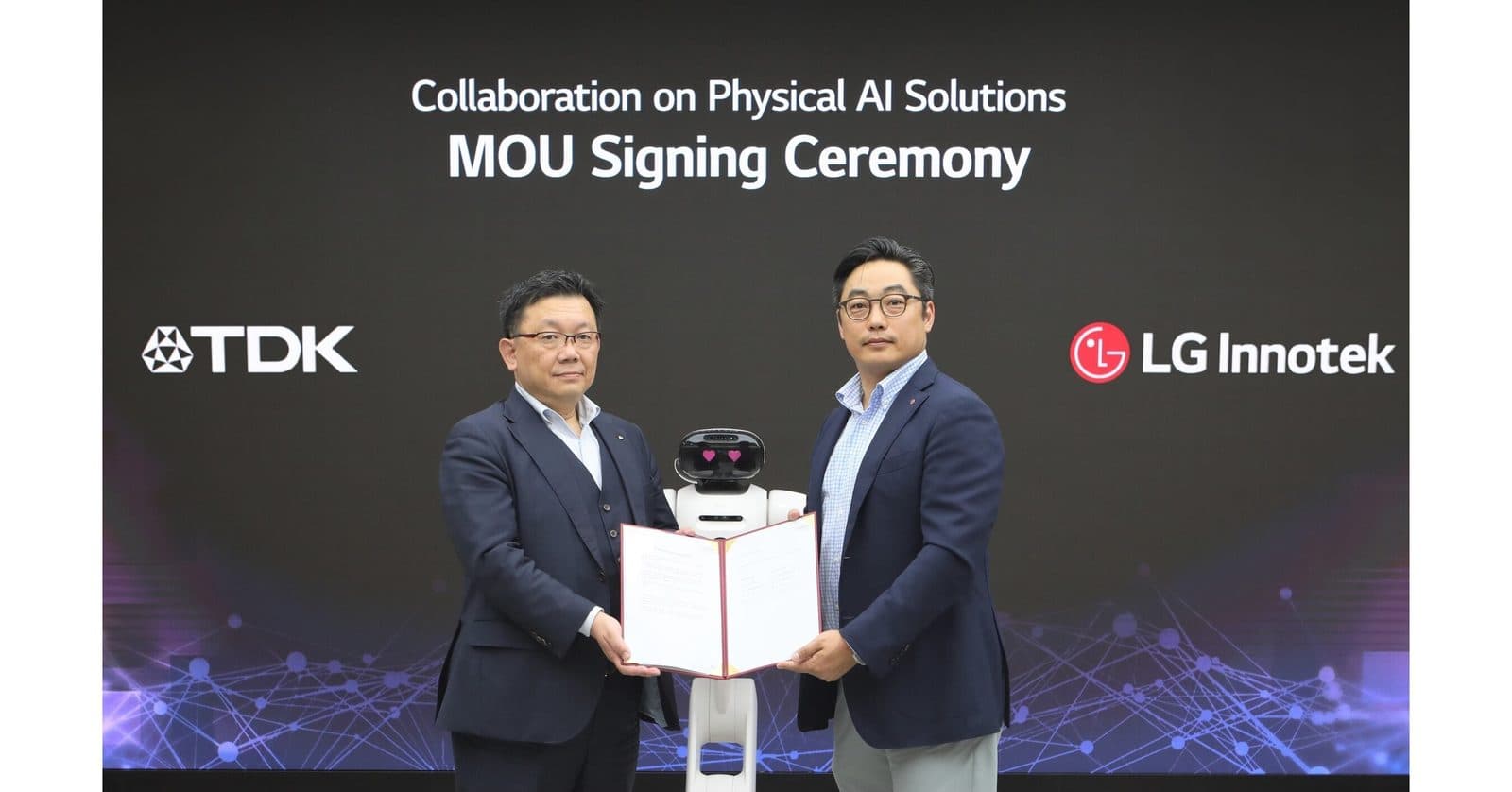
LG Innotek and Japan's TDK announced a memorandum of understanding at 07:00 UTC on 28 July to co-develop sensing modules for physical AI robots — one for vision, one for touch. Both are targeted for 2027.
The division of labour
TDK contributes inertial measurement units, position sensors and microphones. LG Innotek contributes optics, module integration and digital signal processing. The vision sensing module pairs LG Innotek's camera work with a TDK inertial sensor; the second product is a tactile module — robot skin — intended to give a machine a sense of contact and pressure.
Why touch is the interesting half
Vision for robots is comparatively solved. Manipulation is not, and the reason is largely that robots cannot feel. Knowing that a grip is slipping, that an object is deforming, or that contact has been made at all requires dense tactile sensing across curved surfaces — durable enough for industrial duty cycles and cheap enough to cover a whole hand. That is a components problem, not a models problem, and it is why humanoid demonstrations still mostly show walking and carrying rather than assembly.
How much to read into it
Carefully. An MOU is a letter of intent: no binding commitment, no investment figure, no customer, and nothing shipping before 2027. The market projections in the release — physical AI at $81.6 billion in 2025 growing 36.1% a year, tactile sensors going from $3.68 billion in 2025 to $21.5 billion in 2033 — are third-party forecasts republished by the vendors, and one line in the release is garbled to the point of missing its unit. Treat those figures as promotional. A separate $960.4 billion figure carried in some coverage does not appear in the release at all.
The signal worth taking
Not the products — the participants. When two large component suppliers pair up around a category, it means the supply chain has decided the category is real enough to plan capacity for. Robot makers announcing robots is marketing. Sensor makers reorganising around robots is a forecast.