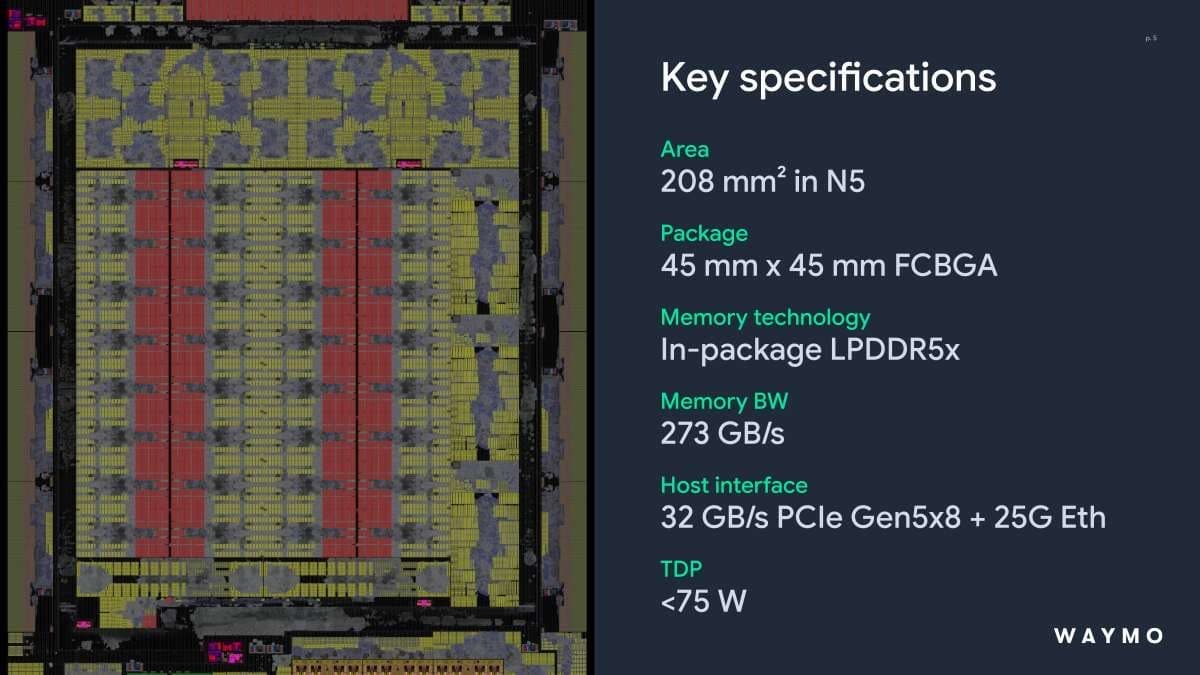
Waymo's engineers presented their sensor fusion processor at Hot Chips on Monday. The disclosed machine-learning throughput is 160 TOPS (INT8×INT8) and 80 TFLOPS (FP16). Since 20 August, when Waymo published a blog post about the silicon, the figure in circulation has been "over 1,000 TOPS", routinely glossed as putting Waymo "on par with Nvidia's latest autonomous-driving systems."
What is on the slides
A 208 mm² die on TSMC N5, in a 45 mm × 45 mm FCBGA package, under 75 W TDP. In-package LPDDR5x at 273 GB/s, 64 MB of on-chip SRAM and an 8 MB register file. 16 processing elements in the core array, two RISC-V CPU cores with vector extensions in the control element, and two third-party GPUs handling point-cloud work and FFTs. PCIe Gen5 x8 to the host, 25G Ethernet, MIPI sensor ingest. It is already deployed, in sixth-generation vehicles, in a live fleet.
What the conventional framing gets wrong
Three errors stack into the 1,000 figure. The first is grammatical: Waymo's post says "these ASICs" — plural. There are two per vehicle, and press coverage turned a pair into a part. The second is what the pair is for. It exists for redundancy: if one dies, the car still brings itself to a safe stop. You do not get to sum a failover pair and quote it as a spec — and even if you did, 2 × 160 is 320 TOPS of ML, not a thousand. The third is the sentence's own hedge. Waymo wrote that the ASICs deliver over 1,000 TOPS "dedicated to front-end processing and ML models" — bundling fixed-function pixel work, image signal processing and temporal denoising in with the matrix engines. Hot Chips separates them. Comparing that composite against an Nvidia Thor-class ML number compares two different denominators.
The more interesting story underneath
A sub-75-watt part was never competing with a 500-watt drive computer on raw throughput, and the talk makes clear it was not trying to: the design target is latency at batch size one. What Waymo built is a small, cheap, low-power sensor front end co-designed with its own fusion encoder, with the heavy driving model kept elsewhere in the vehicle. That is a real achievement and a different claim from the one that ran. Waymo did not replace the big compute; it removed the pixel plumbing.
What remains unitemised
Waymo has not broken down what the remaining throughput in its own composite figure consists of. That gap is stated here as a gap, not filled in.