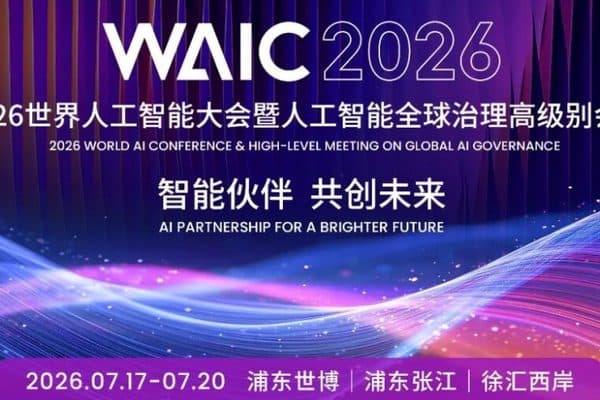
The world's biggest AI show is trying to become a serious academic venue. On July 18, WAIC hosted WAICA, its first standalone peer-reviewed conference — an attempt to pair the conference's commercial spectacle with rigorous research, and to rethink what a scientific paper looks like in the AI era.
Serious credentials
The lineup signals ambition. WAICA is chaired by Turing laureate Andrew Chi-Chih Yao, with fellow Turing winner Richard Sutton — a founding figure of reinforcement learning — as international co-chair. It drew 282 submissions and accepted 57, a selective 20.21% acceptance rate, with Best Paper and Best Student Paper judged on-site.
An 'AI-native' format
The more novel part is the medium. Instead of static PDFs, WAICA converts papers to Markdown with embedded video, audio and interactive demos — arguing that AI research, which is often about dynamic systems, is poorly served by a frozen document. Authors are encouraged to attach runnable code, with planned Hugging Face integration so results can be reproduced rather than merely read.
Rethinking review
Peer review gets reworked too, via a three-tier process combining AI-assisted screening, open program-committee commentary and multi-party adjudication. It is a direct response to the strain AI's publication volume has put on traditional review, where reviewer supply cannot keep pace with submission growth.
Why it matters
Hosting a credible academic conference inside a state-backed commercial event is a statement of scientific ambition — China signaling it wants to set norms for how AI research is published, not just showcased. Whether the "AI-native" format catches on beyond WAICA is unproven, but the experiment targets real, widely felt weaknesses in how the field currently shares its work.