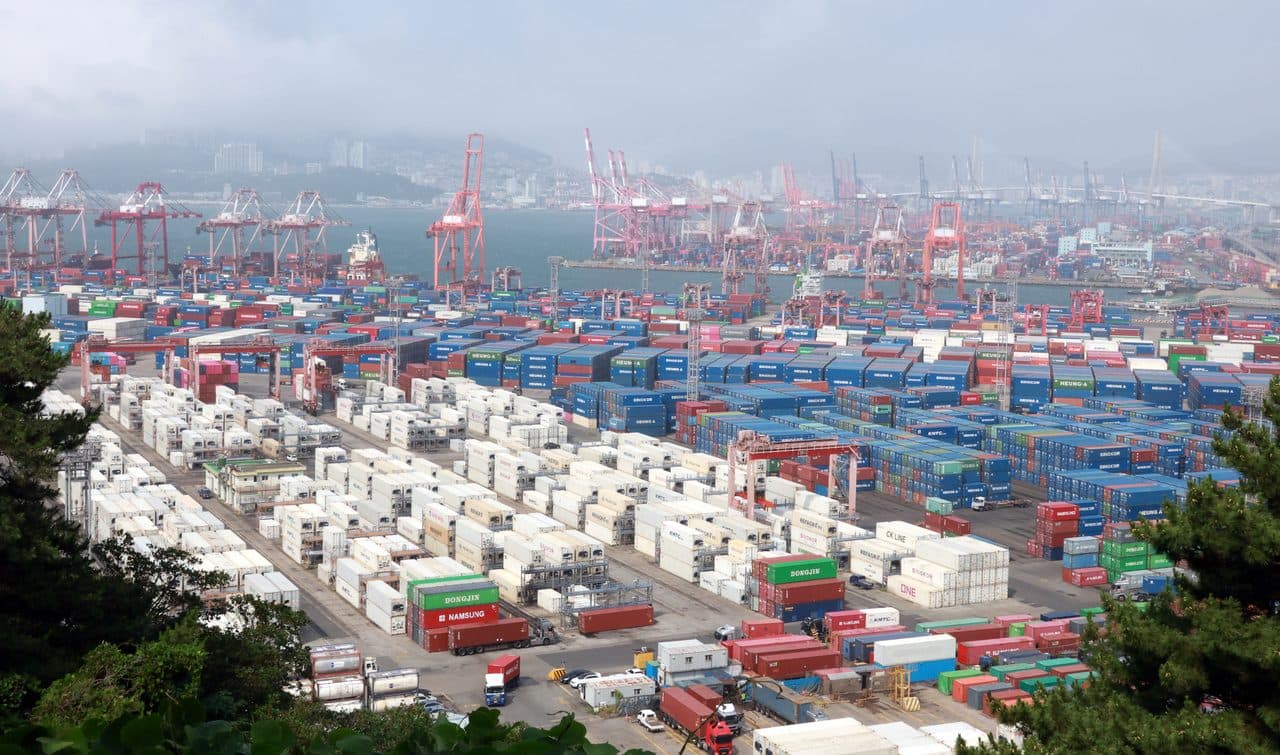
South Korea's Ministry of Trade, Industry and Energy published July trade data on Saturday morning. Semiconductor exports came in at $41 billion, up 179% year on year and the second straight month above $40 billion. Total exports were $98.89 billion, up 63% — the second-highest month on record, behind June's $102.2 billion.
What 179% is measuring
July 2025 was the bottom of the memory price cycle. A percentage calculated against a trough tells you about the trough. The number that carries information about current momentum is the sequential comparison against June, which the headline framing leaves out entirely. On the total-export line, where June is available, the month went the other way — down from a record $102.2 billion to $98.89 billion.
It is not all AI
The $41 billion is all semiconductor exports. That includes legacy DRAM, NAND, foundry work and logic with no AI application whatsoever. HBM and AI-server memory are a subset, and the ministry's release does not break them out. Any reading of this figure as the size of Korea's AI chip business is an invention.
Price, not volume
The distinction running through the entire memory sector this quarter applies here too. Memory revenue is rising substantially on average selling prices rather than bit shipments. Amazon attributed its own capex increase this week to higher memory costs, not to buying more compute. The same dollar can appear as Korean export strength and as an American cost problem.
And the rest of the economy
Total exports up 63% is being read as broad strength. It is heavily one sector. Strip semiconductors out and the picture changes considerably — a calculation almost no coverage supplies.
The signal that does survive
None of this makes the release uninteresting. Two consecutive months above $40 billion is a level, not a growth rate, and levels are harder to argue with — Korean semiconductor exports have never sustained this before. It is also the earliest hard data anyone gets, published within a day of month-end, weeks ahead of the quarterly results from Samsung and SK Hynix that will eventually explain it. The number is real. The 179% is the part doing the misleading.