Two of the largest companies in technology named the same constraint within hours of each other this week, from opposite ends of the supply chain. Amazon raised its capital budget because memory costs more. Apple's chief executive called the same phenomenon a once-a-century event.
What Cook said
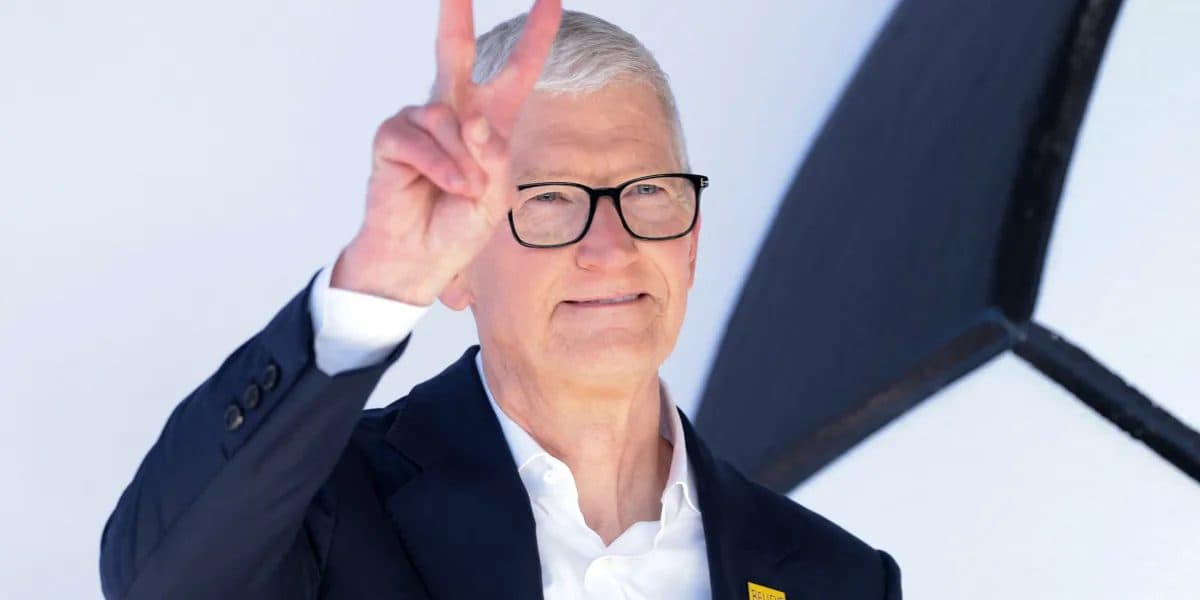
On what was his final earnings call as CEO, Tim Cook said: "We're in what I would characterize as a hundred year flood on the memory pricing." On Apple's refusal to build hyperscaler-scale AI infrastructure, he offered the strategic case: "The ability to run some percentage of requests on-device is also very strategic, sort of a competitive weapon if you will."
The quarter
Revenue was $109.4 billion, up 16%. EPS $2.02, up 29%. Gross margin 50.1%, against 46.5% a year ago. iPhone $54.3 billion (+21.7%), Mac $10.4 billion (+28.7%), Services $30.7 billion (+12.1%), iPad $6.2 billion (−5.9%).
What the headline margin hides
Roughly two percentage points of that 50.1% gross margin and $0.11 of the $2.02 EPS come from tariff refunds — a one-off, not operating improvement. And the "competitive weapon" framing is a virtue built from a constraint: Apple runs inference on-device in part because it never built the datacentres. The same call disclosed supply constraints and guided the September quarter to growth of just 9–11%. A capex figure of $2.46 billion for the June quarter is circulating as proof of a capital-light AI strategy; it does not appear in Apple's press release and should be checked against the 10-Q before anyone repeats it.
Why the corroboration matters
Memory has been treated as a component story — a line item in Samsung's and SK Hynix's results. This week it became the stated reason a hyperscaler raised a $220 billion capital budget, and the thing the CEO of the world's most valuable consumer hardware company chose to warn investors about. When the buyer and the builder describe the same squeeze on the same day, the limiting factor on the AI buildout has arguably moved from GPUs to DRAM.