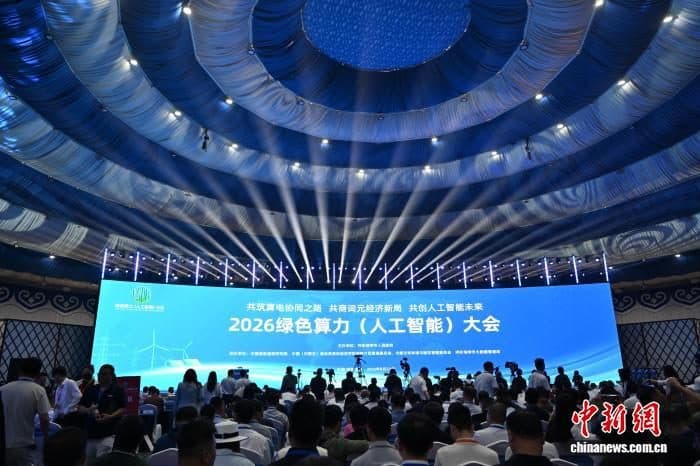
The 2026 Green Computing Power (AI) Conference opened in Hohhot, Inner Mongolia, on 22 August, and Chinese state wire copy filed from the venue between 09:37 and 10:26 UTC. The event signed 13 projects with planned total investment of CNY 136.1bn — about 6.8 times the CNY 20bn signed at the 2025 edition, when 10 projects all landed in Hohhot.
What was signed, and by whom
Eight projects went to Hohhot and five to Ulanqab. Volcano Engine, ByteDance's cloud arm, took a gigawatt-class park in Hohhot and a gigawatt-class computing centre in Ulanqab — the anchor tenant of the corridor, twice. A Cambricon chip laboratory and the Haiwu computing-equipment industrial park cover chip testing and equipment manufacture; GCL Energy's integrated power-and-compute project and a China Telecom data centre round out Ulanqab. The province is explicitly pushing past hosting into what it calls token services, with a Guangdong-Hong Kong-Bay token base aimed at generation and applications downstream.
What the common framing gets wrong
Three things, and they compound. First, signings are not investment. CNY 136.1bn is the sum of signing ceremonies at a promotional conference — not committed capital expenditure, not money spent, not capacity built. The "6.8 times last year" growth story is growth in paper deals signed at a regional expo, which is the metric a host province has every reason to see rise. Second, a gigawatt-class park is a plan: no energisation date, no delivered megawatts and no interconnection figure appears in the announcement. Third, and most usefully, the same conference released a report putting the national rack deployment rate at 71.4% as of end-June 2026 — meaning 28.6% of China's rack estate sits empty. The two numbers point in opposite directions and were published on the same day, in the same place.
The electricity figure is the one that constrains
Chinese computing facilities used 170 billion kWh in 2025, up roughly 30% year on year, and a State Council Development Research Centre survey puts electricity at 60-70% of data-centre operating cost. That is why Inner Mongolia wins these signings: cheap, abundant green power is the whole pitch. Officials at the conference framed global AI pricing as moving from a technology premium to cost-effectiveness competition, which is the same argument stated from the demand side.
Why occupancy is the honest metric
Inner Mongolia is where China's earlier "East Data, West Computing" halls sat under-used, which is precisely why a deployment-rate statistic exists to be published. Hub-node schedulable compute is reported at about six times the 2025 level. Whether the new gigawatt parks become compute or become real estate is the question the 71.4% is quietly answering in advance.