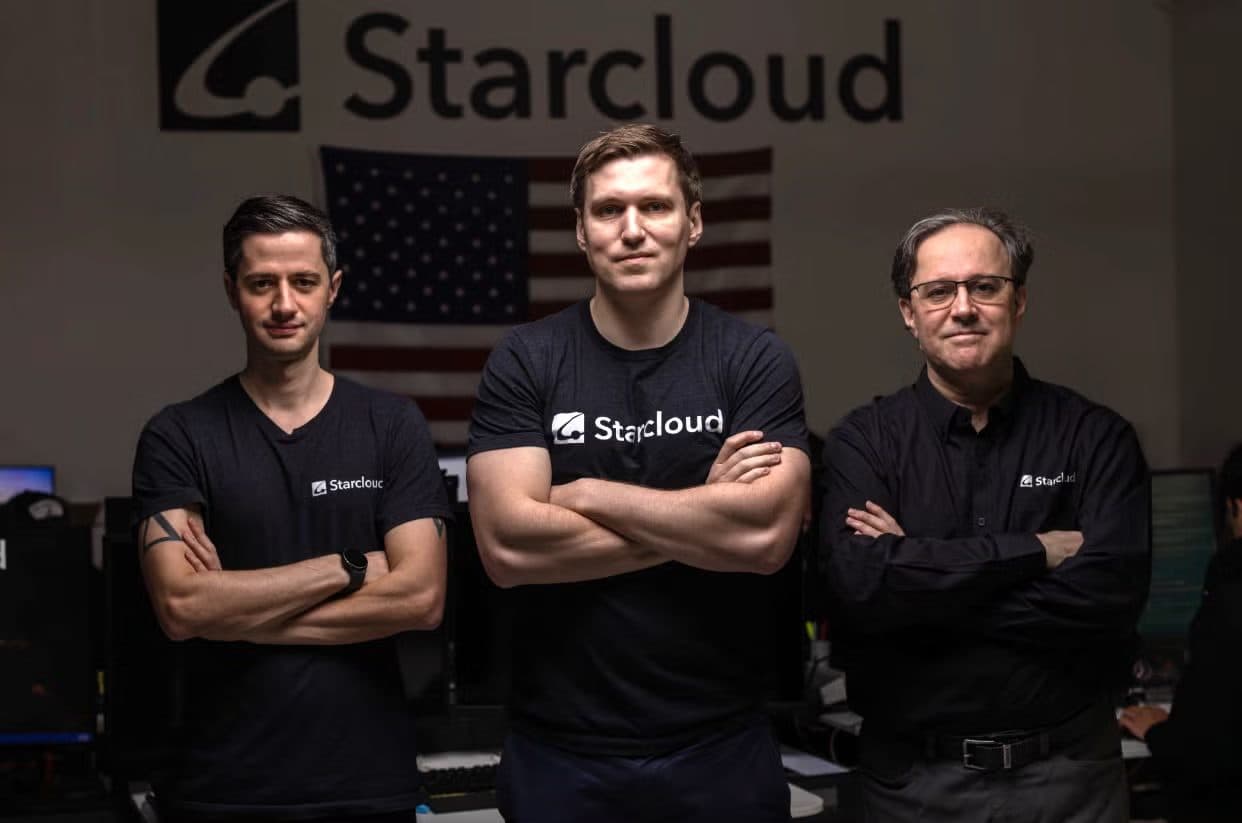
Starcloud, which is building orbital data centres for AI workloads, announced on 21 August that it has added $250m at a $2.3bn valuation. It is not a Series B. It is an extension of the $170m Series A the company raised at a $1.1bn valuation in late March — five months earlier. Total raised since founding in 2024 is $450m.
Who is in
Manhattan West led. Existing investors Benchmark, EQT, Soma, NFX and 776 returned, joined by new backers including Nvidia, Cisco Investments, Cedar Capital, Goanna Capital and Standard Capital. Nvidia's participation is the notable line: the company has been selling into this thesis and is now holding equity in it.
What the common framing gets wrong
Two things. First, the word missing from most headlines is extension — reopening a round is what a company does when it wants capital without submitting to a fresh priced round, and it is a materially different signal from a new lead setting a new mark. Second, "the valuation doubled in five months" compares $1.1bn to a post-money $2.3bn that already contains the incoming $250m. The implied pre-money is roughly $2.05bn, so the step-up is smaller than the doubling framing implies. Third, and largest: the 88,000 satellites and 20 gigawatts of orbital compute are a stated plan, and the constellation figure is the subject of an FCC application — a request, not a licence, not capacity and not funded by this round.
What actually exists in orbit
One demonstration satellite. Starcloud-1 launched in November 2025 carrying an Nvidia H100 — the first data-centre-class GPU put into orbit — and the company says it completed the first orbital AI training run on it. Starcloud-2 is due later in 2026 and Starcloud-3 is intended to fly on Starship. The founding team is chief executive Philip Johnston, chief technology officer Ezra Feilden and chief engineer Adi Oltean.
The constraint is not chips
The bottleneck in the company's own framing is launch allocation, not accelerator supply — which makes this a logistics bet wearing a compute thesis. Twenty gigawatts of orbital compute implies a launch cadence that does not currently exist at any price, and the round funds neither the satellites nor the rockets to that scale. What $250m buys is the next two demonstrators and the time to find out whether the thermal and power engineering works outside a slide.