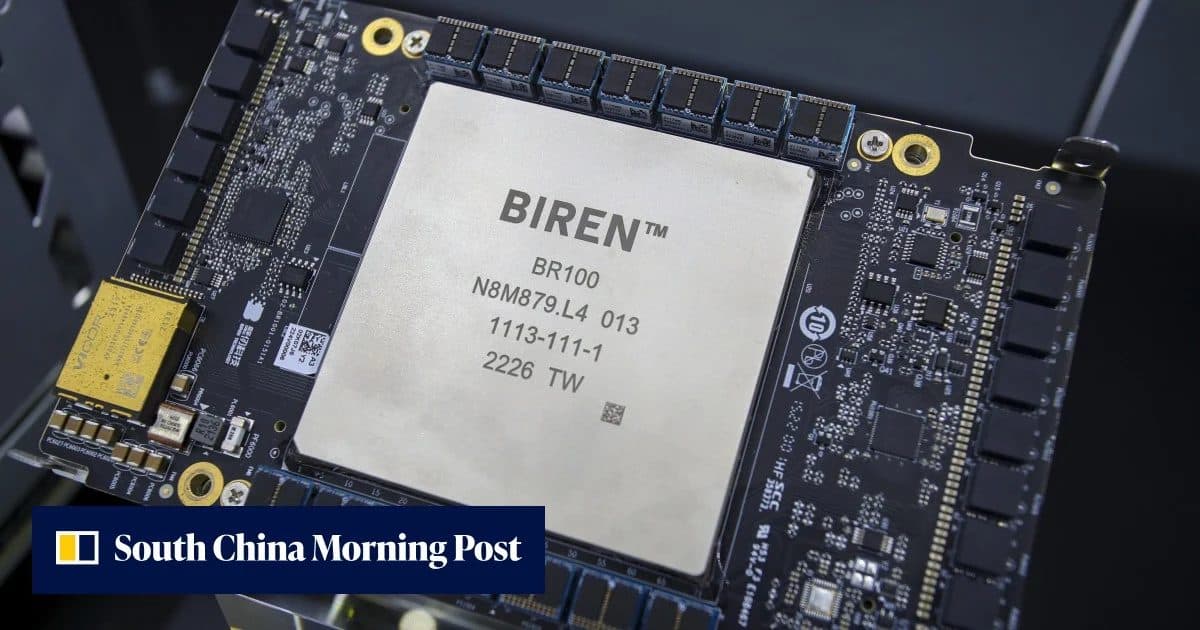
Shanghai Biren Technology, China's most visible domestic challenger to Nvidia in general-purpose GPUs, filed a positive profit alert with the Hong Kong exchange on 17 August. It projects first-half revenue of RMB 1.15bn to RMB 1.30bn, a rise of 1,852% to 2,107% year on year, alongside a continuing loss of RMB 320m to RMB 400m.
The two loss numbers
The filing carries both. Against a prior-year loss of RMB 1,600.5m, the headline loss narrows 75% to 80%. Against a prior-year adjusted loss of RMB 551.6m, the adjusted loss of RMB 290m-360m narrows only 35% to 47%. The gap between the two is share-based payments and listing expenses — one-offs attached to Biren's Hong Kong debut in January 2026.
What the common framing gets wrong
The "22-fold revenue surge" now in every headline is arithmetically correct and economically close to empty. Working backwards from RMB 1.15bn-1.30bn at 1,852%-2,107% growth implies a first-half 2025 base of roughly RMB 55m to RMB 65m — effectively pre-revenue. Biren says as much itself, attributing the increase partly to a "relatively low" revenue base in the prior period. A 22x move off approximately RMB 59m is not evidence of scale.
Second, the two loss figures are being used interchangeably, and they describe different things. The 75%-80% narrowing is flattered by IPO costs that will not recur. The 35%-47% figure is the one that describes the operating business. Coverage quoting only the first is quoting the kinder half of the same filing.
Third, this is a profit alert — a preliminary projection issued ahead of interim results, not audited figures. Every number above is a range. Reporting that Biren "posted RMB 1.3bn" is wrong on both the verb and the precision. And the Hong Kong term itself has tripped up at least one outlet, whose headline had Biren "warning of profit" — which inverts the meaning of a disclosure that exists to flag improvement.
Finally: Biren has not swung to profit and does not claim to. It is still loss-making at both the headline and the adjusted line.
What the company credits
Biren names three drivers: the broader expansion of the AI industry lifting GPGPU demand, accelerating commercialisation as its BIRENSUPA software ecosystem matures and deployments widen, and the base effect it acknowledges directly.
The genuinely new fact
Strip out the multiple and something more interesting remains. This is the first half-year in which a listed Chinese GPGPU vendor has projected revenue in the billion-yuan order at all. Biren is the cleanest public read on whether domestic GPU substitution converts policy enthusiasm into sales. The answer, on this filing: yes — from approximately nothing, and not yet profitably.