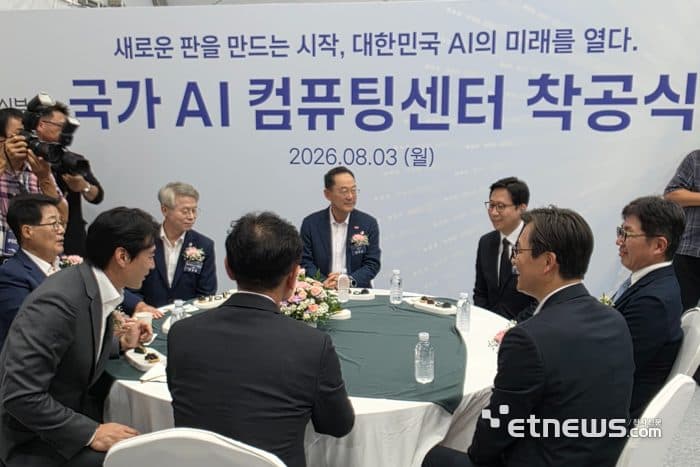
South Korea held the groundbreaking for its National AI Computing Center on the morning of August 3, in the Solar City enterprise development in Haenam, South Jeolla province. The project is valued at 2.5 trillion won and targeted for completion in 2028.
The physical facility
A two-storey building on more than 48,000 square metres, with 40MW of power capacity approved by the utility KEPCO. The chief executive is An Jeong-tae, formerly chief financial officer of Samsung SDS. Completion in 2028 means the facility opens on hardware that has not been chosen yet, in a market that has turned over its accelerator generation twice in the time since the project was announced.
Who actually owns it
The special purpose company is led by Samsung SDS at 30%, with Naver Cloud at 26.1% and government entities — the science ministry, the financial regulator and the National Growth Fund — holding 29% between them. Kakao, KT, Samsung Electronics, Samsung C&T, the provincial and Gwangju governments and the enterprise-city developer also participate. "National" describes the mandate, not the cap table: the state is a minority holder.
Read the megawatts before the won
A 2.5-trillion-won headline invites comparison with American hyperscaler builds. 40MW is roughly one-fiftieth of the gigawatt-class campuses now routine in the United States — this is a national flagship at the scale of a single mid-sized commercial data hall. Reported separately the same morning, the GPU selection is not settled on Nvidia's B200 as has been widely assumed.
The part that is strategic
An area inside the building is reserved for validating domestically developed NPUs. That is a guaranteed proving ground for Korean accelerator designers inside a state-anchored facility — the same lever China used to bootstrap its own chip ecosystem.