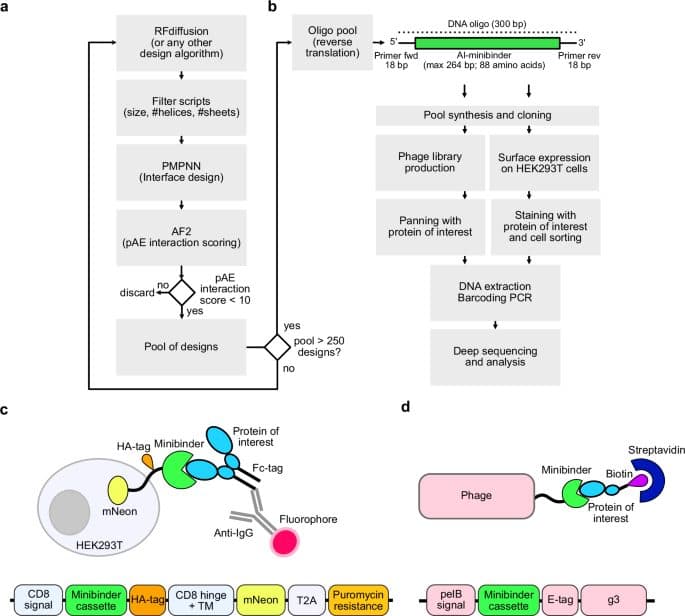
A study published in Nature Communications on 20 August reports a scalable workflow for developing AI-designed minibinders against cancer-associated surface proteins. Screening thousands of designs using mammalian cell-surface display identified several high-affinity binders for PD-L1 but far fewer for CD276 (B7-H3) and VTCN1 (B7-H4) — a result the authors describe as highlighting substantial target dependence.
The part that is actually new
The headline is not the successes but a specific failure. Some minibinders that bound their target well, when built into chimeric antigen receptors, showed poor cell-surface trafficking and limited functionality. Redesigning through a genetic-algorithm diversification strategy that preserved the binding interface while changing non-binding surfaces revealed an isoelectric point window that improved CAR expression and enhanced target-selective tumour-cell killing. The authors state the conclusion plainly: biochemical optimisation beyond the binding interface is a critical requirement for turning AI-designed minibinders into functional applications.
What the common framing gets wrong
"AI designs cancer therapeutics" collapses several distinctions. This is protein engineering in cells, not treatment in patients — no animal efficacy work is reported here, and no clinical programme follows from it. "Designed" also overstates the automation: the workflow is generate-many, screen-many, and the screening is wet-lab work on thousands of candidates, not a model producing a molecule. Most importantly, the target-dependence result cuts against the general claim. A method that yields several strong binders for one protein and markedly fewer for two structurally related ones is not yet a method — it is a method plus an unexplained dependence on the target.
Why the pI finding travels further than the binders
Design models optimise the interface, because the interface is what the objective function scores. This paper shows a molecule can win on that objective and still fail on a bulk property — charge — that no interface metric captures. That is a criticism of the scoring, not of the designs, and it applies to every structure-generation pipeline currently being pointed at therapeutics.