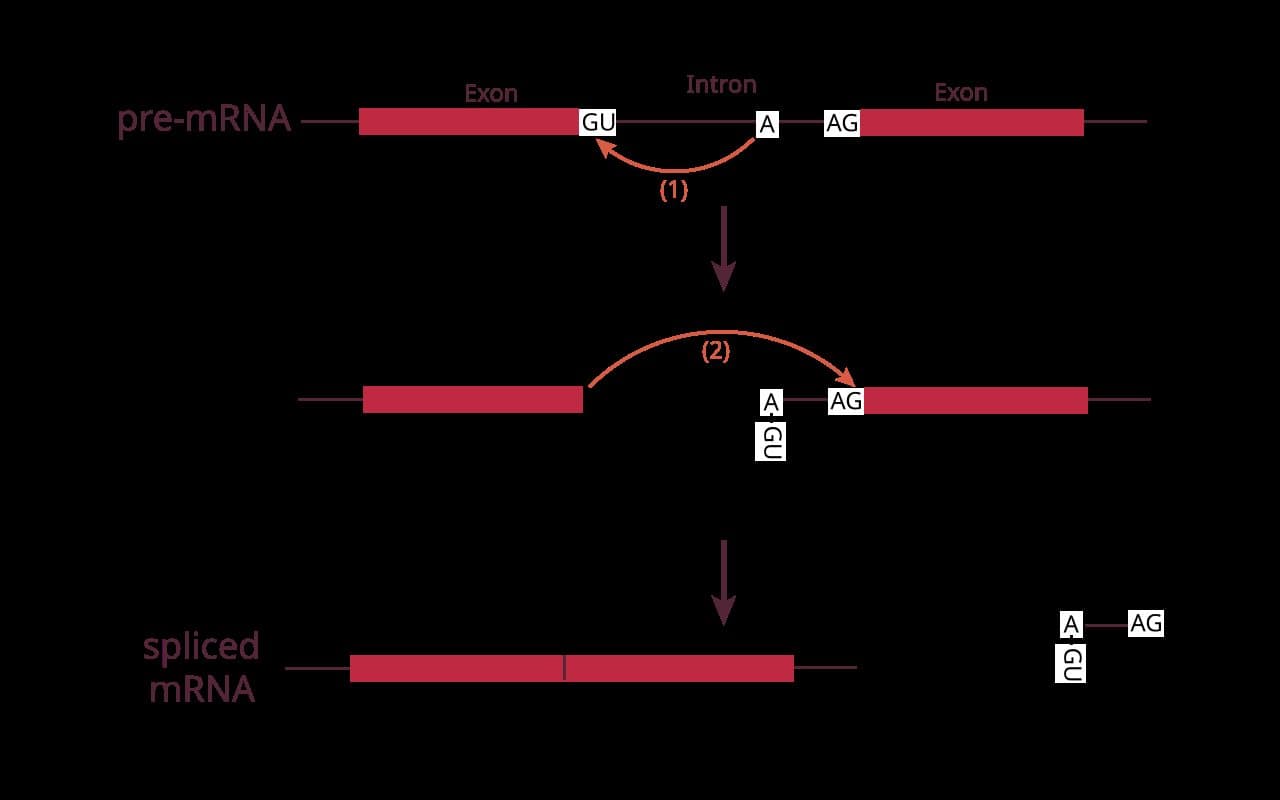
A paper published on 21 August in Genome Biology, which is fully open access, introduces a framework for explaining the prediction logic of deep-learning RNA splicing models through interpretable distillation — training a transparent model to reproduce the opaque one's behaviour, then reading the transparent model. Applied to current splicing predictors, it finds them "suffering from pervasive confounders and blind spots."
What the models turn out to be doing
Three findings. Splicing models recognise exons through surprisingly simple additive combinations of sequence motifs, including known splicing regulatory elements — far simpler machinery than their architecture suggests. They exploit genomic confounders unrelated to splicing. And they fail to adequately capture the effects of RNA structure, which is a genuine mechanism of splicing regulation, not an edge case. The consequence is systematic prediction errors and degraded performance on non-reference sequences.
What the common framing gets wrong
"State-of-the-art performance" is exactly what this paper attacks, and the attack is on the benchmark rather than the leaderboard. Benchmarks in this field are built largely on reference sequences. The models learned shortcuts that survive that benchmark and break on the non-reference sequences that actual patients carry. High held-out accuracy is being read as mechanistic understanding of splicing, and it is not — it is evidence that the model found something predictive in the training distribution, which may or may not be splicing. This is shortcut learning demonstrated at the mechanism level rather than asserted.
Why this is not an academic quarrel
Splicing predictors of this class are not curiosities. Their scores are used to triage variants of uncertain significance in clinical genetics — the decision about whether a genetic variant found in a patient is likely to disrupt a gene. A model that scores well on reference sequence and degrades on non-reference sequence is failing in exactly the population it is being used on.
What it does not quantify here
The abstract states the findings qualitatively; the effect sizes are in the full text, and no magnitude is asserted in this article. The contribution that travels furthest is the method: a framework other groups can rerun against their own models to see what those models are actually keying on. The authors frame the results as illuminating fundamental limitations of training on genomic sequence, and suggest routes past them.