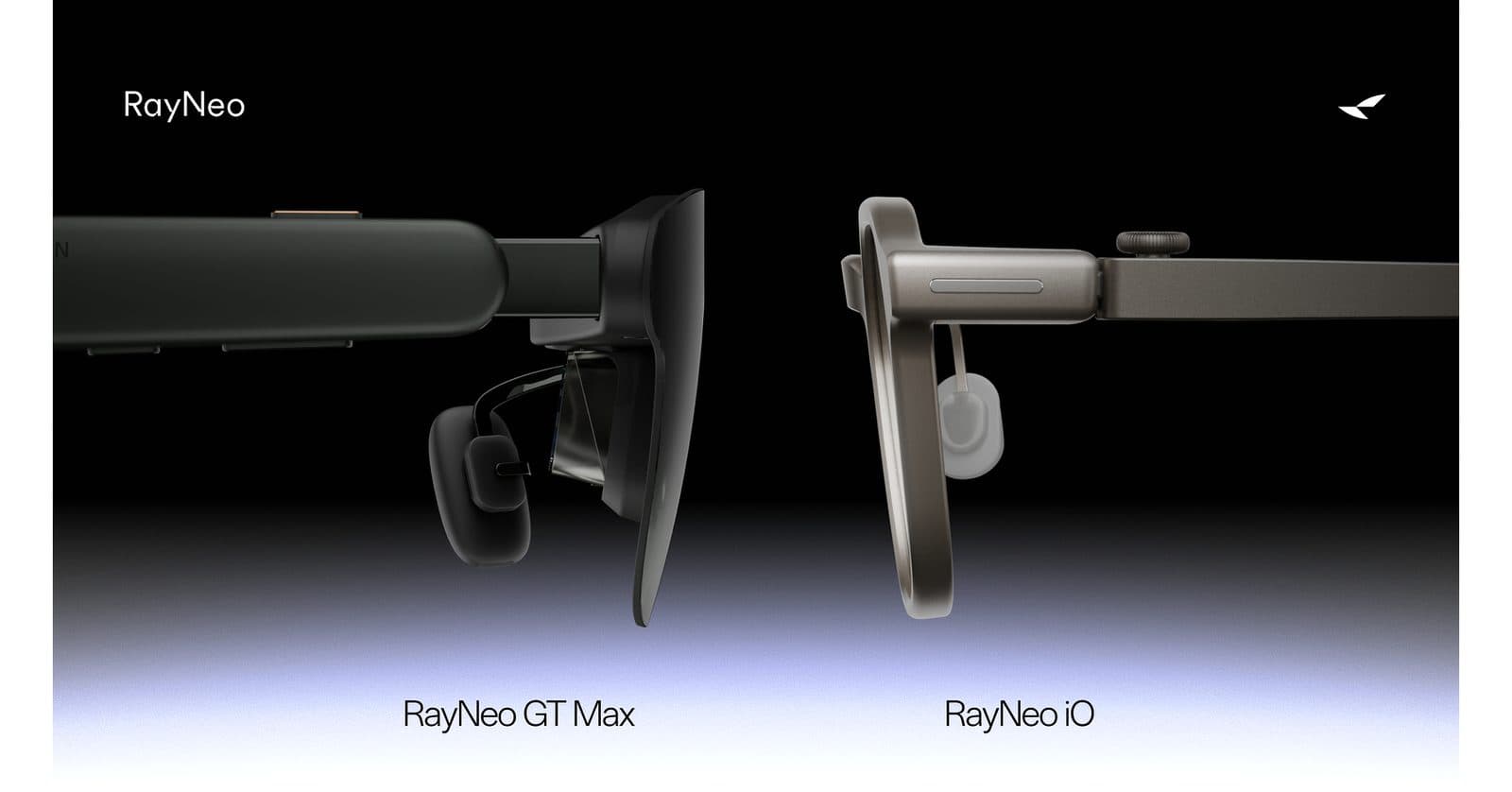
RayNeo announced its iO smart glasses and GT Series in an international release datelined 21 August, 03:00 ET — 07:00 UTC — hours after presenting the same hardware at a launch event in China. Both product lines go on sale 4 September 2026. The iO uses a 0.085cc monochrome green Firefly Nano engine driving a diffractive Blue Lake waveguide at 97% optical transparency, with on-screen text at 1,300 nits eye-level brightness that the company says is invisible to onlookers.
What the glasses do
An Ambient AI Life Log runs in a low-power background tier capturing schedules and conversational context; after meetings it extracts action items and prompts calendar updates, confirmable hands-free with a head nod. Core features are powered by RayNeo AI and Gemini 3.1 Flash Lite, with an optional Multi-Model AI Selection tier that lets users switch between Gemini, ChatGPT, Claude and DeepSeek inside the companion app. Live translation and an auto-teleprompter round out the feature set.
What the common framing gets wrong
Coverage is treating this as one launch. It is two launches of nominally the same product with different specifications and different AI backends per market — the Chinese presentation named domestic models, the international release names Gemini 3.1 Flash Lite. The brightness figures quoted in the two markets differ materially, which means the "same" glasses are not the same glasses. Second, the international release contains no price. The dollar figures circulating in coverage are not in the document, and they sit well above the Chinese first-sale price. Third, the intelligence here is rented, not built — a model-selection dropdown is a licensing arrangement, and it changes at the border.
The category question
Smart glasses are the clearest case of AI capability being a commodity input rather than a differentiator. When the same hardware ships with whichever frontier model is locally available, the product is the waveguide and the battery, and the AI is a supplier relationship.