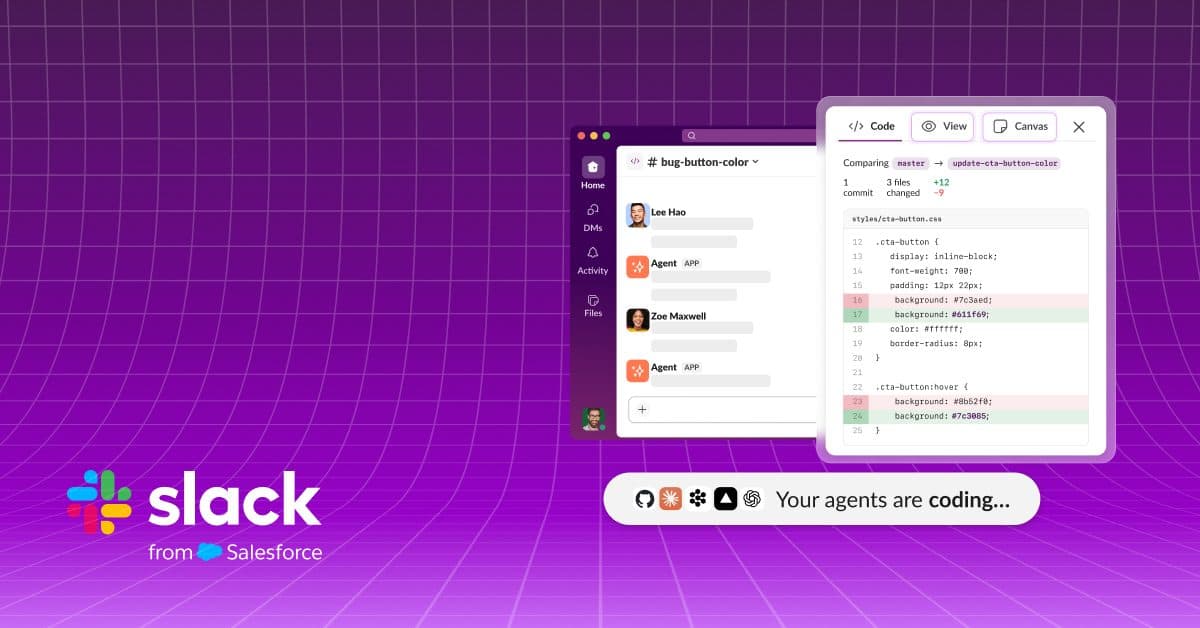
Slack announced Slack Code on 20 August: mention a coding agent on a piece of work and a dedicated code channel spins up around that task, visible to the whole team rather than to the person who invoked it. The channel renders code diffs, planning documents and live HTML previews inline, pulls in colleagues, and archives itself when the work is finished while remaining searchable as a record. Launch partners are Anthropic, Cognition, GitHub, OpenAI and Vercel, with GitHub Copilot operating inside the channels.
The argument being made
Slack's framing is that agent-assisted development has regressed to single-player. Someone opens a private tab, prompts an agent, disappears, and the team discovers the result after the fact with no chance to catch a wrong assumption. The company describes hitting this internally: multi-turn agent execution was too noisy for an ordinary channel thread, but letting engineers retreat to browser tabs lost the visibility that makes Slack useful. Code channels are the answer — a space that expands with the task and disappears after it.
What the common framing gets wrong
The post carries exactly one number: over 70% of code channels spin up and close within a single day, idea to merged pull request. That figure is being repeated as a product result. It is not — it describes Slack's own engineering team dogfooding the feature, with no denominator, no baseline for how long the same work took before, and no external customers in the sample. Second, "enterprise trust, no extra setup" refers narrowly to permissions and admin controls, which Slack Code inherits from Slack. It does not mean the agents are included: the work is done by Anthropic, OpenAI, Cognition, GitHub and Vercel models, each of which is separately licensed and separately metered.
Where this sits
The interesting claim is not technical but organisational — that the reviewable unit of agent work should be the conversation rather than the pull request, and that an archived channel is a better audit log than a commit history. That is a bet about how teams will want to supervise agents, and it will be settled by whether anyone outside Slack reproduces the 70%.