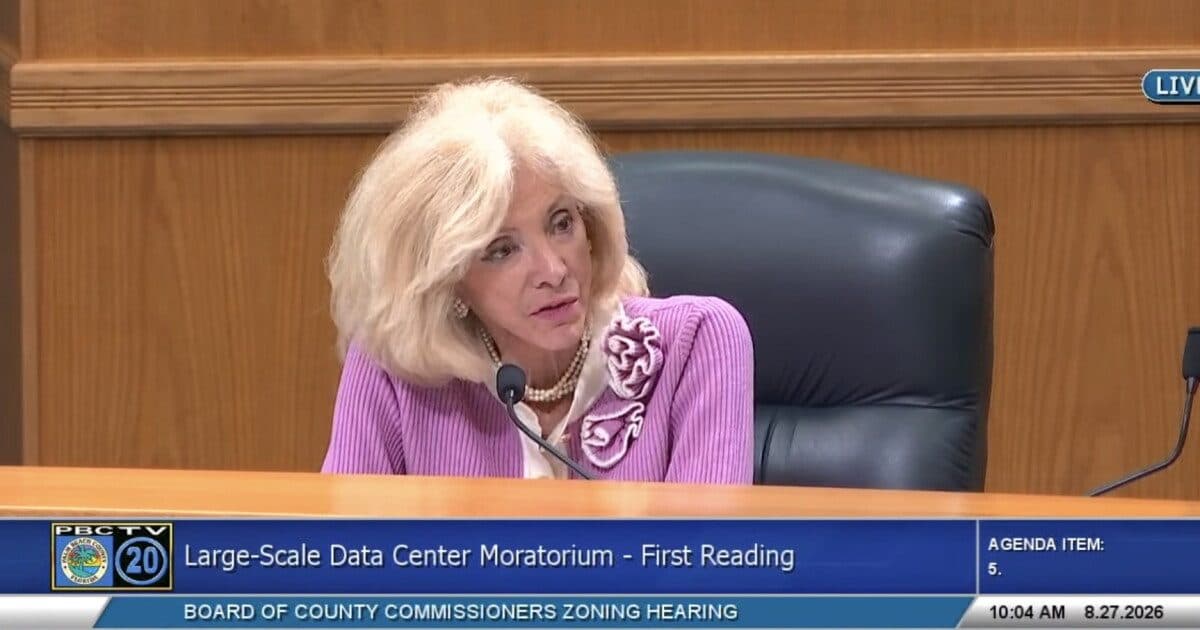
Palm Beach County commissioners voted 7-0 on Thursday 27 August to advance a one-year moratorium on new large-scale data centres. The classification threshold is facilities "expected to use 50 megawatts or more at peak demand." The immediate trigger was Project Tango, a campus that "requested 600 megawatts of power" and was rejected.
The provision that does the work
The county "will evaluate power usage across entire property sites rather than parcel-by-parcel." That is the anti-splitting rule, and it is the reason this ordinance is more than symbolic: developers in other jurisdictions have routinely stayed under a threshold by carving one campus into several applications. The package also carries landscape buffers, separation requirements, sound studies and utility coordination.
What the common framing gets wrong
Headlines read "county halts AI data centers." What happened was a unanimous first reading. The ordinance has no legal force until the second vote on 24 September 2026, which one local outlet describes as only tentatively scheduled — and that interval is exactly the gap developers file applications into.
Second, a moratorium on filings is not a moratorium on power. The 50 MW peak-demand definition governs land use. Projects already in the county's pipeline are untouched, anything under 50 MW is untouched, and the county controls zoning — it does not control the utility's interconnection queue.
Third, the 600 MW was a request, not a connection. It was a developer's asked-for load in an application the county turned down: announced megawatts, never contracted, never energised. It is being repeated as though 600 MW was about to be built.
The problem underneath
Florida law allows developer anonymity for up to one year. Commissioners therefore voted on a load they cannot attribute to a named end user — they know the megawatts and not the buyer. Commissioner Marci Woodward, on the timetable: "A year could fly by pretty quickly, and so I don't want to be at the end of this trying to cram it into another 12-hour meeting."
One correction worth carrying: a local write-up states commissioners acted "on Tuesday." 27 August 2026 was a Thursday, and two other outlets place the vote on Thursday the 27th.