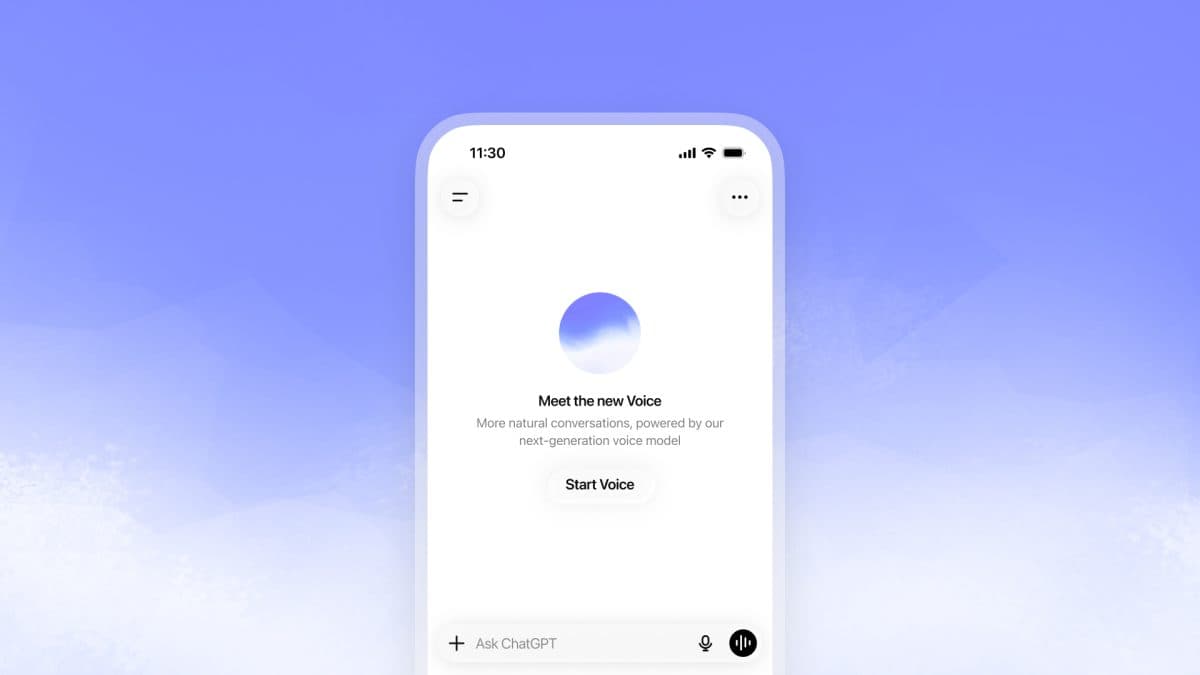
OpenAI is rebuilding how ChatGPT talks. On July 8 the company introduced GPT-Live, a pair of voice models — GPT-Live-1 for paid Go, Plus and Pro users and GPT-Live-1 mini for the Free tier — that listen and speak at the same time instead of taking turns. It replaces Advanced Voice Mode as the default and is rolling out globally on iOS, Android and ChatGPT.com "over the next few days."
Full duplex, explained
The core shift is architectural: GPT-Live continuously processes what it hears while generating speech, making decisions "many times per second" about whether to talk, keep listening, pause, interrupt or call a tool. It offers natural acknowledgments — "mhmm," "got it," "yeah" — handles interruptions, and can be asked to slow down. OpenAI remastered ChatGPT's nine voices for the system and added three reasoning levels: Instant, Medium and High.
The delegation trick
GPT-Live is tuned for fast, natural conversation, so when a request demands web search, deeper reasoning or agentic work, it hands the task to GPT-5.5 in the background and keeps chatting while the computation runs, then folds the result back in. It also surfaces visual cards for things like weather, stocks and sports. What it doesn't do at launch: voice-plus-video, screen sharing, desktop or Codex, and Business, Enterprise and Edu tiers wait for a later phase.
Safety for a new modality
OpenAI published a dedicated GPT-Live System Card. Inputs and outputs are checked as the conversation unfolds; when something risky surfaces, the system can steer or interrupt a response, play a spoken safety message, offer text-based support resources, or end the call in higher-risk cases. Red-teaming spanned impersonation, speaker identification, child-coded voice, self-harm, emotional reliance and scams. OpenAI says the models are "not positioned as an AI companion."
Reception
More than 150 million people already use ChatGPT's voice features, and OpenAI's own evals show GPT-Live "strongly preferred" over Advanced Voice Mode in matched conversations, at roughly a 75% preference rate. "Voice can be the future interface to all kinds of work," said ChatGPT Voice lead Atty Eleti. Not everyone is sold: some early users griped that the constant "mhmm" filler is verbose and grating. An API version is listed as "coming soon," with no pricing yet.