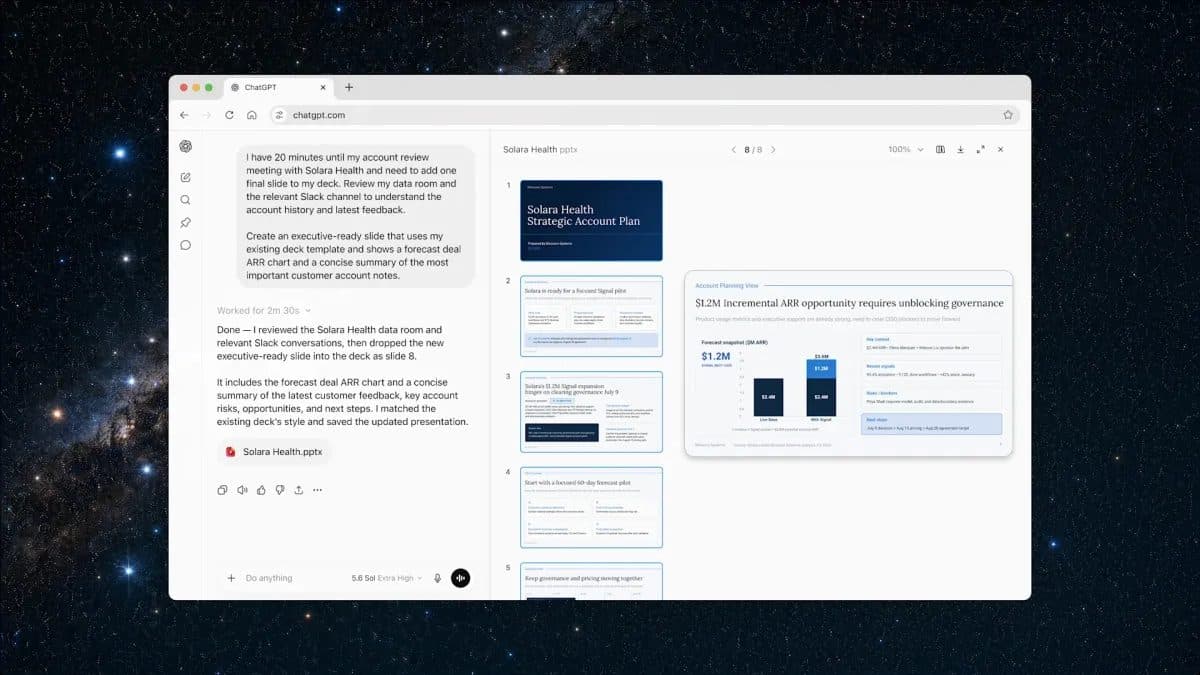
OpenAI spent July 9 adding a product and subtracting one. It launched ChatGPT Work, an agent aimed at people who do not write code, and confirmed it is shutting down Atlas, the standalone browser it shipped only nine months ago.
What ChatGPT Work does
The new mode fuses ChatGPT with Codex, OpenAI's coding agent, and points that machinery at office work. It pulls context from connected apps and files, then — in OpenAI's description — can "understand a user's overall goal, create a plan, use different workplace apps, and complete complex assignments with very little human guidance," producing documents, reports, spreadsheets, presentations, and websites it can host and publish directly. It runs on GPT-5.6, released the same day in Sol, Terra and Luna variants. "You can apply the model's ability to code to solve problems across every industry," said product manager Ty Geri. Altman told CNBC the new model is 54% more token efficient on agentic coding tasks.
Who gets it
ChatGPT Work is live on the new desktop app for every plan. On web and mobile it starts with Pro, Enterprise and Edu, reaching Plus and Business "in the coming days." The target is unmistakable: Anthropic's Claude Cowork, which launched in January with the same pitch — coding-agent capability for people who never open a terminal. The architectures differ. Cowork works against local file systems; ChatGPT Work leans on a cloud browser to act online.
And Atlas is gone
Atlas launched in October 2025 as a browser with ChatGPT at its core. Reporting puts its deprecation at August 9. OpenAI's conclusion is that a browser is a capability, not a destination, so Atlas's features are being scattered across three surfaces: a new Chrome extension that reads page context, summarizes and answers questions — landing directly opposite Google's Gemini Side Panel — an upgraded desktop app that can browse, sign in and download files without leaving ChatGPT, and a remote cloud browser so agents can work server-side on a user's behalf.
The 'side quests' cull
Atlas is the second casualty of a consolidation push associated with Fidji Simo, who said OpenAI had become "distracted by side quests" and that "fragmentation has been slowing us down and making it harder to hit the quality bar we want." The Sora standalone app died in March under the same logic. The timing is its own commentary: Simo announced her own departure from the No. 2 job hours later the same day.