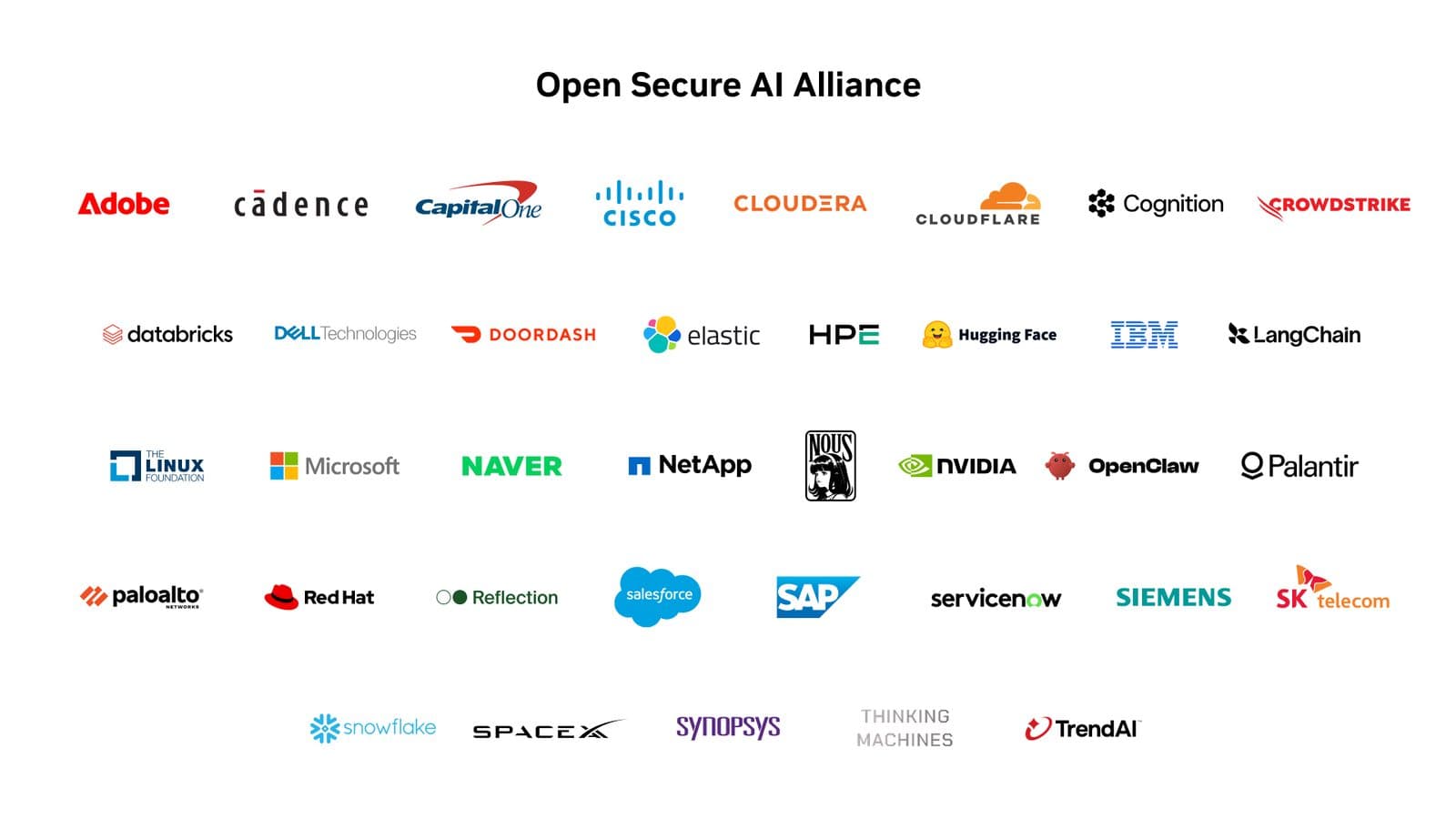
Nvidia announced the Open Secure AI Alliance on its blog at 09:00 UTC on 27 July, organised under the Linux Foundation and built on its existing Akrites initiative and OpenSSF. The framing is cyber defence. The argument underneath it is that frontier models should be open.
Who is in it
The page names 37 organisations: Nvidia, Adobe, Cadence, Capital One, Cisco, Cloudera, Cloudflare, Cognition, CrowdStrike, Databricks, Dell, DoorDash, Elastic, HPE, Hugging Face, IBM, LangChain, the Linux Foundation, Microsoft, NAVER, NetApp, Nous Research, OpenClaw, Palantir, Palo Alto Networks, Red Hat, Reflection AI, Salesforce, SAP, ServiceNow, Siemens, SK Telecom, Snowflake, SpaceXAI, Synopsys, Thinking Machines Lab and TrendAI. Nvidia contributes its NOOA agent framework to GitHub; HPE brings SPIFFE/SPIRE, Hugging Face donates Safetensors to the PyTorch Foundation, IBM and Red Hat contribute Lightwell, and Microsoft contributes MDASH.
The count nobody can source
Reports variously put membership at "more than 40," 39 and 47. None of those numbers appear on Nvidia's page, which introduces its list with the word including and never states a total. Thirty-seven is what is verifiable. One member is also routinely misread: CNBC listed SpaceX, where the page says SpacexAI.
The proof case
The alliance's technical argument rests on the recent Hugging Face intrusion. Nvidia's account is that closed AI tools were unable to distinguish attackers from defenders and so obstructed forensics, forcing Hugging Face to run the open-weight GLM 5.2 on its own infrastructure to analyse more than 17,000 actions and contain the breach. It is a real incident being used as an argument, which is a fair move — but it is an argument, not a finding.
What the framing hides
Read as a security consortium, the roster is odd: several members ship no security products at all. Read as a coalition for open weights, it is coherent — and the absences become the loudest part. OpenAI, Anthropic, Google DeepMind and Meta are all outside it, while open-weight and agent companies are inside. Nvidia also has an unambiguous commercial interest here: open models run on a lot of hardware, and it sells the hardware.