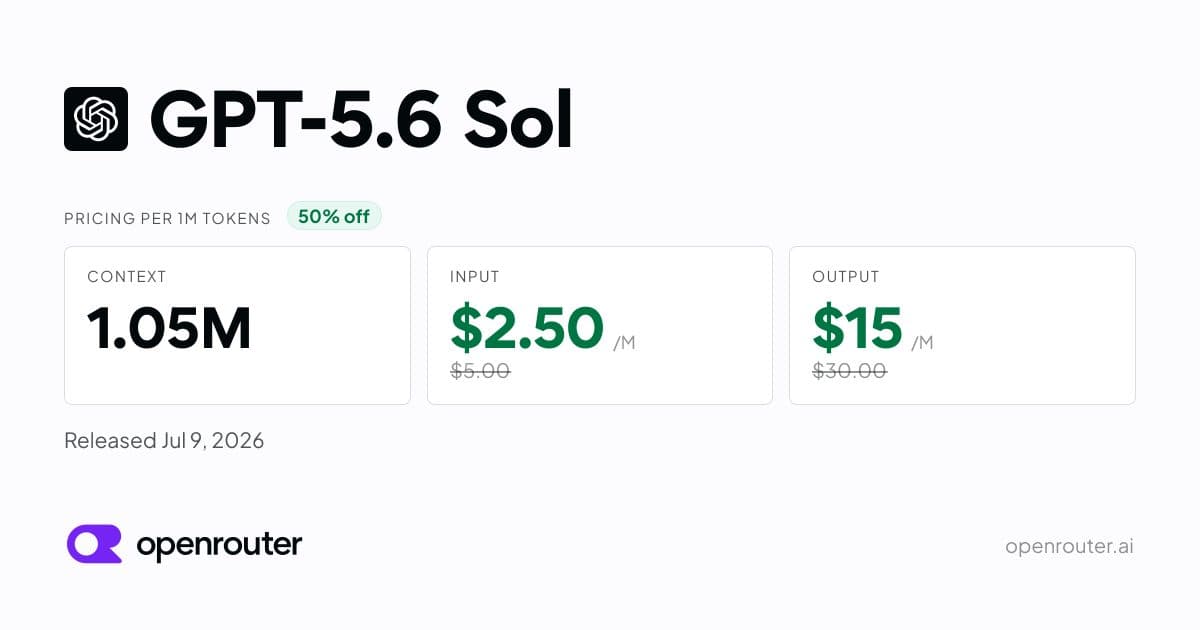
A claim that GPT-5.6 Sol had been cut in half in price circulated widely on 17 August. It is half right in a way that matters for anyone budgeting inference. OpenRouter is serving the model at $2.50 per 1M input tokens and $15 per 1M output, displayed with a 50% off badge against struck-through prices of $5.00 and $30.00. Those struck-through numbers are still OpenAI's real prices.
What the two price cards say
OpenAI's developer pricing page, checked directly, lists GPT-5.6 Sol at $5.00 input and $30.00 output per million tokens. For reference the same page lists Terra at $2.00/$12.00 and Luna at $0.20/$1.20. No discount or promotion is mentioned anywhere on it. The only special pricing structures OpenAI publishes are the standard ones: batch, flex and fast tiers, cached-input rates, and a 10% uplift for regional processing endpoints.
What the common framing gets wrong
"OpenAI cuts GPT-5.6 Sol prices by 50%" is wrong on scope and probably on duration. On scope: this is a promotion at a gateway, not a change to the model's list price. Anyone calling OpenAI's API directly, or through any other route, still pays $5 and $30 — nothing about the cost of the model has changed. On duration: OpenRouter's page shows the discount but states no end date, and the promotion does not appear on OpenRouter's own announcements page. A discount with no published expiry is not a repricing, and a spend forecast built on $2.50/$15 has an unknown cliff in it.
Why a discount would sit at the gateway
Gateways are where buyers actually price-compare. A developer choosing a model on an aggregator sees Sol next to every competitor with the per-token cost printed beside each one; a developer reading OpenAI's own documentation does not. Discounting inside the venue where substitution happens buys share at the decision point, while leaving the published price — the number enterprise contracts and analyst models are anchored to — untouched.
The consequence for the cost curve
The standard claim that inference costs fall by some percentage a year is computed from list prices. If the real transaction price increasingly depends on which venue a request is routed through and which promotions are live that month, list price stops being a reliable measurement of anything. Two developers running identical workloads on the same model can now be paying twice different amounts, and neither price is wrong.