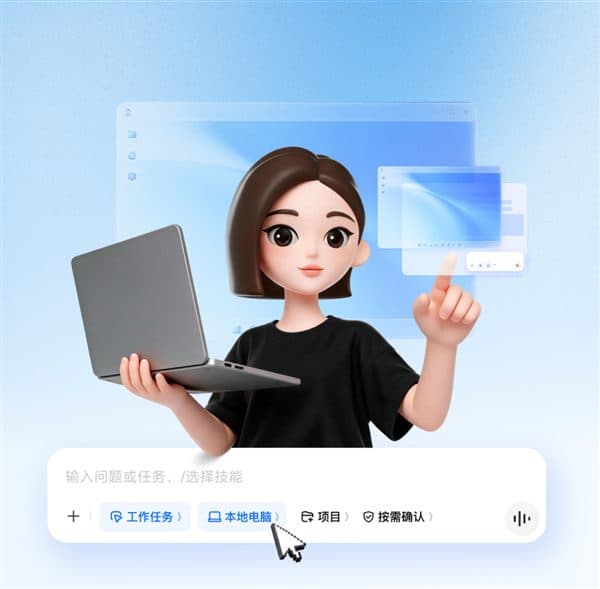
ByteDance announced on 18 August that Doubao's work-task mode now includes a Virtual Desktop on the Windows client, letting the assistant see the screen and operate mouse and keyboard across arbitrary applications. Users reach it by selecting work-task mode, then the local computer, then "operate computer" from the skills bar, and granting authorisation.
The mechanism, in ByteDance's own words
The company describes it as running on generic GUI capability: 豆包虚拟桌面基于GUI能力运行,即使没有MCP、API、插件或CLI,也能直接识别软件界面并完成操作 — it recognises software interfaces and completes operations directly, even where no MCP server, API, plugin or command-line interface exists. The differentiating property is stated just as plainly: 虚拟桌面运行时不会占用用户当前正在使用的鼠标和键盘,也不会打断现有工作 — while it runs, it does not occupy the mouse and keyboard the user is currently using, and does not interrupt existing work. Users can watch the steps live, pause, or take over directly. The company's worked example is pulling résumés from a local folder into a candidate-registration system.
What the common framing gets wrong
Two errors are already circulating. The first conflates this with a different Doubao feature shipped one day earlier — phone-to-PC remote control. They are separate releases on consecutive days. The second reads "virtual desktop" as a cloud VM. It is described as an isolated session on the user's own Windows machine, which is precisely why the mouse-and-keyboard property needs stating at all: a cloud sandbox would never have been competing for local input devices in the first place.
The absence of integrations is a security posture, not just a capability
"No MCP, no API, no plugins" is presented as a boast about coverage, and as coverage it is real: pixels and clicks generalise to software that exposes no integration surface at all. But it also means the agent inherits whatever authority the logged-in Windows user has, gated by a single up-front authorisation. No granular permission model is described on any of the pages announcing it, and no benchmark, user count or price is stated either.
Why this ships in China first
Computer-use agents have been demonstrated far more often than they have been shipped. Putting one into a mass-market consumer assistant makes GUI control a default-on feature for ordinary users rather than a developer preview — and it routes around the entire tool-integration race, where US labs are competing on how many systems expose an API to the model.