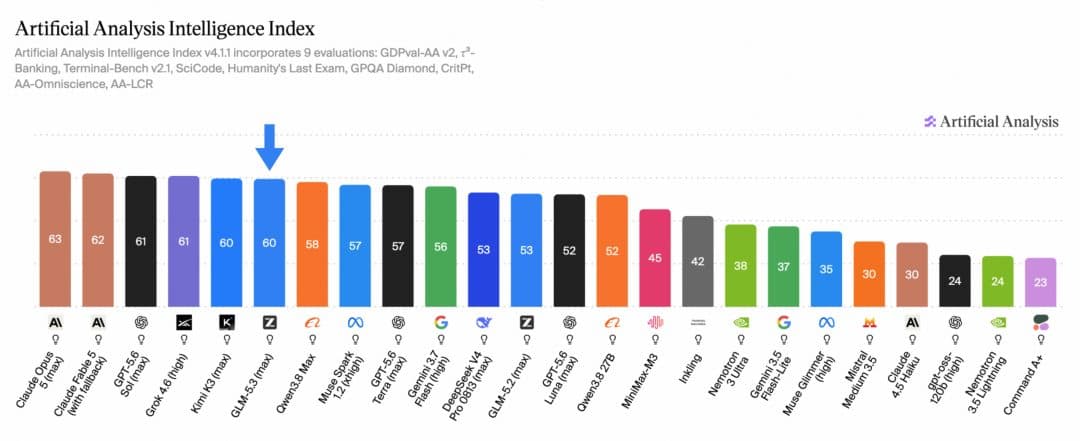
Zhipu opened API access to GLM-5.3 in the small hours of 19 August China time, with Securities Times reporting it at 10:37 CST — 02:37 UTC. The company claims a score of 60 on the Artificial Analysis Intelligence Index, which it describes as entering the frontier band and approaching closed flagships including Claude Fable 5 and GPT-5.6 Sol.
The claims
API pricing is stated as unchanged from GLM-5.2. Zhipu attributes the improvement almost entirely to post-training on the same base as its predecessor rather than to a larger model. The documentation lists a 1M-token context and 128K maximum output.
What the common telling gets wrong
GLM-5.3 is already being described as the leading open model, or as tied for it. It is not an open model yet, because there are no weights. We queried the HuggingFace API directly rather than take this on trust: the zai-org organisation has no GLM-5.3 repository at all, and its most recent published weights are still GLM-5.2, last modified on 2 July. What shipped this week is a hosted API and a subscription plan. The company says weights follow on 28 August.
That distinction matters more than usual here, because an open-weights ranking that credits a model nobody can download is measuring a promise. It is also a promise that has already moved once: at the GLM-5.2 launch on 14 August the weights were said to be coming "within two weeks." And no licence has been stated — "open weights" covers everything from Apache 2.0 to a custom licence forbidding commercial use, and which one applies is not yet public.
The unverifiable price
"Pricing unchanged" cannot be checked either. No per-token figures were published alongside the claim, and the associated coding plan is a points quota with an off-peak discount rather than a straightforward rate card. A points allocation can be repriced without any published number changing.
Why the sequencing is deliberate
Launching the API first and the weights nine days later captures the benchmark coverage and the paying API traffic while the attention lasts, then releases the weights into a news cycle that has already moved on. It is a rational sequence — but it means the headline and the artefact arrive on different days, and only one of them can currently be verified.