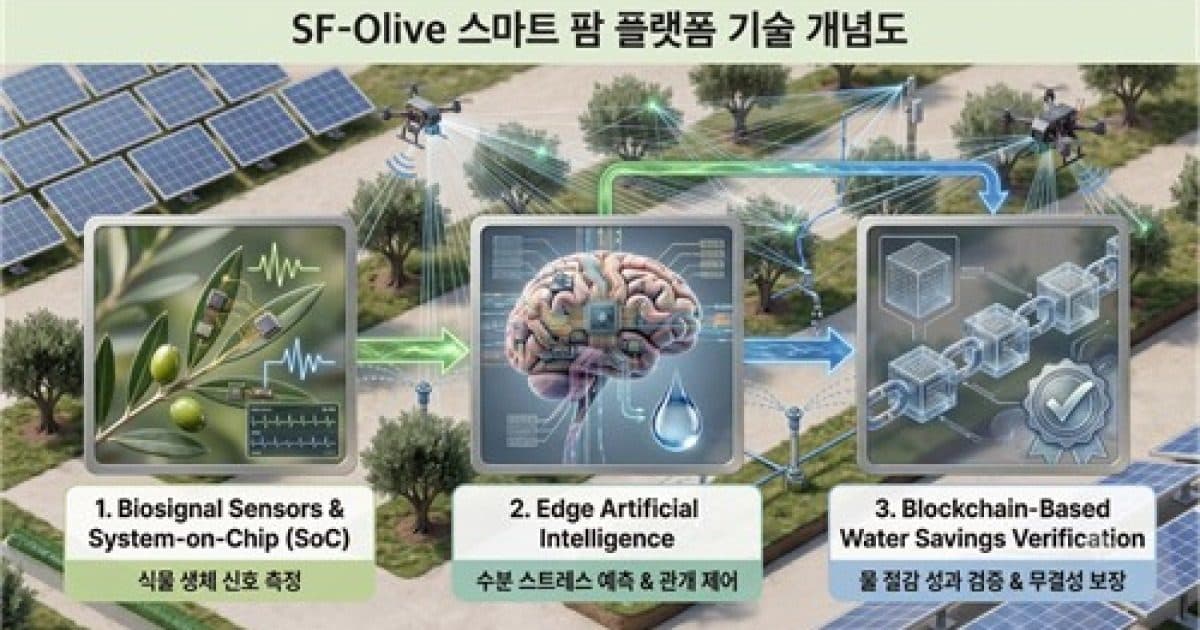
A consortium spanning Korea and Spain has begun work on SF-Olive, a smart-farming platform that tries to measure crop water stress by reading the plant itself rather than the ground around it.
How it works
Conventional precision irrigation infers thirst from proxies — soil moisture, weather, satellite imagery. SF-Olive uses ultra-low-power semiconductor sensors to measure electrical biomarkers directly from olive stems and leaves, with edge AI running on the device judging water stress within 0.1 seconds and no cloud connection required. Blockchain is used to certify data integrity for organic certification and carbon-credit verification.
Who is building it
The Korean side is led by R&NS Lab with KAIST and Social Infrastructure Tech; the Spanish side by Magtel Operaciones with ITERIAM and BrioAgro. It was selected under the 2026 International Joint Technology Development Project of Korea's Ministry of Trade, Industry and Energy and KIAT. The testbed will run on water-scarce olive farms in Andalusia.
A start, not a result
This is the beginning of a government-selected research programme running to 2033. The headline environmental figures — 2.4 million cubic metres of water and 150-200 tons of CO2 saved annually — are projections for the end of that period, not measurements. No product ships, and the budget was not disclosed.
Watch the framing
At least one report has already described this as installing a blockchain smart farm. Development is beginning; nothing has been installed.
Why olives, and why now
Andalusia produces a large share of the world's olive oil and has spent recent years in structural drought. Plant electrophysiology plus on-device inference is a genuinely different approach from the soil-probe status quo — and cheap enough per tree, if it works, to deploy across a grove rather than a research plot.