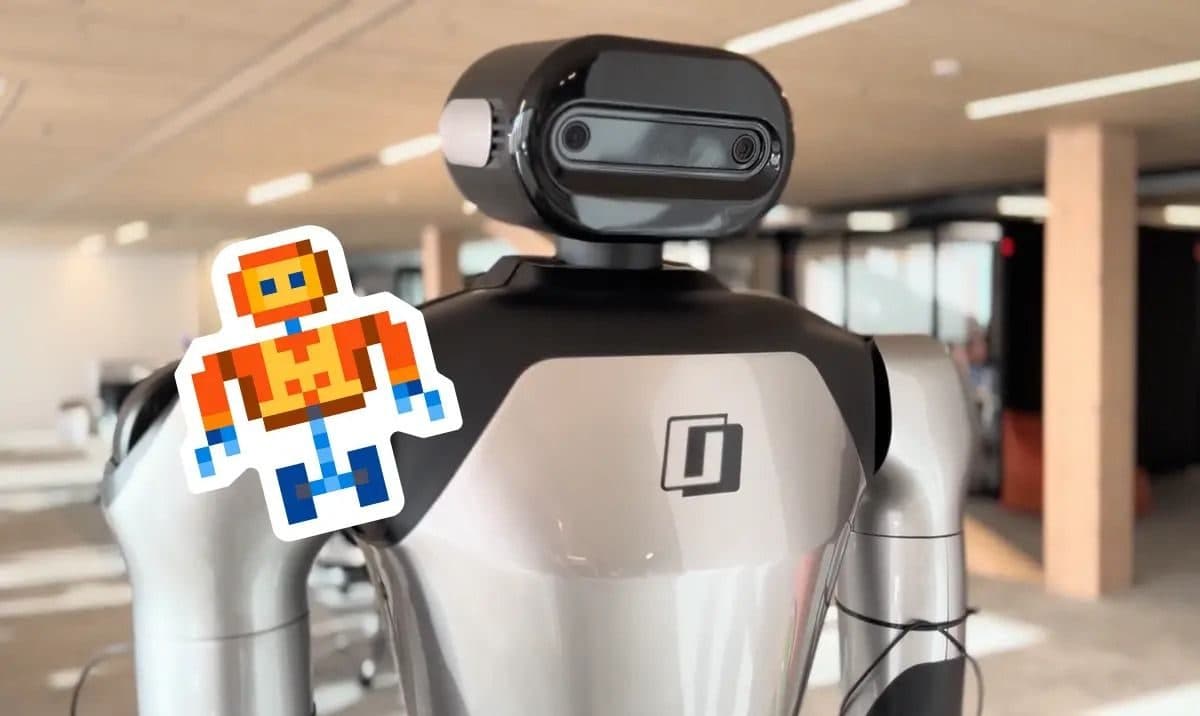
Mistral AI released Robostral Navigate on July 8, 2026, an 8-billion-parameter navigation model that guides a robot using nothing more than a single ordinary camera — the French lab's first move into physical AI.
One camera, no map
The model takes an RGB image plus a plain-language instruction — for example, "leave the lobby, walk through the corridor, enter the supply room, stop facing the second shelf" — and outputs either a pointing coordinate in the current camera view or a local displacement-and-orientation command. It requires no lidar, no depth sensors, no multiple cameras and no pre-built map, a deliberate contrast with the sensor-heavy stacks that dominate robot navigation.
Beating heavier rigs
On the R2R-CE (Room-to-Room, Continuous Environments) benchmark, Robostral Navigate hit a 76.6% success rate on the validation-unseen split and 79.4% on validation-seen. Mistral says that beats the best prior single-camera approach by 9.7 points and outperforms systems that rely on depth sensors or multiple cameras by 4.5 points — while using markedly less hardware.
Trained entirely in simulation
Rather than fine-tuning an existing open model, Mistral built the system in-house, initializing it from its own vision-language model and training it purely in simulation on roughly 400,000 trajectories across 6,000 scenes — with no real-world data collection. A prefix-caching method cut training tokens by 22x, and an online reinforcement-learning stage using the CISPO algorithm added a further 3.2 points of success rate. The result generalizes across wheeled, legged and flying platforms, and across different robot sizes and camera intrinsics, without retraining.
Where it goes next
Mistral is targeting manufacturing, delivery, logistics and hospitality, and says the model is currently available to select partners in those sectors. Notably, the company has not stated a license or confirmed open weights — a departure worth watching from a lab whose brand was built on permissive open releases. Bloomberg first reported the launch on July 8 as part of Mistral's broader push into physical AI.