The AI coding market is crowded with tools for developers. Emergent raised $130 million by selling to everyone else. Announced July 15, the Series C values the Bengaluru company at $1.5 billion post-money — five times its $300 million Series B from January, six months earlier.
The round
The round is co-led by Creaegis with MNI Ventures-Claypond Capital and Sentinel Global, joined by existing backers Khosla Ventures, SoftBank's Vision Fund 2, Lightspeed and Y Combinator. It brings total funding to $230 million across a $7 million seed in 2024, a $23 million Series A in September 2025, an undisclosed check from Google's AI Futures Fund in December, the January Series B and now this. Emergent is India's third AI unicorn and seventh unicorn overall of 2026.
Who it is for
The positioning is the whole story. Emergent targets non-technical entrepreneurs and small businesses, not engineers — roughly 70% of its users have never written code. Where Cursor, Claude Code and Codex serve developers, Emergent ships integrated testing, debugging, deployment, hosting, versioning and monitoring, aiming at production software rather than prototypes. Its closest comparison is Replit. It uses separate AI agents to review generated code and catch hallucinations — the perennial failure mode when the user cannot spot a bad diff themselves.
The numbers
Emergent reports $120 million in annualized run-rate revenue, up 70% in four months, with more than 200,000 paying customers and over 12 million apps built since its public launch in June 2025. Headcount is about 200, mostly in Bengaluru with a handful in San Francisco. A second product, Wingman, launched in April as a personal AI agent for task automation beyond coding.
The founders' pitch
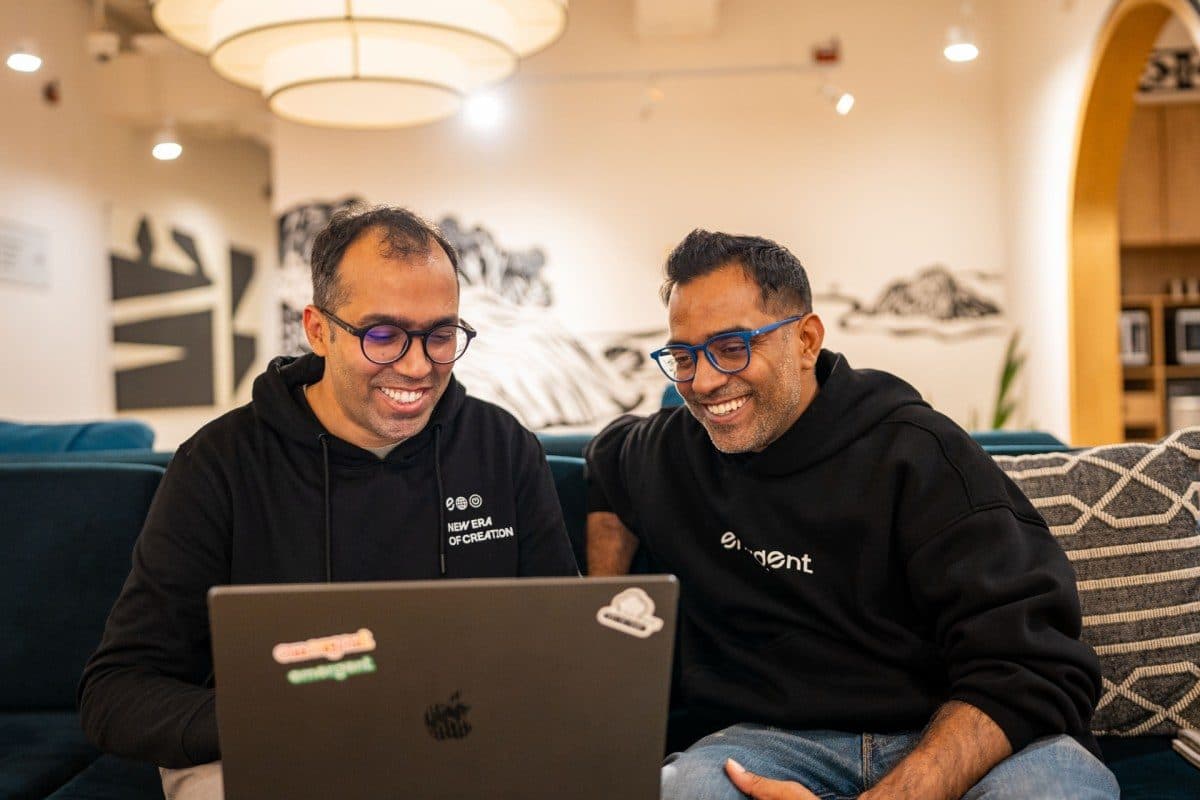
Emergent was founded by brothers Mukund Jha, co-founder and CEO, and Madhav Jha, co-founder and CTO. "You're basically getting an engineering team in a box," Mukund Jha told TechCrunch. In the announcement he framed the wager more broadly: "The real impact of the AI revolution will be a complete democratization of who gets to build software and how much it costs." Creaegis managing partner Prakash Parthasarathy said small businesses "have a historic moment to build, automate, and operate using autonomous platforms."