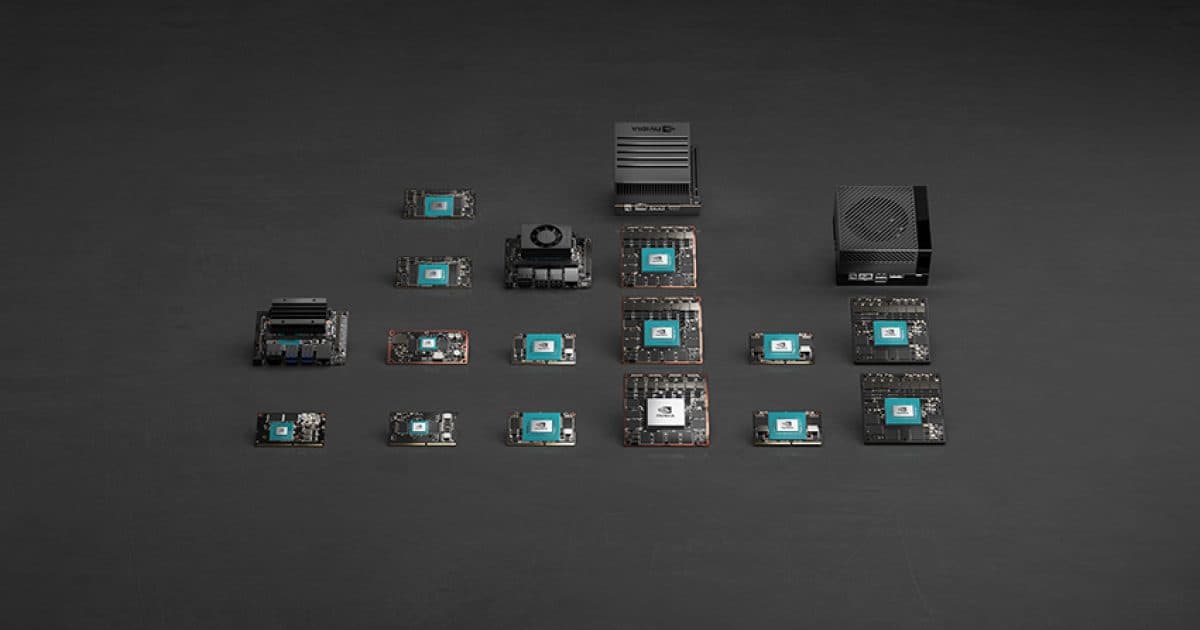
Nvidia briefed press on Tuesday about the Jetson Orin Nano 2, a robotics and edge module marketed as delivering twice the inference performance of the Jetson Orin Nano Super it succeeds. The claimed figure is 78 TOPS.
The arithmetic against Nvidia's own page
Nvidia's published specification table lists the Orin Nano Super 8GB at 67 sparse-INT8 TOPS. Against that, 78 TOPS is an increase of 16.4%. Whatever produces a doubling — and software, memory bandwidth or a shift in the quantisation used for the comparison could each contribute — it is not the raw compute number in the headline, and the briefing did not reconcile the two.
What the common framing gets wrong
"2x inference" and "78 TOPS" are being printed side by side as if the second supports the first. Read against Nvidia's own spec sheet they contradict each other. A doubling claim built on an unstated change of measurement basis is exactly the pattern that makes edge-AI specifications impossible to compare across generations — and this comparison is against Nvidia's own previous part, where both numbers should be directly commensurable.
Then there is the calendar
The module ships in the first half of 2027. No price was disclosed. The previous generation's $249 development kit set the floor for a great deal of academic and startup work on vision-language-action models; a successor announced roughly a year out, with no price, changes nothing about what anyone can build this year.
Worth stating plainly: Nvidia published nothing
There is no first-party Nvidia blog post or press release for this announcement. The entire public record consists of a press briefing and partner releases from hardware vendors reproducing Nvidia's figures. That is a legitimate way to learn about a product, but it means the specification everyone is quoting has no canonical page behind it — and it is why the 78-versus-67 discrepancy went unremarked.