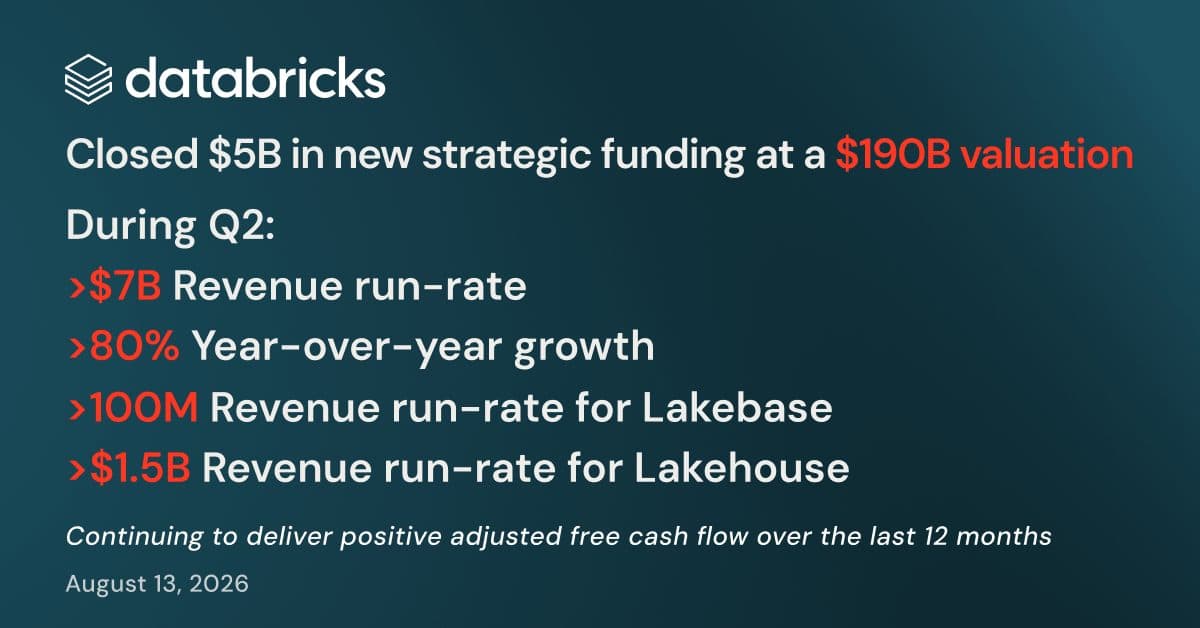
Databricks said on 13 August that it had closed a $5bn strategic round at a $190bn post-money valuation, one of the largest private financings ever raised by a software company.
Who wrote the cheques
Coatue led. Blackstone, MGX, accounts advised by T. Rowe Price and new investor Sixth Street Growth joined, alongside first-time backers BOND, Clearlake Capital, Point72, Premji Invest and TPG. The valuation is 42% above the $134bn set in February 2026 — roughly $56bn of added paper value in six months.
The number the price is hung on
Databricks says revenue run-rate passed $7bn in the second quarter, growing more than 80% year on year. That puts the round at roughly 27x run-rate — expensive, but not the multiple usually attached to a company still compounding at 80% at this scale.
The two product lines to watch
Lakehouse is above a $1.5bn run-rate and growing more than 100% year on year. Lakebase, the serverless Postgres product aimed at applications that agents write to, passed $100m of run-rate. Databricks reports more than 1,000 customers above $1m and over 100 above $10m — the concentration that makes an eight-figure enterprise motion legible to late-stage investors.
What is not disclosed
Run-rate is an annualised snapshot of a recent period, not booked revenue, and Databricks is private: none of these figures carry an audit. Profitability is not addressed in the announcement, and neither is net revenue retention — the two lines that would separate durable expansion from a heavy AI-inference pass-through.
Why raise at all
A company with this growth does not need $5bn to operate. It needs it to buy compute, to fund acquisitions, and to give employees and early holders liquidity without a listing. Each raise at a higher mark also delays the moment a public market gets to price the same numbers.