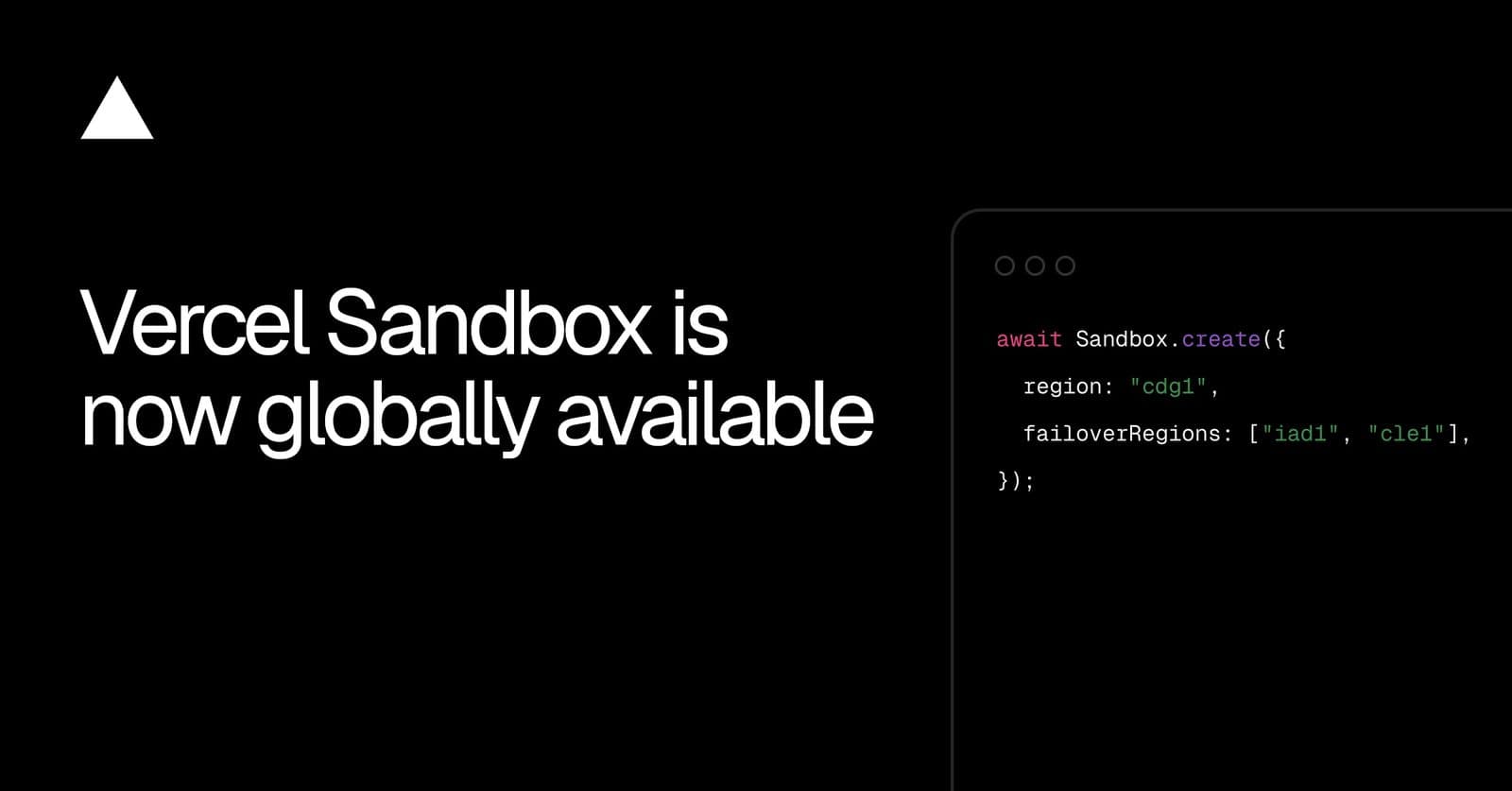
Vercel announced on 24 August that Vercel Sandbox — its isolated compute environment for running untrusted or agent-generated code — is now generally available, with region selection and failover. The changelog headline calls it globally available.
What the common framing gets wrong
Global is doing a lot of work in that sentence. The regions are iad1 (Washington DC), sfo1 (San Francisco), cle1 (Cleveland) and cdg1 (Paris) — three in North America and one in Europe. There is no Asia-Pacific region, no South American region, and none in the Middle East or Africa. Vercel says plainly that "support for all Vercel regions is coming soon," which is the accurate description: this is general availability, meaning out of beta, not global availability, meaning everywhere. For a latency-sensitive workload run from Singapore or Sao Paulo, the nearest option is a different continent.
The plan split
Region selection is available on all plans. Configuring a failover region is limited to Pro and Enterprise teams. So the resilience half of the announcement — the part that makes multi-region interesting rather than merely a placement preference — is gated.
The constraint that limits the failover story
Snapshots "stay in the region where they were created and can't be moved," and to create or resume a sandbox from a snapshot, both must be in the same region. That is a meaningful qualifier on failover: a workload that depends on resuming from a snapshot cannot simply fail over to another region and pick up where it left off, because the snapshot does not travel with it. Failover protects the ability to start fresh somewhere else, not the ability to continue.
What is not stated
No pricing appears in the announcement, and there is no indication of whether region choice or failover carries a cost difference. Four configuration surfaces are offered: team settings, the CLI, the SDK's create call, and the Sandbox CLI.