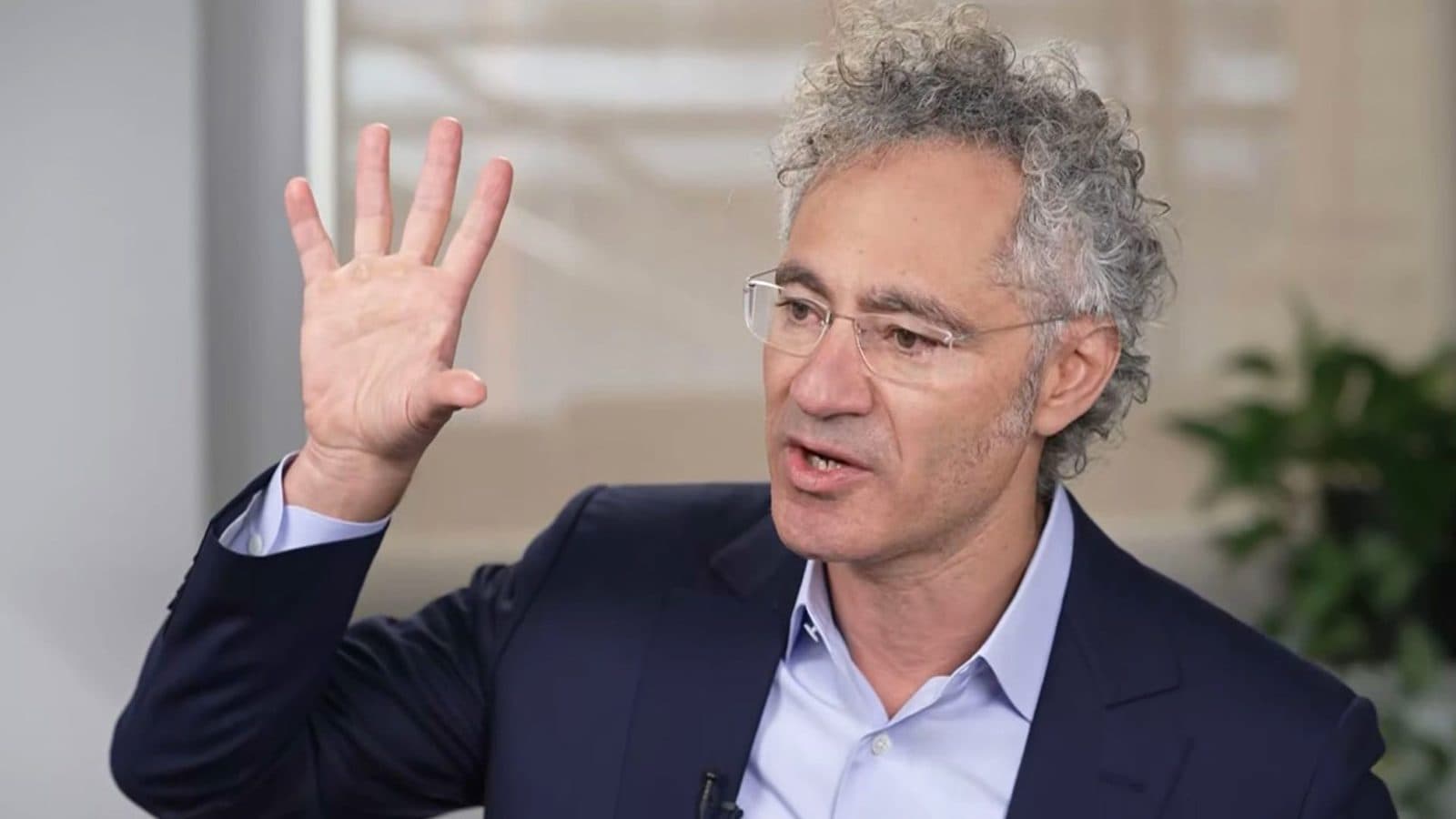
Palantir CEO Alex Karp used a July 1, 2026 appearance on CNBC's "Squawk Box" to unload on the AI industry's pricing, arguing that enterprises are paying "for tokens that create no value" while frontier labs harvest their proprietary data — a dynamic he branded a "wealth tax." The remarks doubled as a sales pitch for Palantir's own competing approach.
What Karp said
In his fullest version of the line, Karp said: "I'm paying for tokens that create no value. These people are stealing the weights and alpha of my business, and they're creating a wealth tax that does not help the poor, it just punishes." He added that the models had been "completely, irresponsibly over-sold." Notably, he cast much of this as "the voice of American business" — reported customer sentiment — as anchors Becky Quick ("you sound pretty angry") and Andrew Ross Sorkin ("that sounds like shade") pushed back. His separate "effing insane" remark was aimed at outsourcing military AI to Silicon Valley, not at pricing.
A real cost problem
The complaint lands on a documented pain point the industry calls "tokenmaxxing" — maximizing token consumption without measuring returns. The emblematic case: Uber reportedly burned through its entire 2026 AI budget in four months as Anthropic's Claude Code spread to about 5,000 engineers, before it capped per-tool spending. Frontier pricing, as cited in coverage, runs to roughly $5 per million input and $30 per million output tokens for OpenAI's GPT-5.5, with Anthropic's Claude Sonnet 5 at introductory rates near $2 and $10.
The Palantir pitch
The timing was not neutral. Days earlier, Palantir posted a nine-point "AI sovereignty" manifesto attacking tokenmaxxing, and unveiled with Nvidia an air-gapped, on-premises "Sovereign AI" stack that keeps a customer's data inside its own perimeter with no external API calls. "They want to know they own the means of production, it's not being transferred to someone else," Karp said. Palantir reported first-quarter 2026 revenue of $1.63 billion, up 85%.
The skeptics
Nearly every analyst flagged the conflict of interest: Palantir is an interested party launching a rival product, so the attack is "marketing before it is analysis." The investor Rui Ma argued the labs profit three ways — charging for tokens, accessing customers' IP, and commoditizing their advantages — but that Karp's fix simply redirects enterprises to pay Palantir instead. Others noted the irony that European governments increasingly invoke "sovereignty" against Palantir itself. Neither OpenAI nor Anthropic publicly rebutted the remarks.