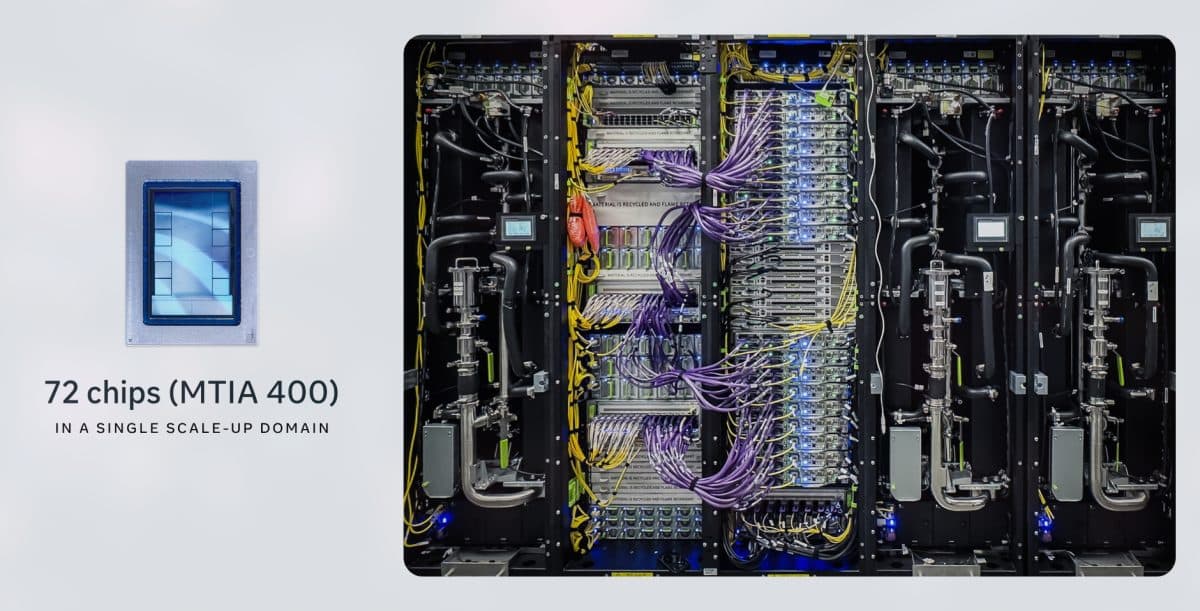
Meta's long-running attempt to stop buying all of its AI silicon from Nvidia reaches the fab this autumn. An internal memo reported by Reuters on July 9 says the company will begin production of a data-center AI chip code-named Iris in September, the newest generation of its MTIA program — the Meta Training and Inference Accelerator, now four generations deep. Meta declined to comment on the memo.
Who builds it
Broadcom assists on design and TSMC manufactures. Around them sits a ring of supply agreements: Samsung Electronics for memory, SanDisk for flash storage, and Sumitomo Electric for fiber-optic equipment. At least one completed chip finished testing in about six weeks with no major issues found, per the memo. "Each MTIA generation builds on the last, using modular chiplets, incorporating the latest AI workload insights and hardware technologies, and deploying on a shorter cadence," Meta has said of the program.
The scale it feeds
The chip exists because of the buildout behind it. Meta plans $125–145 billion of AI infrastructure spending in 2026, with roughly 7 gigawatts of compute deployed this year and about 14 GW targeted for 2027. It continues to buy heavily from Nvidia and AMD regardless. "You can't become an AI titan if you are dependent on another company for chips," said Mike Gualtieri of Forrester Research.
The other shoe: renting it out
The same day, Mark Zuckerberg told Bloomberg that selling access to that infrastructure is now under active consideration: "The offers that you get for using the compute are so high that it may make sense, in some cases, to rent out or consider those kind of deals instead of your own internal uses." It is the first on-record CEO confirmation of the effort reported around July 1 as "Meta Compute," a would-be competitor to AWS, Azure and Google Cloud. At Meta's May shareholder meeting Zuckerberg had already called cloud computing "definitely on the table," saying companies approach Meta "almost every week" for its models or spare capacity.
What is still unsettled
Zuckerberg's phrasing — "may make sense, in some cases" — is not a launch. Meta has not said whether it would sell raw compute, hosted model access, or both, and the reported "Meta Compute" venture remains exploratory. The pricing environment explains the temptation: Anthropic pays SpaceX roughly $1.25 billion a month for Colossus capacity, and Google about $920 million, sums that make idle accelerators look less like slack and more like inventory. Iris, by contrast, has a date. Whether it displaces enough Nvidia silicon to matter will not be visible until the chips are racked and Meta's 2027 capex guidance either bends or does not.