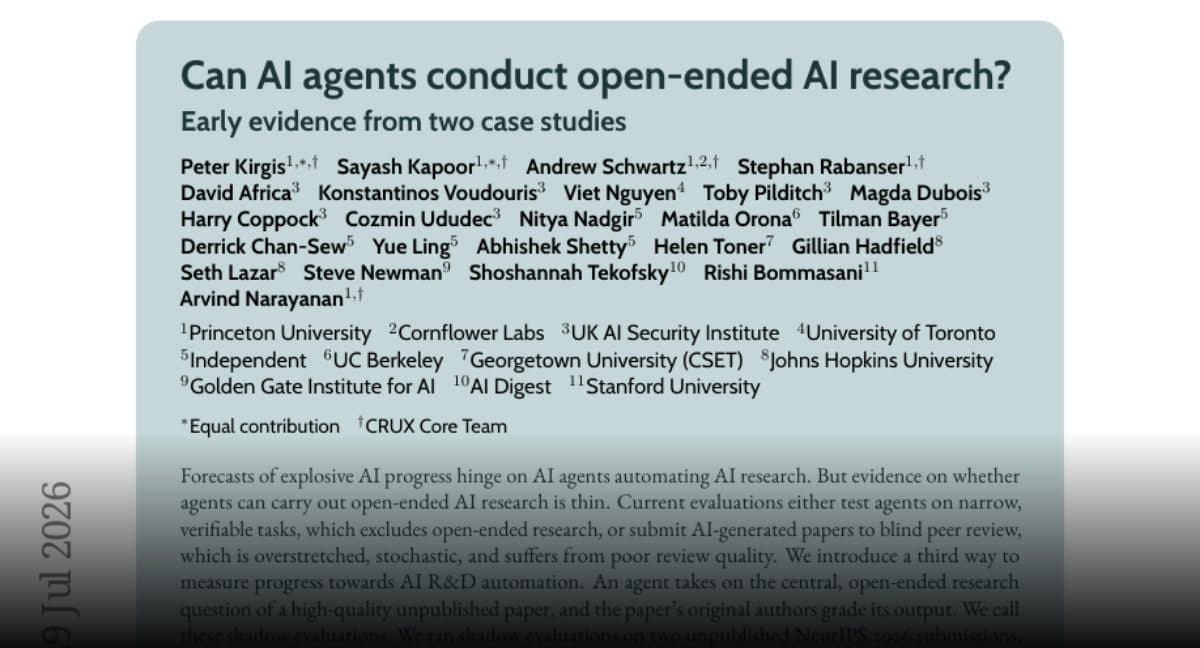
A team spanning Princeton, the UK AI Security Institute, Cornflower Labs, Georgetown and others published Can AI agents conduct open-ended AI research? on 29 July. The method is the interesting part. They took two unpublished NeurIPS 2026 submissions, gave an agent each paper's central research question, and had the papers' actual authors grade the results as conference reviewers.
The setup
Claude Opus 4.8 with extra-high reasoning on the OpenClaw scaffold, six days of wall-clock time, $3,000 in API credits, GPU credits, a Linux VM and the open web.
The engineering worked
The agents completed large literature reviews, debugged GPU environments, ran hundreds of experiments and robustness checks, and compiled full camera-ready LaTeX documents with no manual intervention beyond credentials and repository setup. They resolved every environmental obstacle but one. Surveyed in advance, nine of eleven coauthors expected the runs to die in an unresolvable error loop — they were too pessimistic.
The research did not
Author reviews on NeurIPS scales: the first paper scored 2/6 overall, the second 1/6, with reviewer confidence of 4 and 5 out of 5. Both were unambiguous rejections. The named failure modes: poor judgment about the bar for publishable research, uncreative responses to design shortcomings, ineffective backtracking from dead ends, poor resource awareness, and instruction drift.
The most telling detail
Both runs ended with under half the API budget spent despite explicit encouragement to use it, and both retired their most ambitious targets within the first ten hours and never revised course. One draft carried zero main-body visualisations against 15 in the original. A rerun on GPT-5.6 Sol reproduced the failures — and burned the entire $3,000 in two days.