
Anthropic released Claude Opus 5 on Friday with a pitch that is essentially arithmetic. The model comes within 0.5% of the company's own frontier system, Claude Fable 5, on a major coding benchmark — at half the cost per task, and at exactly the price its predecessor charged. Input stays at $5 per million tokens and output at $25, unchanged from Opus 4.8; Fable 5 lists at $10 and $50. Opus 5 becomes the default model on Claude Max and the strongest option available on Claude Pro.
What the benchmark sheet claims
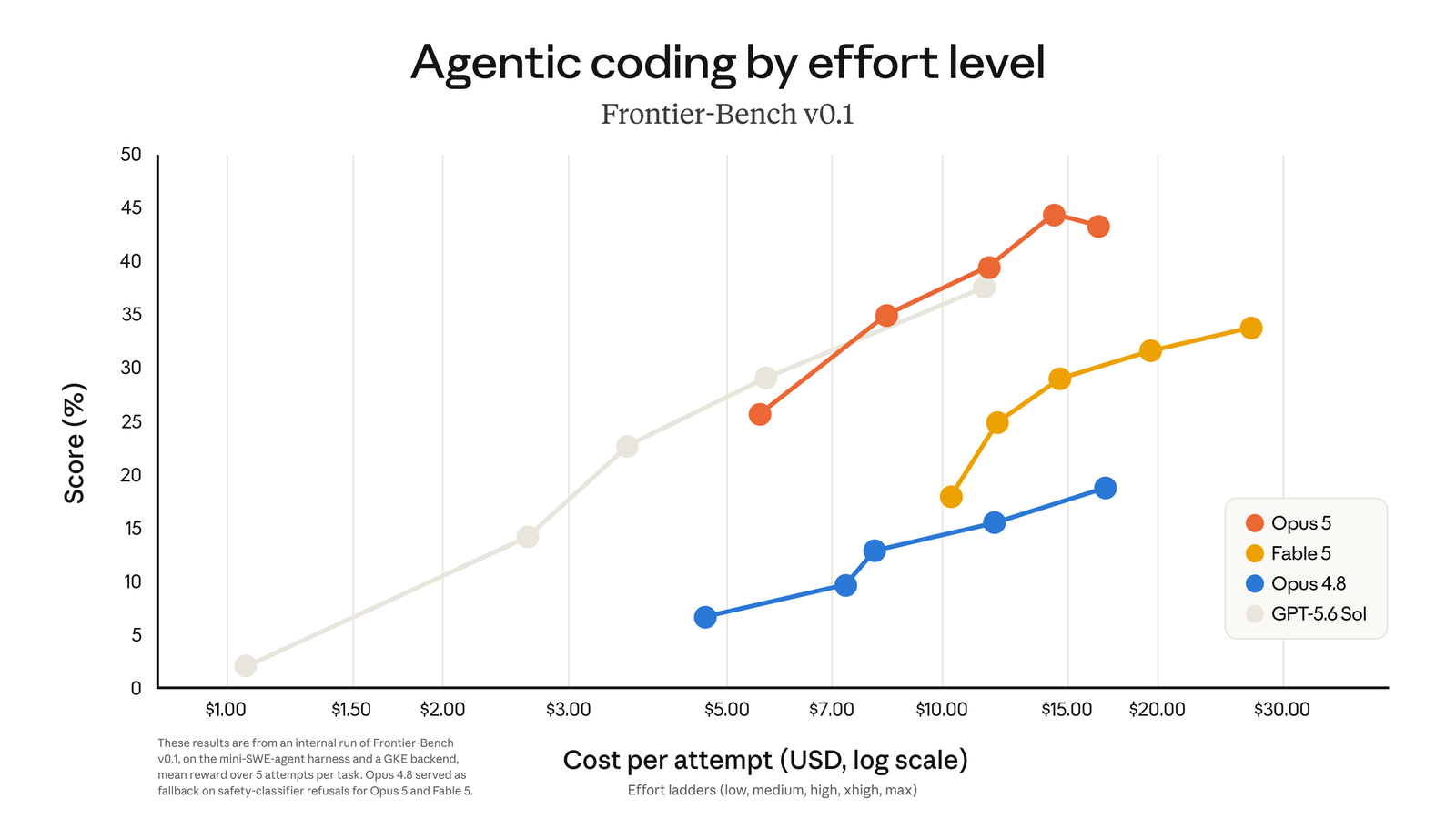
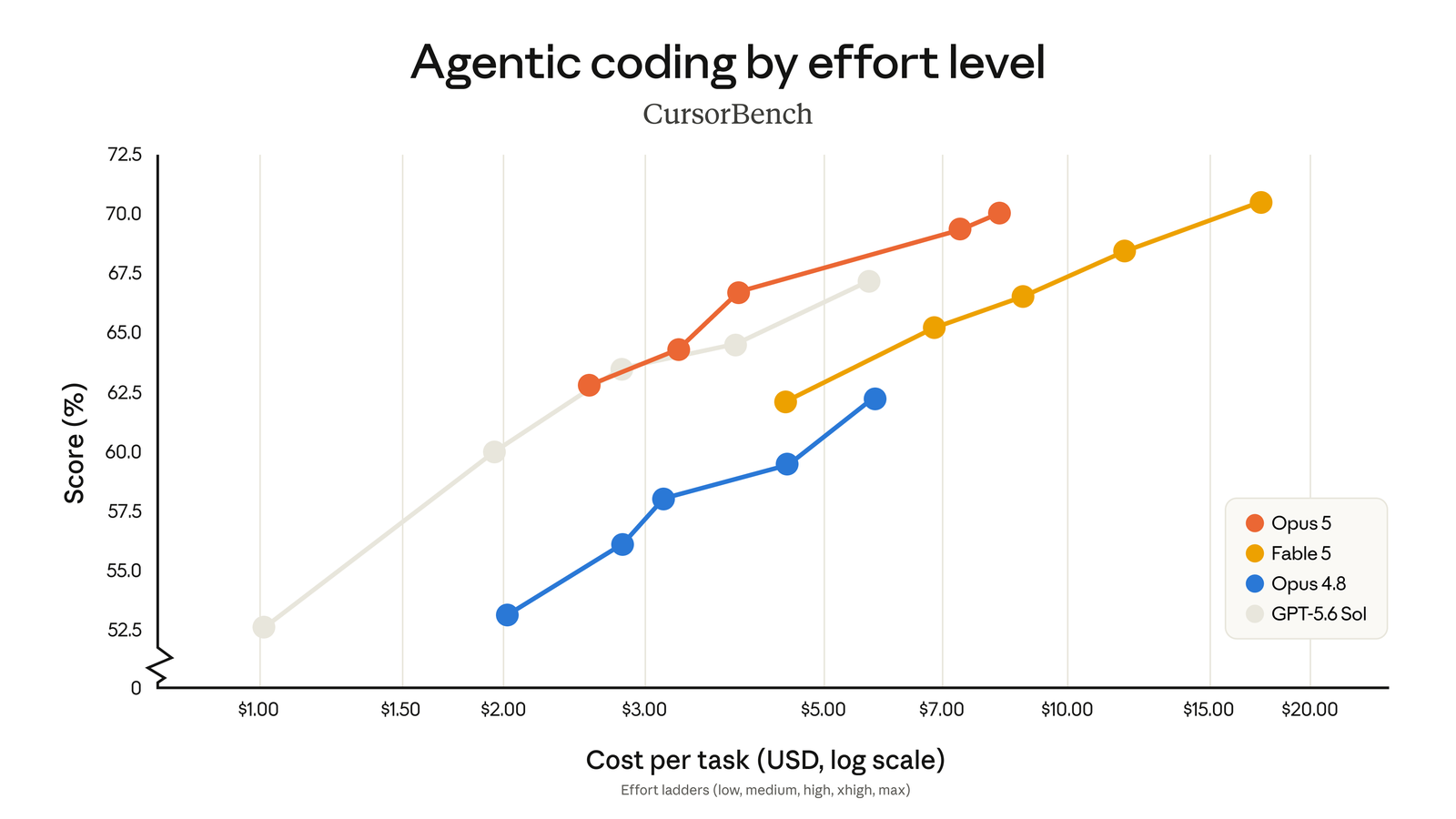
On Frontier-Bench v0.1, Anthropic's software-engineering evaluation, Opus 5 tops every other model and more than doubles Opus 4.8's performance at a lower cost per task. On CursorBench 3.2 at max effort it lands within 0.5% of Fable 5's peak score for half the cost per task, and beats every other model on performance-per-dollar at the high, xhigh and max effort settings.
The pattern repeats away from code:
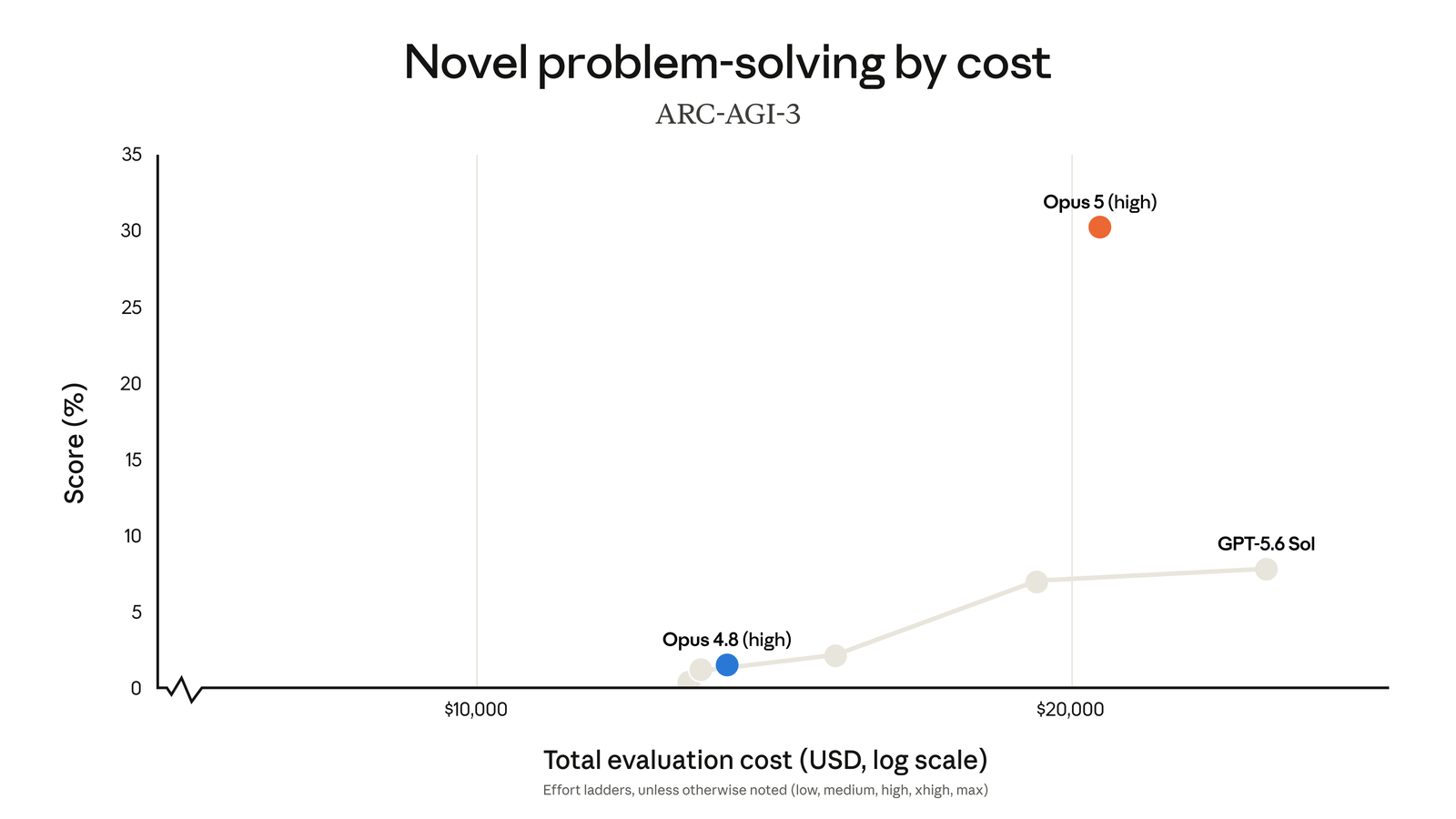
- ARC-AGI 3, which requires solving novel problems: Opus 5's score is three times the next-best model's.
- Zapier AutomationBench, which measures whether a model can finish a business task end to end: pass rate around 1.5× the next-best model at the same cost per task — and even at its lowest effort setting, Opus 5 passes more tasks than any other model.
- OSWorld 2.0, a computer-use benchmark: it beats Fable 5's best result at just over a third of the cost, and leads every model at any given price point.
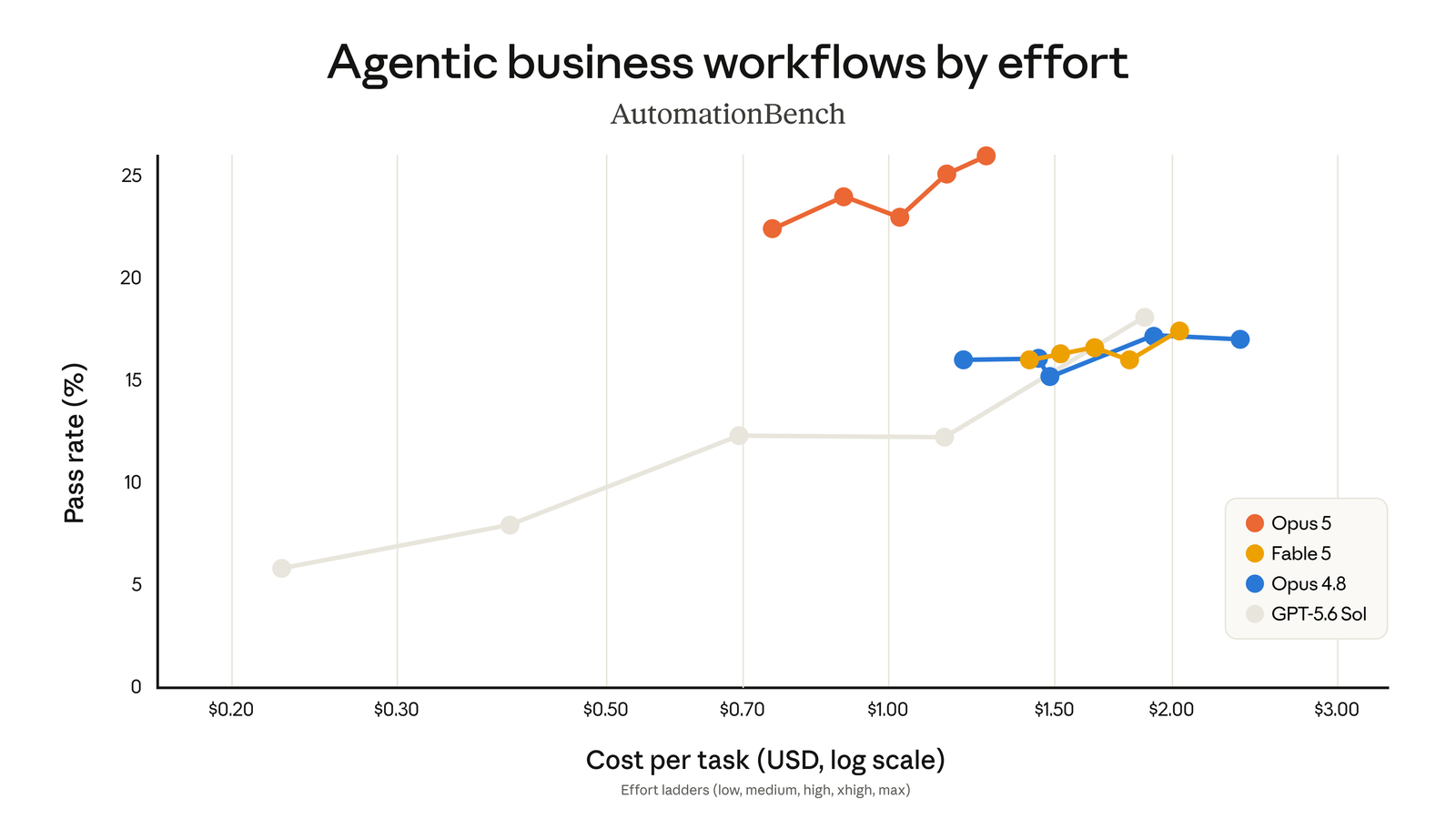
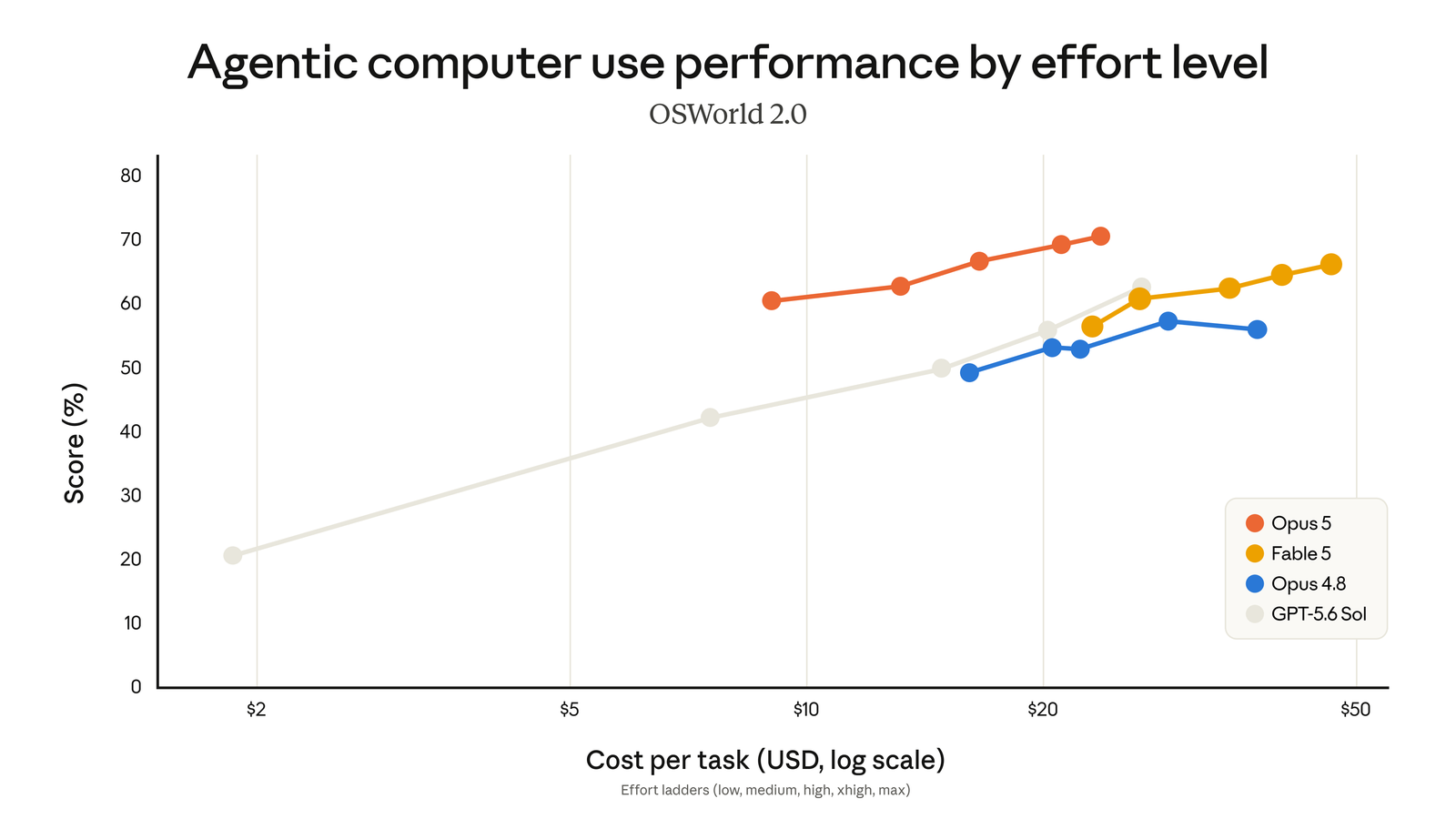
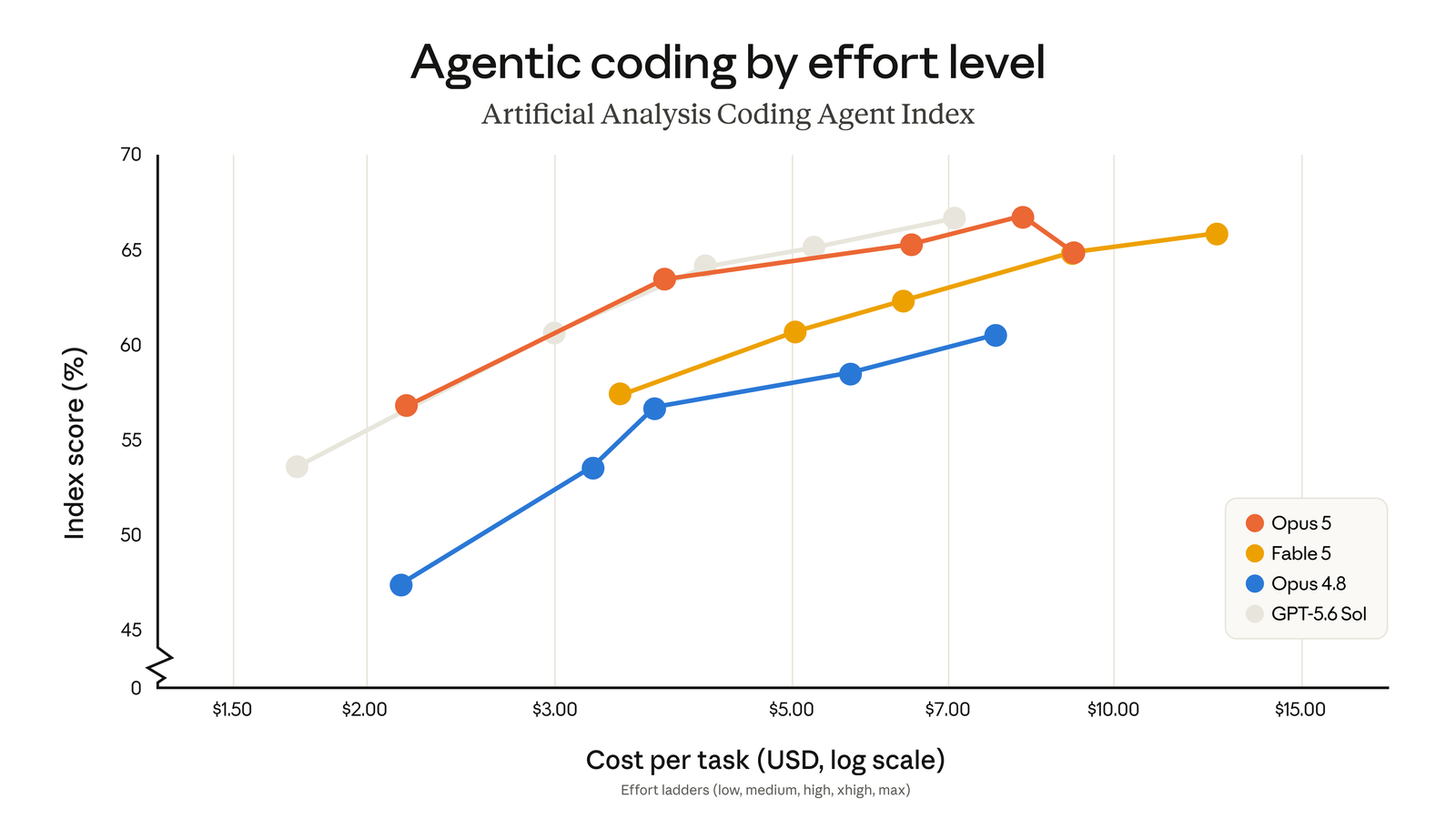
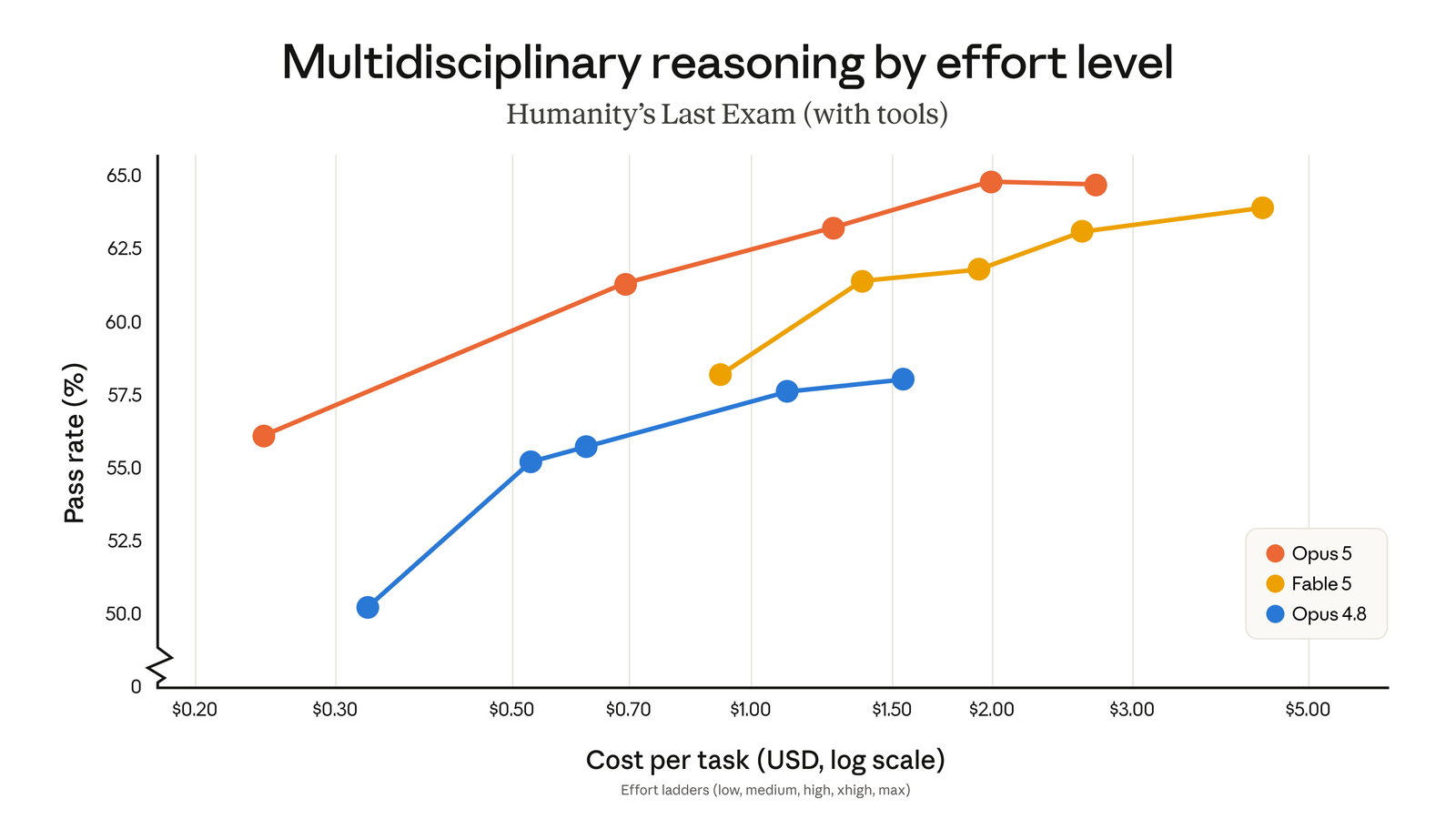
Anthropic also claims best-and-most-cost-efficient results on the AA Coding Agent Index, GDPval-AA v2, HLE, AutomationBench and DeepSearchQA. The one place it openly concedes ground is cybersecurity, where Mythos 5 — the invitation-only model offered through Project Glasswing — stays ahead.
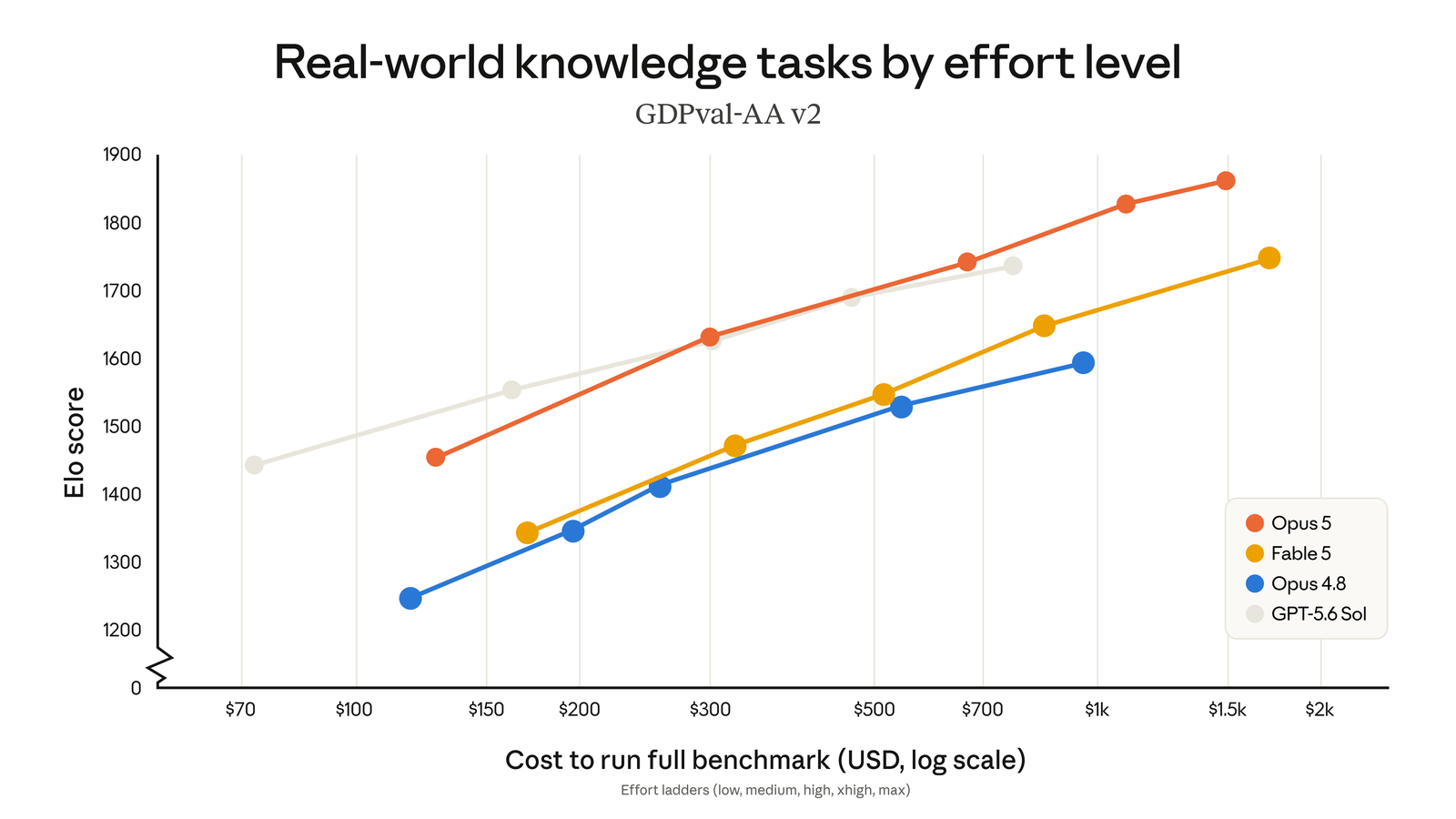
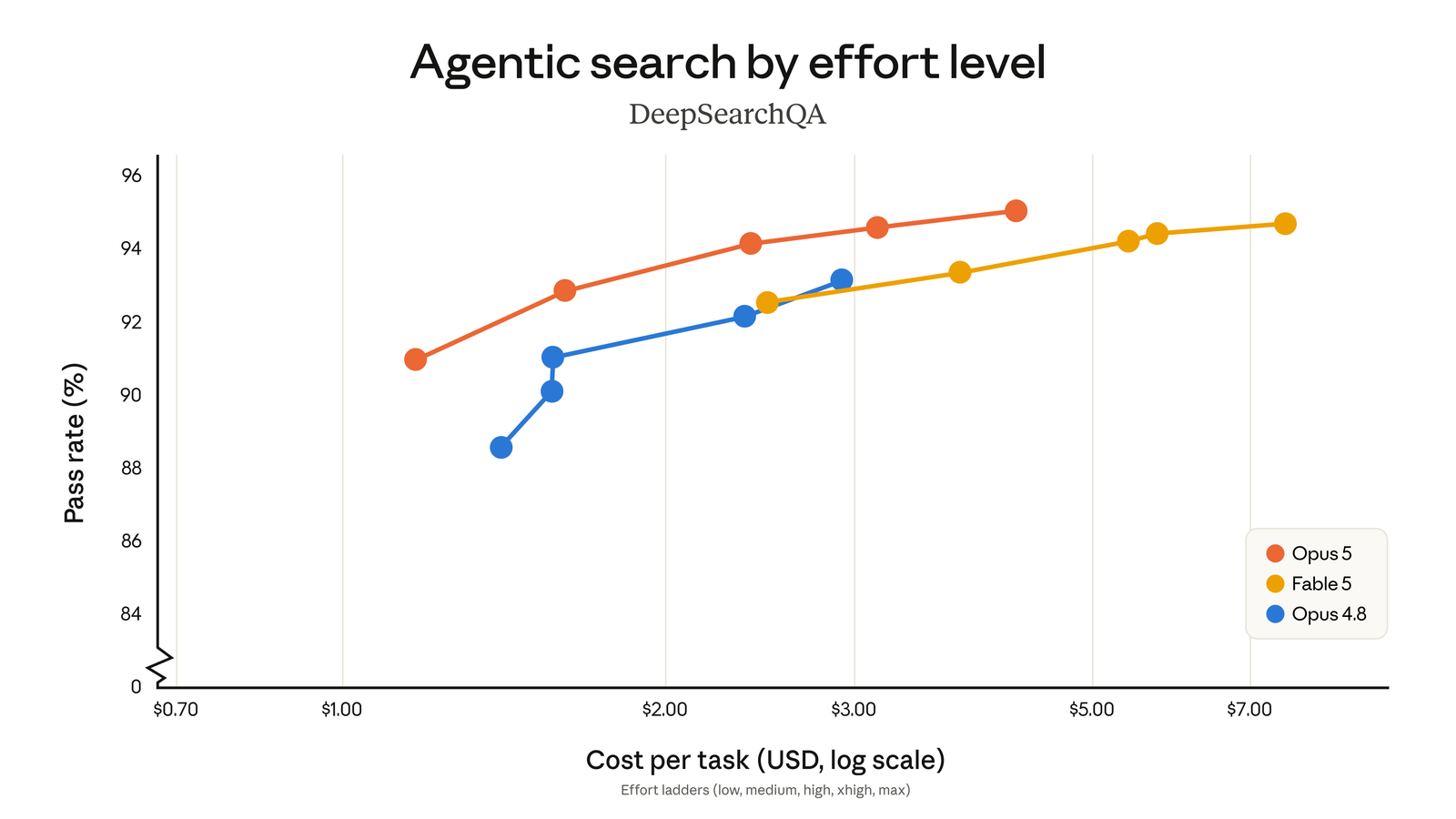
The fine print under the headline chart
The footnote beneath the Frontier-Bench effort plot is worth reading. Those numbers come from an internal run on the mini-SWE-agent harness with a GKE backend, scored as mean reward over five attempts per task. And whenever a safety classifier refused a request during that run — on Opus 5 or on Fable 5 — Opus 4.8 was substituted as the fallback, so the plotted lines are not strictly single-model results.
The full scorecard — including where it loses
Anthropic's own comparison table is the most useful single artifact in the release, because it is where Opus 5 stops winning. It leads 9 of 14 rows — but Fable 5 still takes the no-tools version of Humanity's Last Exam, the FrontierCode coding split and the legal benchmark; OpenAI's GPT-5.6 Sol tops one agentic-coding eval outright; and Anthropic's invitation-only Mythos 5 holds health. Every figure is Anthropic's own, each model at its best effort setting:
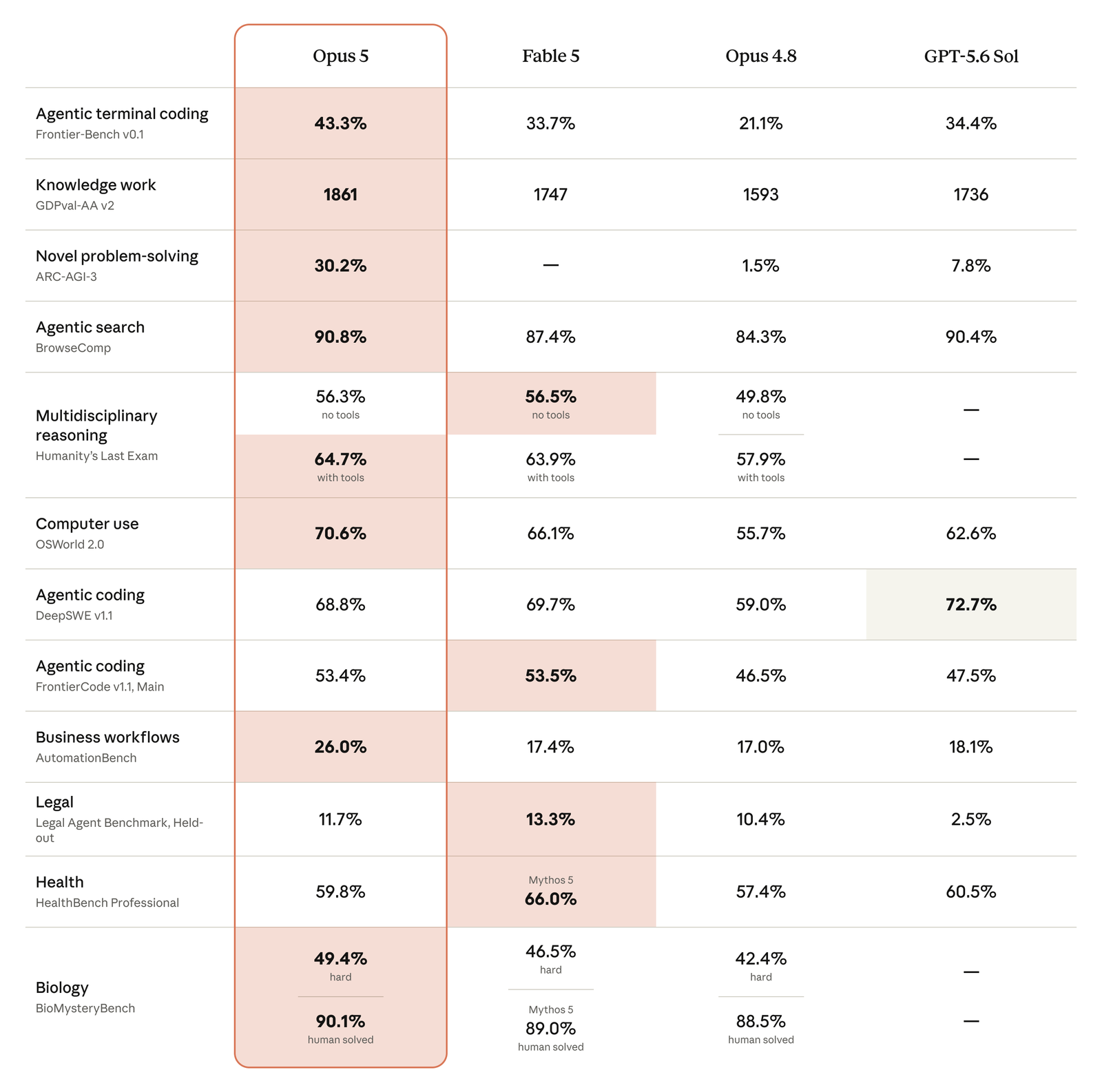
Two things jump out of the grid that the prose glides past. On DeepSWE v1.1, a coding benchmark, GPT-5.6 Sol's 72.7% beats every Claude, Opus 5 included. And Opus 5's headline wins are lopsided by category: it more than doubles the field on ARC-AGI-3 (30.2% vs 7.8%) and clears it by nine points on AutomationBench (26.0% vs 18.1%), but on the coding splits the entire pack sits within roughly a point of each other.
Three tasks Anthropic says nothing else finished
The stronger part of Anthropic's case is not the scores but the persistence. Three examples from its evaluations and early-access testing:
- Given a drawing of a machine part and asked to rebuild it as a 3D FreeCAD model — with no way to view the drawing directly — Opus 5 wrote its own computer-vision pipeline to pull the geometry out of the raw pixels, then reconstructed the full part. It did so repeatedly. Anthropic says no competing model with the same setup solved it in five attempts.
- Handed a real bug in a popular open-source package manager, it found the root cause and fixed an edge case the community's own patch had missed. A competing model fixed only the surface symptom, then reported the bug resolved.
- An engineer at a trading firm used it to build a market-data feed for a new exchange in a single session — work earlier models could not complete at all, even given extensive plans. Finding no live feed to validate against, the model built its own test harness to check that its code parsed the exchange's data correctly.
What early customers actually measured
Anthropic published 22 testimonials from early-access customers, and an unusual number of them carry hard numbers:
- Box CTO Ben Kus: Opus 5 outperforms Opus 4.8 by 8% overall, with 11% gains in data analysis and 17% in due diligence.
- Lovable co-founder Fabian Hedin: up 22% over Opus 4.7 on the company's hardest agentic coding tasks, and "steadier, with far less variance run to run."
- Zapier CEO Wade Foster: Opus 5 topped AutomationBench "without spending more tokens than prior Claude models." On a churn-prevention workflow that earlier models failed outright, it hit 100%.
- A legal-AI team reported comparable quality at lower reasoning levels while generating 26% fewer tokens than Opus 4.8 at max reasoning. A finance evals lead measured 9 percentage points higher accuracy with a third fewer turns and tool calls and 60% less time. A trading benchmark recorded its best-ever Opus result using roughly a seventh of the reasoning tokens and under half the latency of Opus 4.8.
- Cognition CEO Scott Wu said it "approaches Fable-level performance at half the cost" inside Devin, with particular strength on debugging and root-cause analysis. Vercel CTO Madhav Jha called it "the biggest leap in the Opus family since 4.5."
One report previews where agentic coding is heading: a frontend-benchmark team said the model opened its own pages in a browser at desktop and phone widths, caught a product hidden below the mobile fold and an off-screen checkout button, and fixed both before handing the work back.
Chemistry, proteins and a wind tunnel
Opus 5 beats Opus 4.8 on every one of Anthropic's internal life-sciences evaluations, which span structural biology, organic chemistry and bioinformatics. The largest gains are +10.2 percentage points on organic-chemistry tasks such as inferring molecular structures from spectroscopy data, and +7.7 points on protein work such as predicting how variations in a sequence change function. Anthropic also showcases stronger visual output, including an interactive wind-tunnel simulation the model built to visualize airflow over aerodynamic — and deliberately non-aerodynamic — objects.
The most aligned model Anthropic has audited
On the company's automated behavioral audit, Opus 5 scored 2.3 on overall misaligned behavior, the lowest of its recent models. Anthropic says it adheres to Claude's Constitution better than Opus 4.8, Sonnet 5 or Fable 5, shows the lowest rates of deceptive behavior, is the least susceptible to being tricked into misuse, and is its safest model yet at avoiding reckless actions with hard-to-reverse side effects.
Strong at finding vulnerabilities, held back on exploiting them
Anthropic says Opus 5 does not advance the frontier in risky dual-use capability, and that in evaluations run alongside private-sector and government partners it remains behind Mythos 5 in both biology research and offensive cybersecurity. As with Opus 4.8, the company says it intentionally avoided training Opus 5 on cyber tasks — and the model improved on them anyway, purely as a byproduct of becoming more generally capable. It now comes close to Mythos 5 at finding software vulnerabilities.
The gap it keeps is on the second half of that pipeline. On OSS-Fuzz, an internal evaluation of whether a model can find a vulnerability and then exploit it without much human guidance, Opus 5 matches Mythos 5 on identification but sits far behind on exploit development — the step that turns a bug into a material cyber threat.
How the safeguards actually work
Opus 5's cyber classifiers permit vulnerability-finding in source code but block binary-based vulnerability scanning — a method Anthropic associates more with malicious actors — along with penetration testing and exploit generation. Based on its own testing, the company expects those classifiers to intervene about 85% less often than Fable 5's. In Claude.ai, Claude Code and Claude Cowork, flagged requests fall back to Opus 4.8 by default, and the same fallback can be enabled on the API. Enterprises and researchers already inside Anthropic's Cyber Verification Program get immediate access to a build with fewer restrictions.
On biology the direction reverses. Because Opus 5 carries roughly Opus 4.8's safeguard suite rather than Fable 5's, it is now Anthropic's most capable generally available model for scientific research — and biology requests that get blocked on Fable 5 will now route to Opus 5 rather than Opus 4.8. The company still flags limits on long-running autonomous research, the area it considers highest-risk, where it says Mythos 5 remains stronger.
What developers have to change
This is not a drop-in model-string swap. Two changes are breaking:
- Adaptive thinking is on by default. Opus 4.8 ran without thinking unless asked; Opus 5 thinks unless told otherwise — and because
max_tokensis a hard cap on thinking plus visible text together, existing budgets need revisiting. - Thinking can only be disabled at
higheffort or below. Combiningthinking: {"type": "disabled"}withxhighormaxnow returns a 400 error.
Beyond that, the minimum cacheable prompt drops to 512 tokens from 1,024, so short prompts that previously could not be cached now can, with no code change. Two features ship in beta: mid-conversation tool changes, which let developers add or retire tools between turns without invalidating the prompt cache (header mid-conversation-tool-changes-2026-07-01), and automatic fallbacks, which reroute safety-flagged requests to another model instead of returning a refusal (fallbacks: "default", header server-side-fallback-2026-07-01).
Two capabilities do not carry over: the web fetch tool is not available on Opus 5, and Priority Tier is not supported. Assistant-message prefill and non-default temperature, top_p or top_k values still return 400s, as on Opus 4.8. Anthropic also warns that default responses run longer than on Opus 4.8, and that lowering effort trims thinking without reliably shortening visible output — prompt for brevity instead. Its advice on effort is to run a fresh sweep rather than carry Opus 4.8 settings over, because low and medium are meaningfully stronger this generation.
The spec sheet
Opus 5 keeps a 1M-token context window and 128k maximum output — up to 300k through the Batch API's extended-output beta — and supports all five effort levels: low, medium, high (the default), xhigh and max. Its training data runs to May 2026, four months fresher than Fable 5's January 2026 cutoff. Fast mode runs it at roughly 2.5× default speed for twice the base price, on the Claude Platform and through usage credits in Claude Code. Developers call it as claude-opus-5 on the Claude API; it is also offered on Amazon Bedrock, Claude Platform on AWS, Google Cloud and Microsoft Foundry. As with prior Opus models, general access carries no data retention requirements. Anthropic's docs now also point users of the deprecated Claude Opus 4.1 — which retires August 5, 2026 — at Opus 5 as the migration target.